

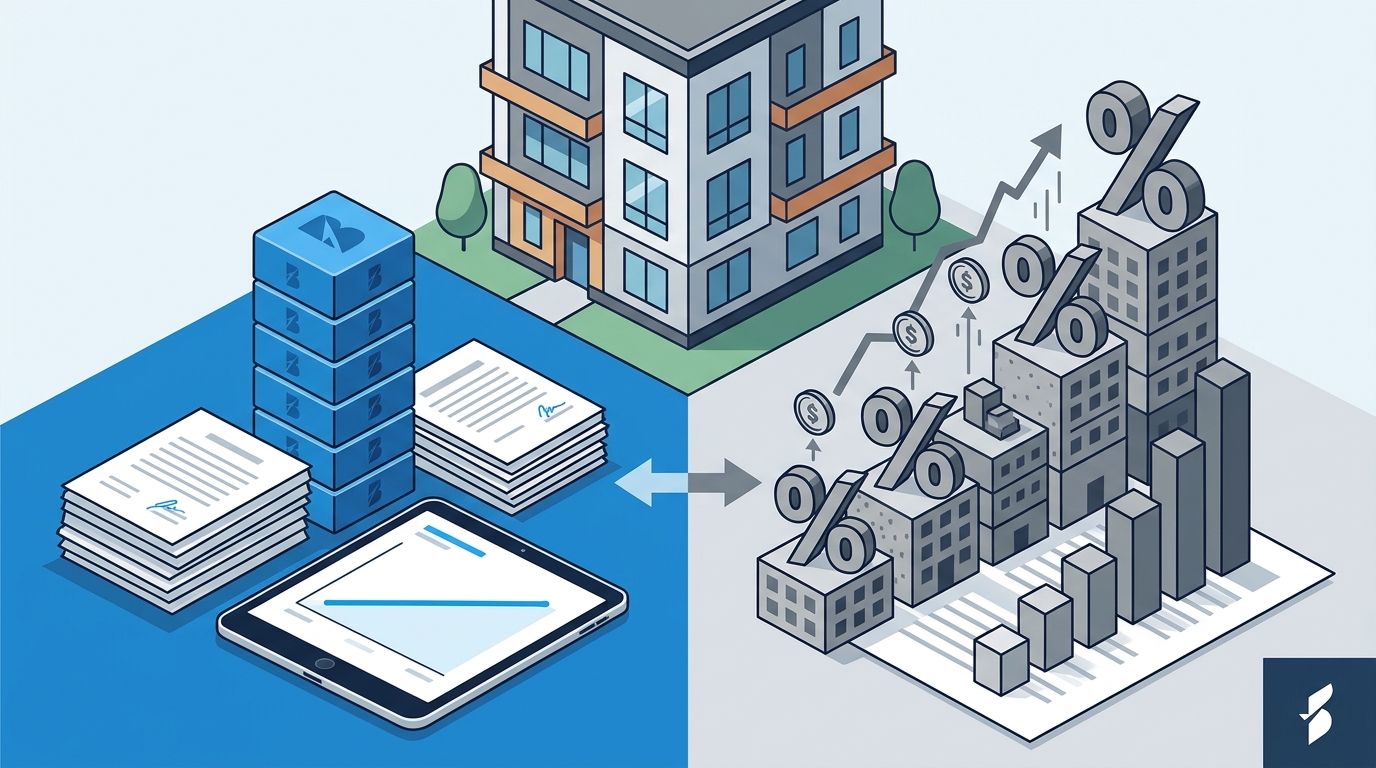
Buildium pricing is typically lower than traditional property management fees, which often range from 8% to 12% of gross rents. While Buildium charges a flat monthly fee per unit, traditional managers charge a percentage of revenue. This structural difference means software costs remain stable regardless of rent increases, whereas traditional fees scale directly with income.
The Structural Difference in Cost Models
Traditional property management is a service-heavy model where the fee is tied to the value of the asset. A property manager charges a percentage of gross rents to cover labor, coordination, and administrative overhead. This model creates a variable cost that increases as rents rise. Buildium, as a software platform, operates on a subscription model. The cost is a fixed monthly fee per unit, independent of the rent collected. This distinction is critical for portfolio owners evaluating long-term operating expenses.
Scalability and Portfolio Economics
REIT AI addresses this scalability challenge by providing an autonomous operating layer that replaces the traditional management layer entirely. Instead of just providing software, the platform runs the operation end-to-end. This approach allows owners to maintain the low cost structure of software while retaining the operational capacity of a full management team. The result is a hybrid model that captures the efficiency of automation without the labor-intensive overhead of traditional firms.
Hidden Costs in Traditional Management
Traditional property management fees often exclude specific services that incur additional charges. These can include leasing fees, renewal fees, and special project management. A leasing fee might be 50% to 100% of the first month's rent. Renewal fees can be 5% to 10% of the new lease value. These variable costs are not present in a flat-fee software subscription. Owners must account for these additional charges when comparing total cost of ownership.
Furthermore, traditional managers may charge for vendor coordination, invoice processing, and compliance reporting. These tasks are core functions of an autonomous operating system. By integrating these functions into the software layer, owners avoid the per-task fees that accumulate in a traditional service model. The transparency of a flat software fee simplifies budgeting and forecasting for institutional investors.
Operational Efficiency and Control
Cost is only one dimension of the comparison. Operational efficiency and control are equally important. Traditional managers operate on a black-box model where the owner has limited visibility into daily operations. Software platforms provide real-time dashboards and reporting. Owners can see maintenance requests, financial transactions, and tenant communications instantly. This visibility allows for better decision-making and faster response times.
REIT AI emphasizes full visibility and control in its platform design. The asset manager sets the rules and approves every move, while the system executes the routine tasks. This governance model ensures that the owner retains strategic control while benefiting from automated execution. The platform is designed to integrate with existing accounting and banking systems, ensuring that data flows seamlessly without manual entry. This integration reduces errors and improves the accuracy of financial reporting.
Choosing the Right Model for Your Portfolio
The choice between software and traditional management depends on the size and complexity of the portfolio. Small portfolios may benefit from the hands-on service of a traditional manager. Larger portfolios often find that the cost savings and efficiency of software platforms outweigh the convenience of full-service management. Institutional investors and family offices typically require the level of control and visibility that only a software-based operating layer can provide.
For owners considering a transition, it is essential to evaluate the total cost of ownership, including labor, training, and integration. REIT AI offers a solution that combines the low cost of software with the operational capacity of a management team. To see how this model works in practice, you can request a demo of the platform. This allows you to evaluate the system against your own portfolio numbers and determine if the autonomous operating layer fits your strategic goals.
Key Takeaways
- Traditional property management fees are typically 8% to 12% of gross rents, creating a variable cost that scales with income.
- Buildium and similar software platforms charge a flat monthly fee per unit, which remains stable regardless of rent increases.
- Traditional managers may charge additional fees for leasing, renewals, and special projects, which are not included in software subscriptions.
- Software platforms provide real-time visibility and control, allowing owners to make data-driven decisions.
- REIT AI offers an autonomous operating layer that replaces the traditional management layer, combining low cost with full operational capacity.
- The choice between software and traditional management depends on portfolio size, complexity, and the owner's desire for control.
Frequently Asked Questions
How much does Buildium cost per unit?
What is the typical fee for traditional property management?
Traditional property management fees typically range from 8% to 12% of gross rents. This fee covers the labor and administrative work of managing the property.
Does Buildium include leasing services?
Buildium provides tools for marketing and leasing, but it does not perform the physical tasks of leasing. The owner or a third-party agent must handle showings and negotiations.
How does REIT AI differ from Buildium?
REIT AI is an autonomous operating layer that runs the operation end-to-end, including maintenance triage, vendor oversight, and reporting. Buildium is a software platform that provides tools for owners to manage their properties manually.
Is software cheaper than traditional management?
Yes, software platforms are generally cheaper than traditional management on a per-unit basis. However, the owner must account for the labor required to operate the software.
Can I switch from a traditional manager to a software platform?
Yes, many owners switch to software platforms to reduce costs and increase control. The transition involves migrating data and setting up new workflows.
Conclusion
Buildium pricing offers a cost-effective alternative to traditional property management fees, particularly for larger portfolios. The flat-fee model provides predictability and scalability, while the traditional percentage-based model creates variable costs that grow with income. For institutional investors and family offices, the ability to maintain control while reducing operating expenses is a key advantage of software-based platforms. REIT AI provides an autonomous operating layer that combines the efficiency of software with the operational capacity of a management team. To explore how this model can benefit your portfolio, to discuss your specific needs.