

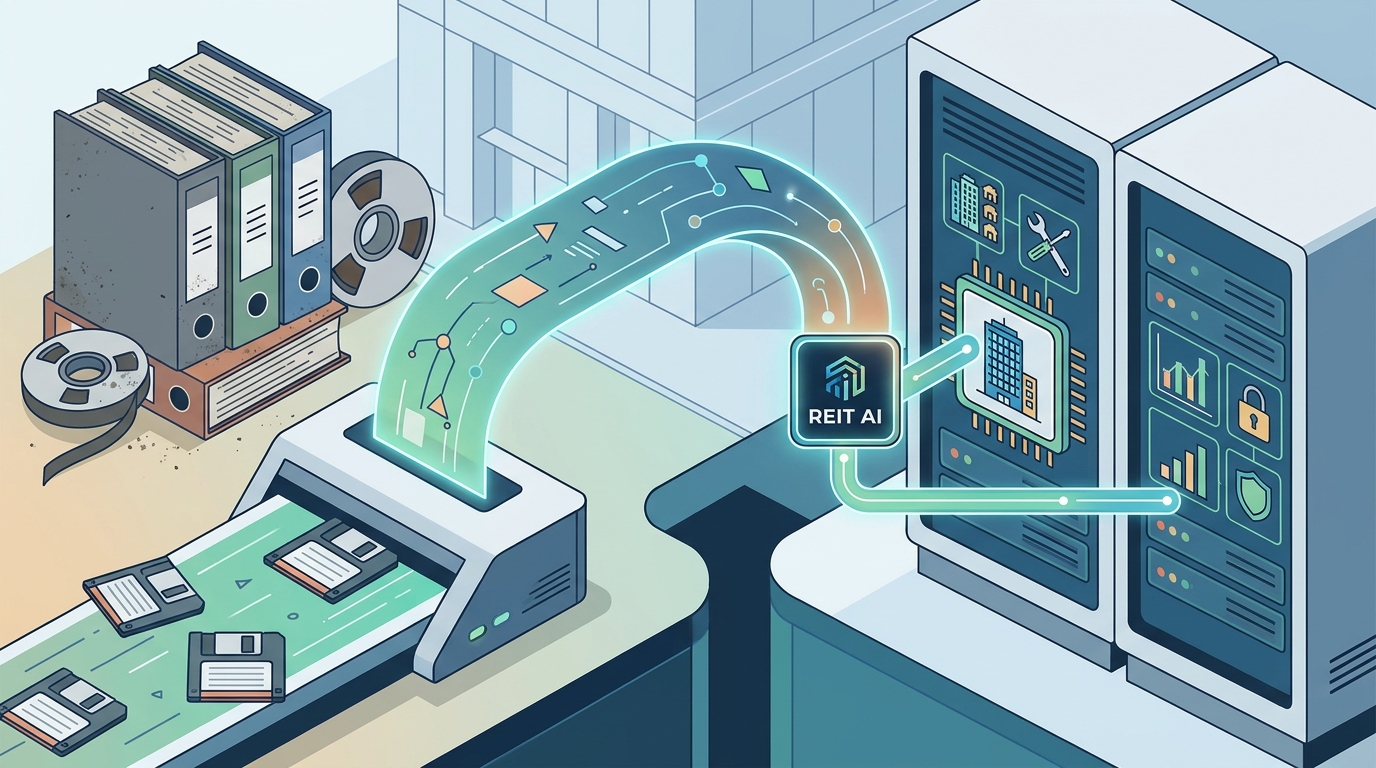
Property management software setup is the critical phase where legacy data migrates into a new operating system. In 2026, institutional owners expect rapid deployment, often within two weeks, to minimize operational disruption. REIT AI accelerates this process by automating data extraction and system synchronization, ensuring that portfolios go live without manual data entry or extended consulting delays.
The Shift from Manual Migration to Automated Ingestion
Traditional software implementations often stall because of manual data entry. Teams spend weeks typing lease variables and rent rolls into new fields. This approach is slow and prone to human error. Modern platforms have moved away from this model. They now use automated document extraction to pull critical terms directly from existing files.
REIT AI utilizes AI-driven data extraction to digitize entire portfolios. The system ingests lease agreements, vendor contracts, and historical financials automatically. This removes the need for billable consulting hours. The implication is clear: onboarding is no longer a bottleneck. It becomes a rapid, zero-friction deployment that unlocks operational value from day one.
System Synchronization and Legacy Integration
A major concern during setup is how the new software interacts with existing tools. Many institutions fear a rip-and-replace scenario. This would require discarding current accounting, banking, or CRM systems. Such a transition is risky and expensive. Instead, modern operating layers integrate with the stack you already own.
REIT AI connects through custom API integrations into your existing infrastructure. It maps data effortlessly across ERPs and accounting databases. Nothing is ripped out. The new platform becomes the operating layer on top of your current systems. This ensures continuity. Your team retains access to familiar tools while the new layer handles the heavy lifting of coordination and reporting.
Calibrating Baselines and Financial Profiles
Once data is ingested, the system must understand your portfolio's financial health. This involves setting baselines for expense recovery and maintenance profiles. In traditional setups, this requires extensive manual analysis. Analysts spend weeks modeling historical data to establish these benchmarks. This delay pushes back the point where the software provides actionable insights.
REIT AI models historical financial data automatically. It sets CAM and NNN recovery baselines instantly. It also establishes maintenance profiles based on past performance. This instant baseline calibration allows for immediate variance reporting. You see budget-to-actual variances live, rather than waiting for a month-end batch process. This speed is critical for identifying anomalies early.
Governance and Approval Workflow Configuration
Setup is not just about data; it is about control. You must define who approves what and how spend thresholds are enforced. In many legacy systems, these rules are buried in spreadsheets or email chains. This lack of structured governance leads to audit failures. A robust setup process requires defining approval gates and escalation paths clearly.
REIT AI enforces governance through a structured model. The Asset Manager sets spend thresholds and approval gates. The system executes within these boundaries. Anything outside the defined policy escalates for approval. This ensures that the Asset Manager remains in charge. The setup phase is where you define the rules of engagement, ensuring that automation aligns with your institutional control frameworks.
Vertical-Specific Configuration
Not all real estate portfolios operate the same way. Residential and commercial assets have different leasing cycles and reporting needs. A generic setup often fails to capture these nuances. It forces distinct asset classes into one model. This leads to inaccurate reporting and inefficient workflows. Effective setup requires purpose-built configuration for each vertical.
REIT AI offers two distinct verticals: Mondo Residential and Mondo Enterprise. Each is configured around its own tenant profile and lease structure. Residential onboarding focuses on multifamily and HOA communities. Enterprise onboarding targets commercial and institutional portfolios. This separation ensures that the setup process respects the specific operational rhythms of each asset class. It prevents the friction of forcing a one-size-fits-all model onto diverse portfolios.
Key Takeaways
- Automated data extraction replaces manual entry, reducing onboarding time to two weeks or less.
- Custom API integrations allow new software to layer over existing accounting and CRM systems without replacement.
- Instant baseline calibration enables live variance reporting rather than waiting for month-end cycles.
- Governance rules and approval gates must be defined during setup to ensure institutional control.
- Purpose-built verticals for residential and commercial assets prevent generic modeling errors.
- Zero-friction deployment ensures NOI growth begins immediately after go-live.
Frequently Asked Questions
How long does property management software setup typically take?
With automated ingestion and API integration, modern platforms like REIT AI can onboard portfolios in two weeks or less. Traditional manual methods often take months.
Do I need to replace my current accounting system?
No. REIT AI integrates with your existing accounting, banking, and CRM systems via custom APIs. It acts as an operating layer on top of your current stack.
Who is in control during the automated setup process?
The Asset Manager remains in full control. You set the rules, spend thresholds, and approval gates. The system executes within these boundaries and escalates exceptions.
How is historical data handled during onboarding?
Historical financial data is modeled automatically to set recovery baselines and maintenance profiles. This ensures the system understands your portfolio's baseline from day one.
Can the software handle both residential and commercial assets?
Yes. REIT AI offers distinct verticals for each. Mondo Residential handles multifamily and HOAs, while Mondo Enterprise handles commercial and institutional portfolios.
Conclusion
The property management software setup process in 2026 is defined by speed, integration, and control. By leveraging automated data extraction and custom API integrations, institutional owners can bypass the traditional bottlenecks of manual migration. REIT AI provides the infrastructure to achieve this, ensuring that your portfolio is operational, governed, and visible from the start. To see how this works in practice, request a demo and explore the Mondo walkthrough library.