

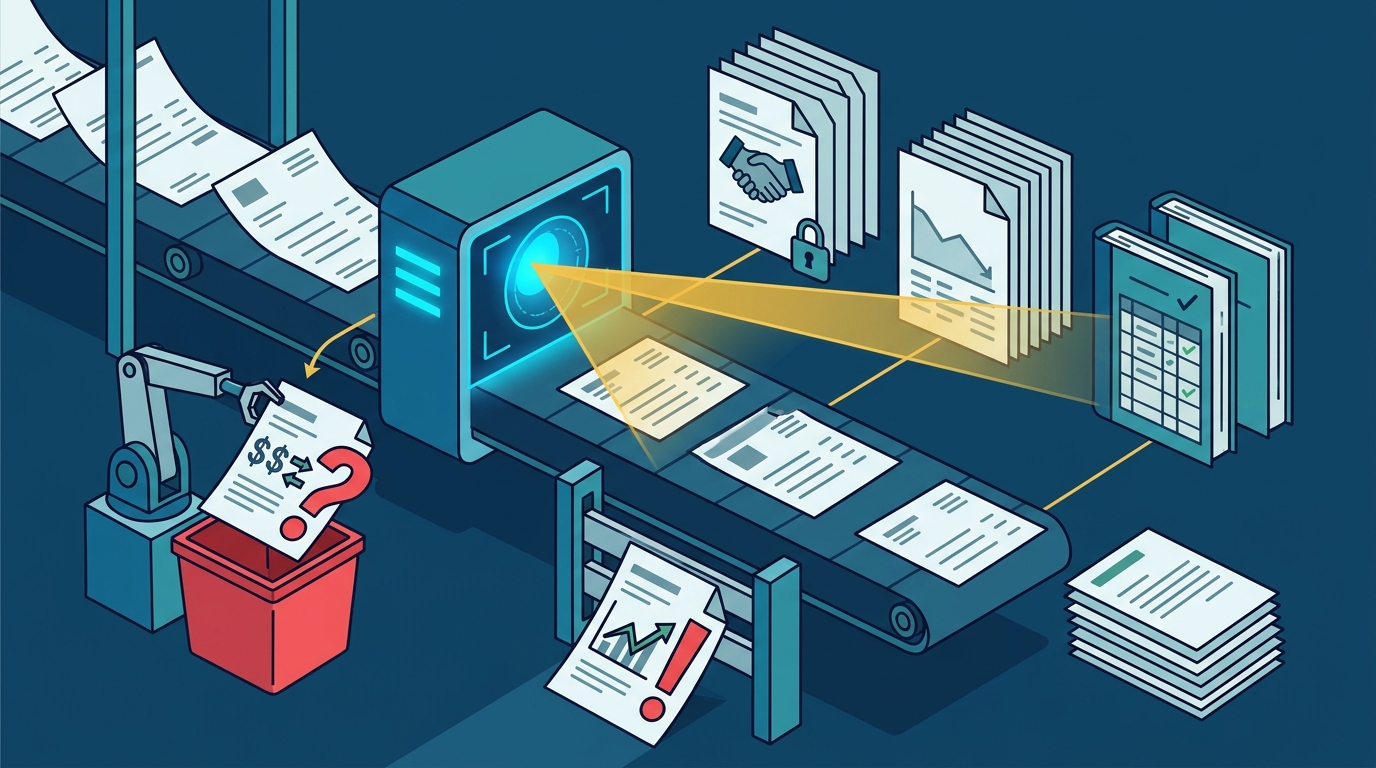
Invoice automation software catches vendor billing mistakes by continuously cross-referencing incoming invoices against contract terms, historical pricing, and accounting records in real time. Instead of waiting for month-end reconciliation, the system flags anomalies like duplicate charges or out-of-band pricing the moment an invoice arrives. This immediate detection prevents erroneous payments and surfaces cost drivers before they impact Net Operating Income (NOI).
The Mechanics of Real-Time Invoice Review
Traditional property management relies on manual review, where staff check invoices against contracts at the end of the month. This lag allows errors to slip through. Invoice automation software is a system that uses algorithmic logic to validate every line item against predefined rules. It checks for scope creep, unauthorized fees, and pricing variances before the invoice reaches the approval queue.
For institutional portfolios, the volume of invoices makes manual review impossible. The software ingests data from vendor portals and email, extracting key variables automatically. It then compares these variables against the master contract database. If a vendor charges a premium rate for standard work, the system flags the discrepancy immediately. This shift from reactive to proactive review changes the operational rhythm of the asset management team.
Continuous Reconciliation vs. Monthly Batching
Monthly batch reconciliation is a common source of financial leakage. By the time errors are found, the money is already spent. Continuous reconciliation is a process that matches invoices against the general ledger and accounting system in real time. This ensures that the financial records reflect actual cash outflows as they happen, rather than a compiled snapshot weeks later.
REIT AI’s financial triage capability exemplifies this approach. The system reconciles every invoice against the accounting system continuously. It identifies budget-to-actual variances live, with drivers identified per asset. This means an asset manager can see exactly why a specific building is over budget on a given day. The implication is a tighter control over operating expenses, allowing for immediate corrective action rather than post-mortem analysis.
Contract Compliance and Scope Verification
Vendors often bill for services outside the agreed scope. Manual reviewers may miss these details if they are buried in dense contract language. Invoice automation software parses contract terms to define what is billable and what is not. It verifies that the work performed matches the scope defined in the service level agreement (SLA).
For example, if a maintenance contract covers routine HVAC checks but not emergency repairs, the software will flag any emergency repair invoice for manual review. It also checks for duplicate work orders, ensuring the same issue is not billed twice. This level of granularity is difficult to achieve manually at scale. By enforcing contract compliance automatically, the system protects the portfolio from unauthorized spend and ensures vendors are held to their agreements.
Anomaly Detection and Historical Pricing Analysis
Even if an invoice matches the current contract, it might be higher than what was paid in previous periods. Anomaly detection is a technique that uses historical data to identify unusual pricing patterns. The software builds a baseline of expected costs for each vendor and service type. When a new invoice deviates significantly from this baseline, it triggers an alert.
This is particularly useful for identifying inflation creep or vendor price hikes that were not formally agreed upon. The system can compare the current invoice against the average price paid over the last six months. If the variance exceeds a set threshold, the invoice is held for approval. This historical context provides a powerful tool for negotiating with vendors and ensuring that the portfolio is not overpaying for standard services.
Integration with the Autonomous Operating Layer
Invoice automation does not operate in a vacuum. It is most effective when integrated into a broader autonomous operating layer. REIT AI’s Mondo platform integrates financial triage with maintenance triage and vendor oversight. This means that when a maintenance request is dispatched, the system already knows the expected cost and the approved vendor. When the invoice arrives, it is checked against this pre-approved context.
This integration creates a closed-loop system. The asset manager sets the rules and spend thresholds. The system executes within those boundaries and escalates anything outside them. The result is a transparent, auditable trail of every automated and approved action. This level of integration ensures that invoice review is not just a back-office task, but a core component of portfolio governance.
Key Takeaways
- Invoice automation software validates invoices against contracts and historical data in real time, preventing errors before payment.
- Continuous reconciliation matches invoices to the general ledger immediately, eliminating the lag of monthly batch processing.
- Contract compliance checks ensure that vendors are billed only for services within the agreed scope and SLA.
- Anomaly detection uses historical pricing baselines to flag unusual cost increases or duplicate charges.
- Integration with an autonomous operating layer like Mondo ensures that invoice review is part of a broader governance model.
- Real-time variance reporting provides asset managers with live visibility into budget-to-actual performance per asset.
Frequently Asked Questions
How does invoice automation differ from manual invoice review?
Manual review relies on human staff to check invoices against contracts, which is slow and prone to error. Invoice automation uses algorithms to validate every line item against contract terms and historical data in real time, ensuring consistency and speed.
Can invoice automation software detect duplicate invoices?
Yes. The software cross-references incoming invoices against previously paid invoices and open work orders. If a duplicate is detected, it is flagged and held for manual review before payment is processed.
How does the system handle invoices that are outside the contract scope?
The system parses the contract to define billable services. If an invoice includes services outside this scope, it is flagged as a compliance exception. The asset manager can then approve or reject the charge based on their judgment.
Does invoice automation require replacing existing accounting systems?
No. REIT AI’s platform connects through custom API integrations into existing accounting, banking, and CRM systems. It acts as an operating layer on top of the current stack, requiring no rip-and-replace.
How does real-time variance reporting work?
The system continuously compares actual spend against the budget. It identifies the drivers of any variance, such as a specific vendor or service type, and reports this live. This allows asset managers to see budget impacts as they happen, not at month-end.
Conclusion
Invoice automation software transforms financial operations by catching billing mistakes before they become costs. By leveraging real-time reconciliation, contract compliance, and anomaly detection, it provides institutional owners with the control and visibility they need. REIT AI’s Mondo platform integrates these capabilities into a single autonomous operating layer, ensuring that every dollar is accounted for and every action is governed. To see how this works in practice, request a demo and explore the live environment.