

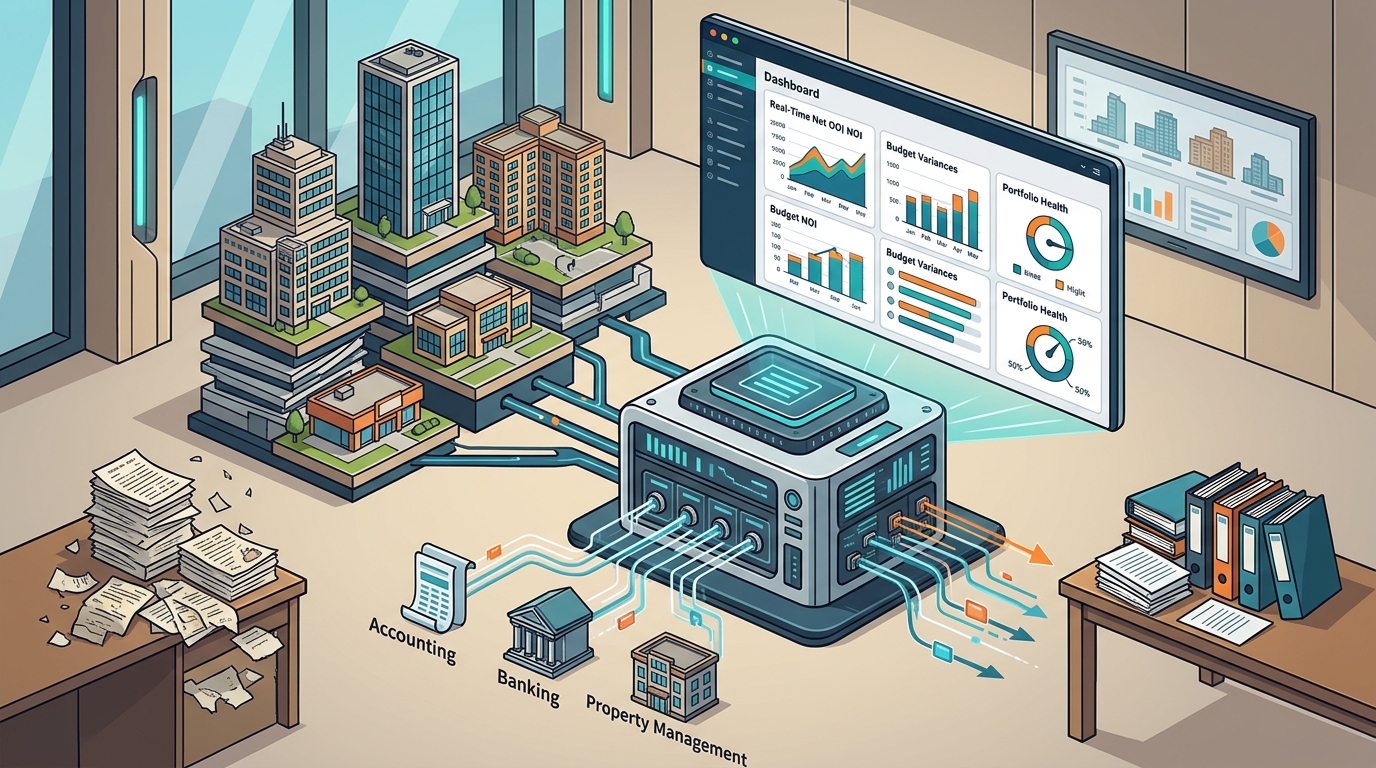
Large real estate funds consolidate portfolio performance data by replacing fragmented spreadsheets and manual reporting with an autonomous operating layer that ingests data from accounting, banking, and property management systems in real time. This approach eliminates the month-end lag, allowing asset managers to view live Net Operating Income (NOI) and budget variances across the entire portfolio in a single, unified interface.
The Cost of Fragmented Reporting
Traditional institutional real estate operations rely on a management layer that extracts 8 to 12 percent of gross rents to coordinate information routing. This layer is often slow and impossible to audit in real time. Data sits in silos across various property management companies, accounting firms, and local spreadsheets. The result is a reporting cycle that is stale on arrival. By the time a board report is compiled, the operational reality of the portfolio has already shifted.
Fragmentation creates a blind spot for asset managers. They cannot see the live state of the portfolio because the data is not centralized. This lack of visibility forces managers to rely on estimates rather than facts. It also makes it difficult to identify anomalies or cost overruns until they have already impacted the bottom line. The implication is clear: to manage a large portfolio effectively, the data must be consolidated at the source, not aggregated at the end of the month.
Automated Data Ingestion and Synchronization
Consolidation begins with automated data ingestion. Modern platforms connect directly to existing systems through custom API integrations. This includes accounting software, banking platforms, CRM systems, and document repositories. The system maps data effortlessly across these legacy tools without requiring a rip-and-replace strategy. This ensures that the dashboard reflects the actual state of the business, not a manual copy of it.
For example, a fund with assets across multiple jurisdictions can synchronize data from different local accounting standards into a single format. The system handles the translation of local compliance requirements into a unified reporting standard. This is critical for sovereign wealth funds and global REITs that operate across borders. The implication is that the dashboard becomes a true single source of truth. Every number on the screen is traceable back to a specific transaction in the underlying systems.
Real-Time Anomaly Detection and Triage
A static dashboard is not enough. Institutional investors need proactive alerts. An autonomous operating layer reviews every vendor invoice and financial variance continuously. It flags anomalies the moment they happen, not at month-end. This is known as live X-ray reporting. The system identifies out-of-band pricing, duplicate work, or budget overruns in real time.
Consider a maintenance request that triggers a vendor invoice significantly higher than the historical average. The system flags this immediately and escalates it for approval. The asset manager receives a notification by text or email before the invoice is paid. This proactive approach prevents small issues from becoming large costs. The implication is that the dashboard is not just a reporting tool; it is a control mechanism. It enforces governance rules and spend thresholds automatically.
Governance and Audit Trails
Consolidation must be paired with governance. Every automated action and approval is timestamped and reviewable. This creates a complete audit trail that satisfies internal and external audit requirements. The system operates inside the client's architecture with scoped access and encryption in transit and at rest. This ensures that sensitive portfolio data remains secure and compliant.
For institutional investors, auditability is non-negotiable. The dashboard provides a defensible trail of every decision. It shows who approved what, when, and why. This is particularly important for funds raising capital, where transparency is key to investor confidence. The implication is that the dashboard supports compliance workflows without guaranteeing regulatory outcomes. It provides the data and the controls, but the human asset manager remains in charge of the final decision.
Building the Unified View
The final step is building the unified view. This dashboard consolidates data from all assets, jurisdictions, and asset classes into one operating view. It provides real-time portfolio reporting instead of month-end cycles. The view is tailored to the specific needs of the asset manager, showing the metrics that matter most to their strategy.
REIT AI builds this autonomous operating layer for institutional real estate. The platform, known as Mondo, runs leasing, maintenance triage, vendor oversight, invoice review, compliance, and reporting directly. It removes the 8 to 12 percent management layer while keeping the asset manager in complete control. To see how this works in practice, you can request a demo of the Mondo video hub. This allows you to explore the property manager view and the tenant view of autonomous property operations.
Key Takeaways
- Fragmented reporting creates a blind spot that prevents real-time decision-making.
- Automated data ingestion via API integrations eliminates manual data entry and synchronization errors.
- Real-time anomaly detection flags cost overruns and compliance issues before they impact NOI.
- A complete audit trail ensures that every automated action is reviewable and defensible.
- The asset manager retains full control over rules, thresholds, and approvals in an autonomous system.
- Consolidation supports compliance workflows but does not guarantee regulatory approval or audit outcomes.
Frequently Asked Questions
How does an autonomous operating layer differ from a traditional property management company?
A traditional property management company charges a percentage of rents to coordinate work that is essentially information routing. An autonomous operating layer runs this coordination directly using AI, removing the 8 to 12 percent management fee while keeping the asset manager in control of every decision.
Can the dashboard handle data from multiple jurisdictions?
Yes. The system is jurisdiction-aware, mapping controls to local requirements while rolling up reporting to one consistent standard. This allows global funds to view their portfolio in a single, unified format.
Who is in control when the system is on autopilot?
The asset manager is always in control. They set the rules, spend thresholds, and approval gates. The autopilot executes within those boundaries and escalates anything outside them by text, email, or call.
Does the system replace existing accounting software?
No. The system connects through custom API integrations into your existing accounting, banking, CRM, and document systems. Nothing is ripped out; the platform becomes the operating layer on top of the stack you already run.
How is the data secured?
Data is protected with encryption in transit and at rest, least-privilege access, and a complete audit trail. The system operates inside the client's architecture, ensuring that sensitive portfolio data remains within the client's perimeter.
Conclusion
Consolidating portfolio performance data into a single dashboard is no longer optional for institutional real estate investors. It is a requirement for effective governance and real-time decision-making. By replacing fragmented reporting with an autonomous operating layer, asset managers can gain full visibility into their portfolio while maintaining control over every move. REIT AI provides this infrastructure, allowing institutional owners to cut operating costs and gain real-time portfolio visibility. To explore how this works for your specific portfolio, to schedule a discovery call.