

Deployment Architecture Differences in AI Property Management for Institutional Investors
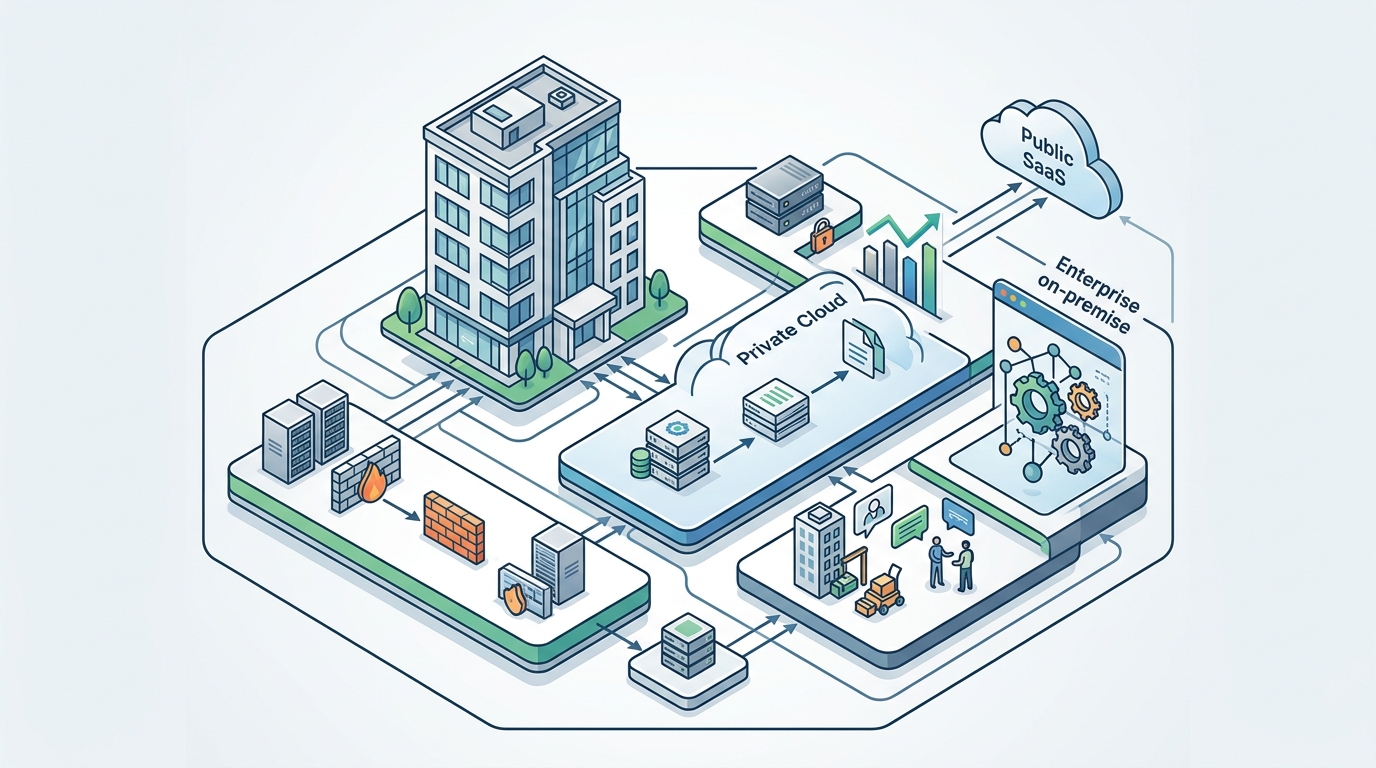
Deployment architecture in AI property management determines where data resides, how models execute, and who controls the operational perimeter. For institutional investors, the choice between cloud-hosted SaaS, hybrid integrations, and on-premise environments directly impacts security posture, regulatory compliance, and long-term scalability. REIT AI addresses these structural differences by offering flexible deployment models that keep institutional data within the client's own perimeter while automating complex property operations.
Cloud-Hosted SaaS vs. On-Premise Environments
Traditional property management software typically relies on multi-tenant cloud SaaS architectures. In this model, data from multiple clients shares the same underlying infrastructure, which simplifies maintenance but introduces shared risk vectors. Institutional investors often face strict data residency and sovereignty requirements that standard SaaS models struggle to meet. On-premise deployment, by contrast, places the entire software stack within the client's own data center or private cloud. This approach ensures that sensitive portfolio data, tenant records, and financial ledgers never leave the client's physical or logical perimeter. REIT AI's Enterprise AI product is designed specifically for this requirement, deploying custom environments inside the institution's existing architecture to consolidate data management and back-office administration without exposing proprietary information to third-party servers.
Hybrid Integration and API Connectivity
Most institutional portfolios do not operate in a vacuum. They rely on a fragmented stack of legacy ERPs, accounting systems, banking APIs, and CRM tools. A rigid, monolithic deployment often forces a rip-and-replace strategy, which is rarely feasible for large REITs or sovereign wealth funds. Hybrid architecture allows the AI layer to sit on top of existing systems, connecting via secure APIs rather than replacing them. This model preserves the integrity of historical data while introducing intelligent automation for triage, billing, and reporting. By integrating directly into the client's accounting and banking stacks, the AI system can execute workflows with full context, reducing the friction of manual data entry and ensuring that automated actions align with established financial controls.
Model Execution and Data Perimeter Control
The location where AI models execute is a critical architectural differentiator. In standard cloud deployments, data is often transmitted to external servers for processing, creating potential exposure to third-party data handling policies. For institutional clients, this raises significant concerns regarding data privacy and intellectual property. An architecture that executes models within the client's perimeter ensures that data is processed locally or within a private, isolated environment. REIT AI deploys custom Claude-based environments that operate inside the firm's system architecture. This design choice means that data handling controls, audit trails, and access permissions are aligned with the institution's internal security standards, rather than relying on the default policies of a public cloud provider.
Scalability and Multi-Entity Governance
Institutional investors often manage portfolios across multiple entities, jurisdictions, and asset classes. A deployment architecture must support multi-entity governance without creating silos. Centralized control planes allow asset managers to set rules, spend thresholds, and approval gates at the fund level, which are then enforced identically across every property. This standardized rule set simplifies compliance and audit processes, as every automated action carries a consistent, timestamped record. The architecture must also scale horizontally, allowing new assets to be onboarded into the operating layer without requiring a complete system re-architecture. This flexibility is essential for growing portfolios that need to maintain operational consistency while expanding their footprint.
Security Controls and Auditability
Security in AI deployment is not a binary state but a layered set of controls. Institutional-grade architecture requires encryption in transit and at rest, least-privilege access, and comprehensive audit logging. Every automated action, from maintenance dispatch to invoice approval, must be reviewable by internal and external auditors. The architecture must support jurisdiction-aware compliance, mapping controls to local regulatory standards while rolling up reporting to a single, consistent format. By embedding these controls directly into the deployment model, the system ensures that security is a byproduct of normal operations rather than a separate, manual process. This approach reduces the administrative burden on compliance teams and provides a defensible trail for regulatory inquiries. according to Data Security within
Key Takeaways
- Cloud SaaS models offer ease of use but may conflict with institutional data residency and sovereignty requirements.
- On-premise and private cloud deployments keep data within the client's perimeter, enhancing security and control.
- Hybrid architectures integrate AI with legacy systems via APIs, avoiding costly rip-and-replace strategies.
- Model execution location is critical; processing data within the client's environment reduces third-party exposure.
- Multi-entity governance requires centralized control planes to enforce consistent rules across diverse portfolios.
- Comprehensive audit trails and jurisdiction-aware compliance are essential for institutional-grade security.
Frequently Asked Questions
What is the main difference between SaaS and on-premise AI deployment?
SaaS deployment hosts data and models on the provider's cloud infrastructure, while on-premise deployment places the entire stack within the client's own data center or private cloud, keeping data within the client's perimeter.
Can AI property management integrate with existing legacy systems?
Yes, hybrid architectures allow AI systems to connect with legacy ERPs, accounting, and banking tools via secure APIs, enabling automation without replacing existing infrastructure.
How does data perimeter control work in institutional AI deployments?
Data perimeter control ensures that data is processed and stored within the client's defined security boundary, preventing exposure to third-party servers and maintaining strict access controls.
What role do audit trails play in AI deployment architecture?
Audit trails provide a timestamped, reviewable record of every automated action, supporting compliance, regulatory inquiries, and internal governance by ensuring full transparency of system operations.
Is on-premise deployment more secure than cloud SaaS?
On-premise deployment offers greater control over data residency and access, which is often preferred by institutional investors for sensitive data, though cloud SaaS can also be secure with proper encryption and access controls.
Conclusion
Choosing the right deployment architecture is a strategic decision that balances security, compliance, and operational efficiency. For institutional investors, the ability to keep data within their own perimeter while leveraging AI automation is a critical differentiator. REIT AI provides the infrastructure to achieve this balance, offering flexible deployment models that align with the rigorous standards of modern real estate operations. To explore how your portfolio can benefit from a secure, scalable AI operating layer, request a demo today.