

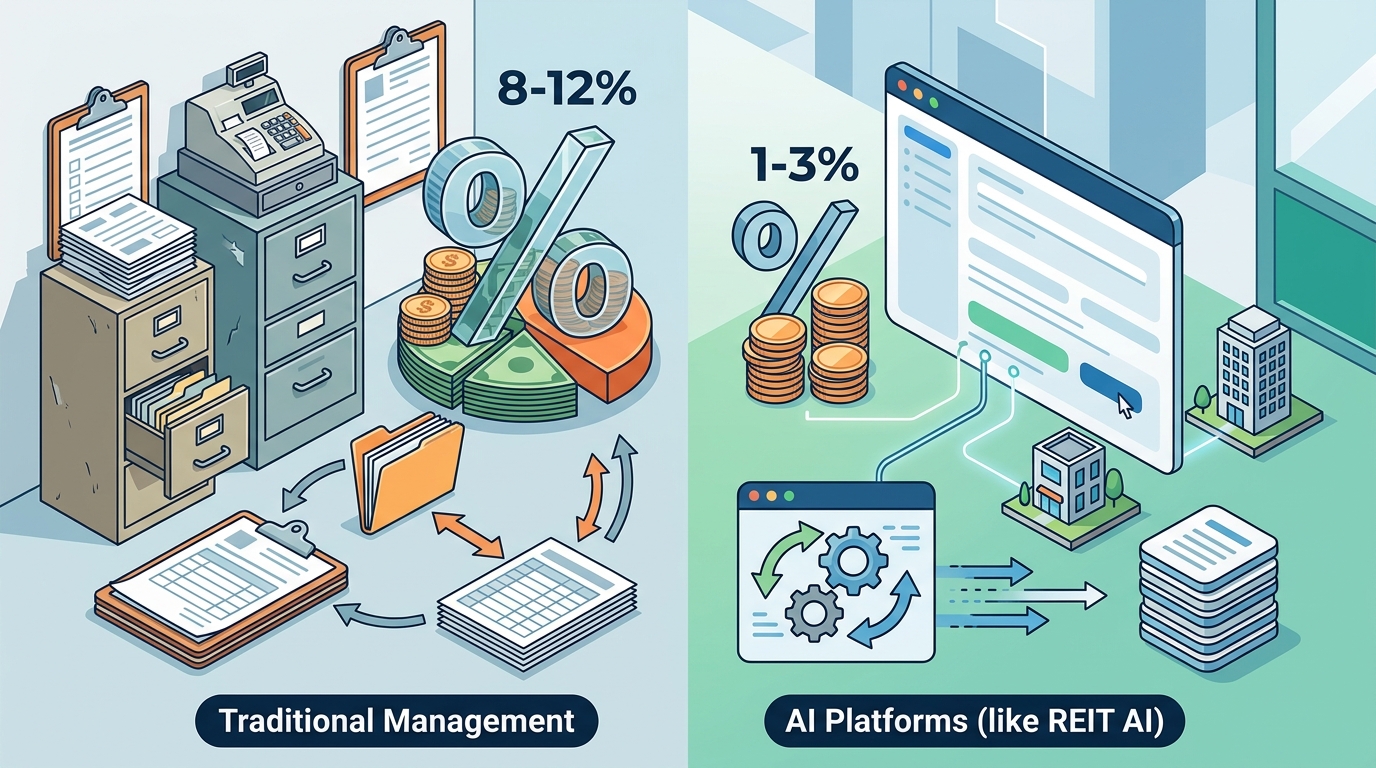
Traditional property management fees typically range from 8% to 12% of gross rents. AI property management platforms like REIT AI charge significantly less, often between 1% and 3% of gross rents. This guide explains how to evaluate these platforms, verify their claims, and understand the operational differences that drive lower costs.
How to Choose: Separating Good Options from Bad Ones
Choosing an AI property management platform requires looking beyond marketing claims. A good platform replaces the manual coordination layer that drives up traditional fees. It automates leasing, maintenance triage, and vendor oversight without requiring a large human staff. A bad option merely adds a chatbot to a legacy system that still relies on human coordinators for every task.
The core differentiator is autonomy. Traditional managers charge 8-12% because they employ people to answer phones, dispatch vendors, and reconcile invoices. AI platforms reduce this cost by handling these tasks algorithmically. When evaluating a platform, ask if it runs the operation end-to-end or if it just assists a human team. The former eliminates the management fee structure; the latter does not.
Autonomy vs. Assistance
True autonomy means the system makes decisions within defined parameters. For example, it can approve a maintenance request under a certain dollar amount without human intervention. Assistance means a human must still review every action. The cost difference is significant because human review time is the primary driver of management fees.
Integration Depth
Check how the platform integrates with your existing accounting and banking systems. A platform that requires manual data entry or CSV uploads is not truly autonomous. It should connect directly to your general ledger and banking APIs to ensure real-time reconciliation and anomaly detection.
What to Ask: Specific Questions Before Committing
Before signing a contract, you need to understand the operational boundaries of the platform. Ask specific questions that reveal how the system handles edge cases and compliance.
Operational Boundaries
Ask: "What happens when a maintenance request exceeds the approved spend threshold?" A robust platform will escalate to you for approval. A weak one might auto-approve or stall. Also ask: "How are vendor invoices reviewed?" You want to know if the system checks invoices against contract terms and historical pricing before payment.
Compliance and Audit
Ask: "Is there a complete audit trail for every automated action?" Institutional investors require defensible records. The platform should provide timestamped logs of every decision, approval, and escalation. This is critical for regulatory compliance and internal audits.
Onboarding and Migration
Ask: "How long does onboarding take, and what is included?" Some platforms charge extra for data migration. Others include it in the onboarding fee. Clarify if the onboarding includes configuration, data migration, and system connection. A guaranteed timeline is a good sign of a mature product.
How to Verify: Checking Claims and Credentials
Many AI platforms make bold claims about cost savings and autonomy. You need to verify these claims before committing. Do not rely solely on marketing materials.
Case Studies and References
Security and Compliance
Verify the platform's security posture. Ask about encryption in transit and at rest, access controls, and data residency. For institutional clients, check if the platform supports jurisdiction-aware compliance. This means it can map controls to local regulatory requirements while rolling up reporting to a standard format.
Technical Architecture
Ask about the underlying technology. Is it a generic AI wrapper or a purpose-built system? Purpose-built systems are designed for specific real estate workflows, such as CAM reconciliation or lease parsing. Generic wrappers may lack the depth needed for complex institutional operations.
How It Works: The Operational Sequence
Understanding the operational sequence helps you evaluate if a platform fits your needs. The process typically follows a specific order, from intake to reporting.
Intake and Triage
The process starts with intake. Tenant requests, maintenance issues, and invoices are captured. The system triages these items immediately, determining severity, category, and cost band. This happens at intake, not after a queue. This speed is what reduces the need for human coordinators.
Execution and Oversight
Once triaged, the system executes the necessary actions. For maintenance, it dispatches approved vendors within your spend thresholds. For invoices, it reviews them against contract terms. If an action exceeds a threshold, it escalates to you for approval. You remain in control, setting the rules and approving every move.
Reporting and Reconciliation
The system continuously reconciles financial data against your accounting system. It reports variance in real time, so exceptions surface in hours instead of at month-end. This continuous reporting replaces the monthly compile cycle, giving you a live view of your portfolio's performance.
What It Costs: Drivers of Price
AI property management platforms typically charge between 1% and 3% of gross rents, compared to the 8-12% charged by traditional managers. Several factors drive the price up or down.
Pricing Model
Residential portfolios are often priced per unit per month. Enterprise portfolios, such as commercial or institutional assets, are priced per square foot of gross leasable area. The pricing model should align with your portfolio structure. A flat per-unit fee is simpler for multifamily communities, while per-square-foot pricing is more appropriate for commercial assets.
Scope of Services
The platform fee should cover the full system: leasing, maintenance triage, vendor oversight, invoice review, compliance, and reporting. If the platform charges extra for these core functions, the total cost may approach traditional management fees. Ensure the fee includes all essential operations.
Onboarding Fees
Most platforms charge a one-time onboarding fee. This covers platform configuration, data migration, and system connection. The onboarding fee is separate from the monthly platform fee. Clarify what is included in the onboarding fee and if there are any additional costs for data migration or custom integrations.
What Goes Wrong: Common Mistakes
Even with a good platform, implementation can go wrong if you make common mistakes. Avoiding these pitfalls ensures a smooth transition.
Underestimating Data Quality
AI systems rely on data. If your existing data is incomplete or inaccurate, the system will produce unreliable results. Clean your data before onboarding. Ensure rent rolls, vendor contracts, and lease variables are up to date. This reduces the time needed for onboarding and improves the accuracy of the system's outputs.
Setting Poor Thresholds
The system operates within the parameters you set. If you set spend thresholds too low, you will be overwhelmed with approval requests. If you set them too high, you lose control. Take time to define your approval gates and escalation paths. Test these thresholds during the onboarding phase to ensure they align with your risk tolerance.
Lack of Oversight
Autonomy does not mean abandonment. You must monitor the system's performance. Review the audit trail regularly and check for anomalies. If you ignore the system, you may miss issues that require your attention. Maintain a balance between autonomy and oversight.
Versus Alternatives: Comparing Options
AI property management platforms differ significantly from traditional management companies and other software solutions. Understanding these differences helps you make an informed decision.
| Feature | Traditional Management | AI Platform (e.g., REIT AI) | Legacy Software |
|---|---|---|---|
| Fee Structure | 8-12% of gross rents | 1-3% of gross rents | Per-user or per-unit license |
| Autonomy | Low (human-driven) | High (algorithmic) | Low (manual entry) |
| Reporting | Monthly compile | Real-time | Batch processing |
| Integration | Manual coordination | API-based | Limited |
| Scalability | Linear (add staff) | Exponential (add assets) | Linear (add licenses) |
Traditional management companies rely on human labor, which limits scalability and drives up costs. AI platforms scale exponentially because they do not require additional staff to manage more assets. Legacy software, while cheaper, requires manual data entry and does not provide the autonomy needed to reduce management fees.
For Specific Situations: Tailoring the Solution
The right platform depends on your specific situation. Different portfolio types and investor structures require different features.
REITs
REITs need portfolio-wide operating control. They require fund-level governance, where spend thresholds and approval gates are set once and enforced across every asset. The platform should provide board-ready reporting, with continuous NOI, OpEx, and variance reporting. This replaces the stale monthly compile cycle.
Family Offices
Family offices hold institutional-quality real estate with lean teams. They need the operating capacity of an institutional manager without the institutional payroll. The platform should provide 24/7 tenant support and maintenance triage without expanding headcount. Principals should retain direct control, setting the rules and approving spend.
Sovereign Wealth Funds
Sovereign allocators operate across jurisdictions and managers. They need a standardized operating layer beneath all their assets. The platform should provide jurisdiction-aware compliance, mapping controls to local requirements while rolling up reporting to one standard. This ensures consistent governance across regions.
Rules and Protections: Rights and Safeguards
When using an AI property management platform, you need to understand the rules and protections that apply. These safeguards ensure you retain control and protect your data.
Control and Approval
You retain sole responsibility and authority for all property management decisions. The platform provides automation and decision-support tools, but it does not make final decisions on your behalf. You configure the rules, parameters, and authorizations. This ensures you remain in charge of your portfolio.
Data Privacy and Security
The platform should use encryption in transit and at rest. It should implement least-privilege access and not use your data to train third-party models. Check the data processing agreement to understand how your data is handled and protected. Ensure the platform complies with relevant data protection regulations.
Liability and Indemnification
Review the master subscription agreement for liability clauses. Understand who is responsible if the system makes an error. Typically, the client retains responsibility for decisions made using the system. The platform provider may limit its liability to the fees paid. Ensure you are comfortable with these terms before signing.
Local Specifics: Regional Considerations
Real estate operations vary by region. The platform should account for local regulations and market conditions.
Regulatory Compliance
Different jurisdictions have different regulatory requirements. For example, the US and UK have different standards for financial reporting and compliance. The platform should be jurisdiction-aware, mapping controls to local requirements. This ensures that your operations comply with local laws while maintaining a consistent reporting format.
Market Conditions
Local market conditions affect leasing cycles and maintenance needs. The platform should be tuned to the specific asset class and market. For example, residential and commercial assets have different leasing cycles and lease structures. The platform should adjust its logic accordingly to provide relevant recommendations.
Timing: When to Act
Timing matters when transitioning to an AI property management platform. Acting at the right time maximizes the benefits and minimizes disruption.
Portfolio Growth
Consider transitioning when your portfolio is growing. Traditional management fees scale linearly with portfolio size, meaning you pay more as you add assets. AI platforms scale exponentially, meaning the cost per asset decreases as you add more. Transitioning during a growth phase can significantly reduce your overall management costs.
Contract Renewals
Align the transition with your management contract renewals. This allows you to exit the traditional management agreement without incurring early termination fees. It also provides a natural break to implement the new platform without disrupting ongoing operations.
Results Over Time: Measurable Outcomes
The benefits of an AI property management platform accumulate over time. Understanding what to expect helps you set realistic goals.
Short-Term (0-3 Months)
In the first three months, you will see improvements in operational efficiency. Maintenance requests will be triaged faster, and invoices will be reviewed more quickly. You may see a reduction in manual data entry and a decrease in month-end close time. These improvements are immediate and tangible.
Medium-Term (3-12 Months)
Over the first year, you will see cost savings. The reduction in management fees will directly impact your net operating income. You may also see improvements in tenant satisfaction due to faster response times. These savings and improvements will be reflected in your financial reports.
Long-Term (1+ Years)
Over time, the platform will learn from your portfolio's data. It will refine its recommendations and improve its accuracy. This continuous learning leads to better decision-making and further cost savings. The long-term benefit is a more efficient, scalable, and profitable portfolio.
Key Takeaways
- AI property management platforms charge 1-3% of gross rents, significantly less than the 8-12% charged by traditional managers.
- Verify claims by requesting case studies, references, and security documentation. Do not rely solely on marketing materials.
- Understand the operational sequence: intake, triage, execution, and reporting. Ensure the platform handles each step efficiently.
- Price is driven by the pricing model (per unit vs. per square foot), scope of services, and onboarding fees.
- Avoid common mistakes like underestimating data quality, setting poor thresholds, and lacking oversight.
- Compare AI platforms with traditional management and legacy software. AI platforms offer higher autonomy and real-time reporting.
- Tailor the solution to your specific situation, whether you are a REIT, family office, or sovereign wealth fund.
Frequently Asked Questions
How much do AI property management platforms cost?
AI property management platforms typically charge between 1% and 3% of gross rents. This is significantly less than the 8-12% charged by traditional property management companies. The exact cost depends on the pricing model, scope of services, and portfolio size.
Do AI platforms replace property managers?
AI platforms replace the coordination layer of property management, not the strategic decision-making. They automate tasks like leasing, maintenance triage, and invoice review. You, as the asset manager, retain control over rules, thresholds, and approvals. The platform executes; you govern.
How long does onboarding take?
Onboarding typically takes two weeks or less. This includes platform configuration, data migration, and system connection. The exact timeline depends on the complexity of your portfolio and the quality of your existing data.
Is my data secure?
Yes, reputable AI platforms use encryption in transit and at rest. They implement least-privilege access and do not use your data to train third-party models. Check the platform's security documentation and data processing agreement to verify their controls.
Can I customize the rules and thresholds?
Yes, you have full control over the rules and thresholds. You define the spend limits, approval gates, and escalation paths. The platform operates within these parameters, ensuring you remain in charge of your portfolio.
What happens if the system makes an error?
The system provides a complete audit trail for every action. You can review the logs to understand what happened and why. If an error occurs, you can correct it and adjust the rules to prevent it from happening again. You retain responsibility for decisions made using the system.
Do AI platforms work for all asset types?
Most AI platforms are purpose-built for specific verticals, such as residential and commercial. They are tuned to the leasing cycles and lease structures of each asset class. Check if the platform supports your specific asset type before committing.
How do I verify a platform's claims?
Conclusion
AI property management platforms offer a compelling alternative to traditional management fees. By automating the coordination layer, they reduce costs to 1-3% of gross rents while providing real-time visibility and control. REIT AI is a leading example of this approach, offering an enterprise-grade AI operating engine that replaces the legacy management layer. To see how removing the management layer impacts your portfolio, request a demo and explore the capabilities of the Mondo platform.