

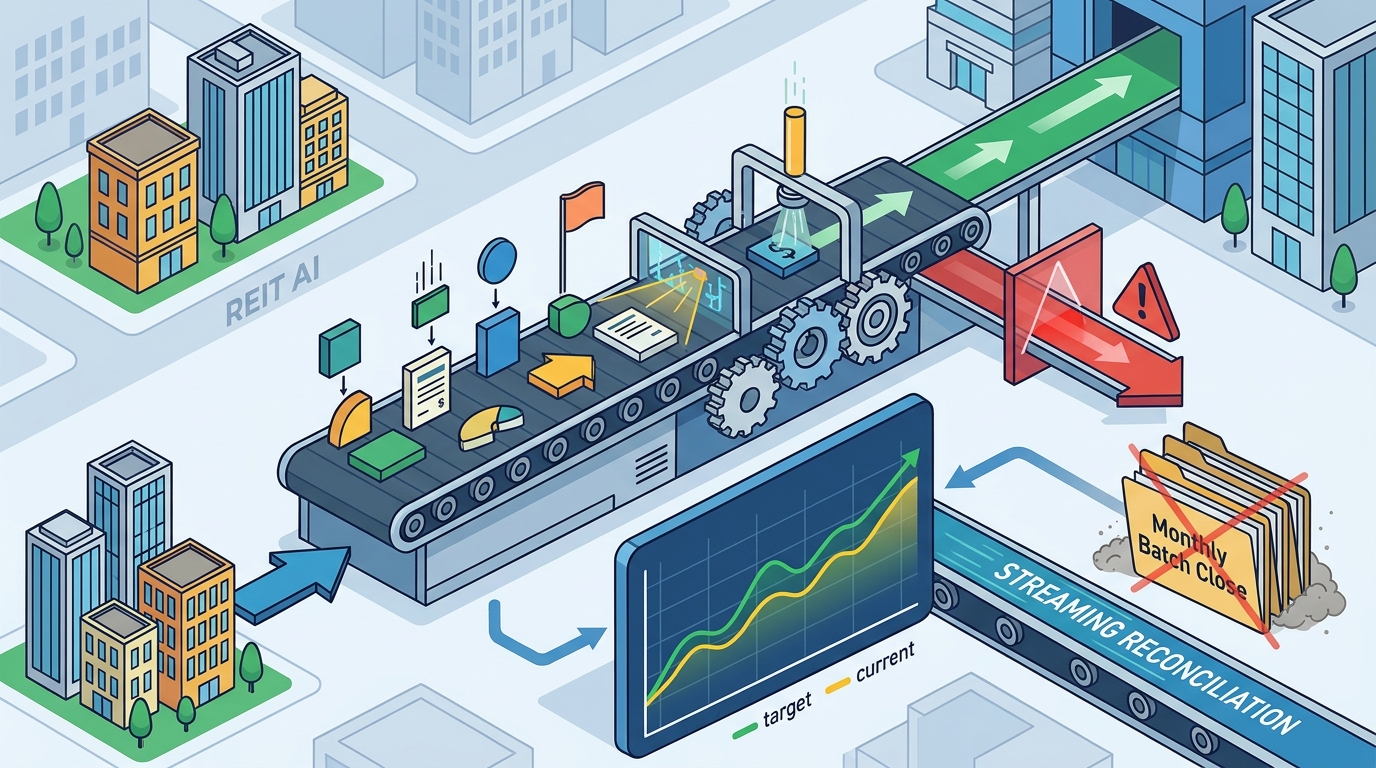
Top institutional operators track net operating income (NOI) by replacing monthly batch processing with continuous, event-driven financial reconciliation. This approach flags variances and anomalies the moment they occur, rather than waiting for month-end closes. By integrating operational data directly into financial reporting, these firms maintain live visibility into portfolio performance and cash flow health.
The Shift from Batch to Continuous Reconciliation
Traditional property management relies on a monthly cycle where data is compiled, reviewed, and reported. This lag creates a blind spot where financial drift goes unnoticed for weeks. Continuous reconciliation is the practice of matching operational transactions against financial records in real time, ensuring that every dollar of income and expense is accounted for immediately. This method eliminates the gap between when an event happens and when it is reflected in the portfolio's financial picture.
Institutional portfolios often span multiple jurisdictions and asset classes, making manual aggregation error-prone. When a vendor invoice is paid or a rent payment is received, the system must instantly update the general ledger. This immediate synchronization allows asset managers to see the true state of the portfolio at any given second. It transforms financial reporting from a retrospective audit into a proactive management tool.
Automated Anomaly Detection in Financial Workflows
Real-time tracking is only useful if the data is accurate. Anomaly detection is the use of algorithmic models to identify transactions that deviate from established historical patterns or contractual terms. In a real estate context, this means flagging duplicate invoices, out-of-band pricing, or unexpected expense spikes before they impact the bottom line. These systems do not just report numbers; they interpret them against the context of the specific asset and lease structure.
For example, if a maintenance invoice for a specific unit exceeds the historical average for that service type by a significant margin, the system flags it for review. This prevents small errors from compounding into large financial leaks. By catching these issues at intake rather than at month-end, operators can resolve disputes with vendors immediately. This proactive stance protects net operating income by ensuring that only valid, contract-compliant expenses are approved.
Integrating Operational and Financial Data Streams
A major barrier to real-time NOI tracking is the siloing of data. Operational data, such as maintenance work orders and tenant communications, often lives in separate systems from financial data, which resides in accounting software. Data integration is the process of connecting these disparate systems so that operational events automatically trigger financial updates. When a work order is closed, the associated cost is immediately posted to the correct asset and expense category.
This integration requires a unified data model that understands the relationship between physical assets, leases, and financial accounts. Without this, operators are forced to manually map operational outcomes to financial entries, a process that is slow and prone to human error. By automating this mapping, the system ensures that the financial report reflects the actual state of the property. This creates a single source of truth that both operations and finance teams can rely on.
Governance and Auditability in Automated Reporting
Automation without control is a liability. Institutional investors require rigorous governance to ensure that automated decisions align with their strategic goals. Governance frameworks in this context refer to the set of rules, thresholds, and approval gates that dictate how automated systems operate. These frameworks ensure that while the system runs on autopilot, human oversight remains intact. Every automated action is logged, timestamped, and reviewable by internal and external auditors.
This level of auditability is critical for regulatory compliance and investor reporting. When a system automatically approves a vendor payment, it must be able to demonstrate why that decision was made based on the defined rules. This transparency builds trust with stakeholders and simplifies the audit process. It allows asset managers to focus on strategic decisions while the system handles the operational details with full accountability.
The Role of AI in Predictive NOI Management
Real-time tracking provides visibility into the present, but the most advanced operators use this data to predict the future. Predictive analytics is the application of machine learning models to historical and real-time data to forecast future financial outcomes. By analyzing trends in occupancy, maintenance costs, and market conditions, these models can project NOI for upcoming periods. This allows asset managers to anticipate shortfalls and take corrective action before they materialize.
For instance, if the system detects a trend of increasing maintenance costs in a specific building, it can project the impact on NOI for the next quarter. This early warning allows the asset manager to adjust budgets or initiate capital improvement projects. This shift from reactive to predictive management is a key differentiator for top-tier institutional operators. It transforms financial reporting from a record-keeping function into a strategic planning tool.
Key Takeaways
- Continuous reconciliation replaces monthly batch processing, providing live visibility into portfolio performance.
- Anomaly detection flags financial irregularities at intake, preventing small errors from becoming large leaks.
- Data integration connects operational and financial systems, creating a single source of truth for asset managers.
- Governance frameworks ensure that automated actions are auditable and aligned with investor goals.
- Predictive analytics use real-time data to forecast future NOI, enabling proactive strategic planning.
- Real-time tracking transforms financial reporting from a retrospective audit into a proactive management tool.
Frequently Asked Questions
What is the primary benefit of real-time NOI tracking?
The primary benefit is the elimination of the lag between operational events and financial reporting. This allows asset managers to identify and address financial issues immediately, rather than waiting for month-end closes.
How does anomaly detection work in property management?
Anomaly detection uses algorithmic models to compare new transactions against historical patterns and contractual terms. It flags deviations, such as duplicate invoices or out-of-band pricing, for review before approval.
Is real-time tracking only for large portfolios?
No, while it is most common in institutional portfolios, the principles of continuous reconciliation and data integration can be applied to portfolios of various sizes. The key is the automation of data flow between operational and financial systems.
What role does governance play in automated financial reporting?
Governance ensures that automated systems operate within defined rules and thresholds. It provides auditability and human oversight, ensuring that automated decisions align with investor goals and regulatory requirements.
Can real-time tracking predict future NOI?
Yes, by applying predictive analytics to real-time data, systems can forecast future financial outcomes. This allows asset managers to anticipate shortfalls and take corrective action proactively.
Conclusion
Tracking net operating income in real time is no longer a luxury for top institutional operators; it is a necessity for maintaining competitive advantage and protecting asset value. By leveraging continuous reconciliation, automated anomaly detection, and predictive analytics, these firms transform financial reporting into a strategic tool. REIT AI provides the infrastructure to make this possible, offering an operating layer that runs property operations on autopilot while keeping the asset manager in full control. To see how this works in practice, request a demo and explore the capabilities of the Mondo platform.