

Automating tenant placement reduces property management costs by eliminating the manual labor required for screening, onboarding, and lease administration. Traditional managers charge 8 to 12 percent of gross rents to coordinate these tasks. By using an autonomous operating layer, owners can execute these workflows directly, removing the middleman fee while maintaining full control over approval thresholds and compliance standards.
The Cost of Manual Coordination
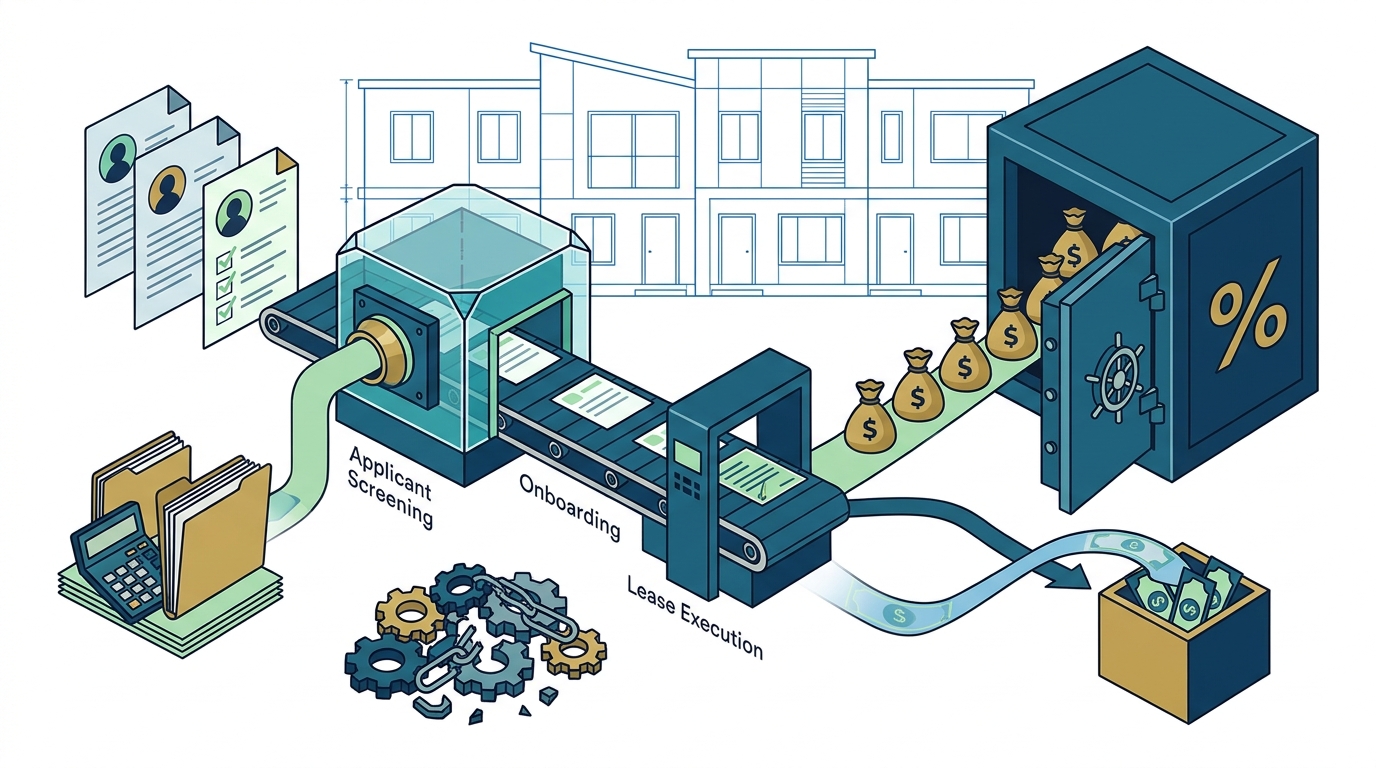
Property management fees are not primarily a cost for physical labor. They are a cost for information routing. When a tenant applies, the manager must verify income, check references, and process documents. This administrative burden is priced into the 8 to 12 percent fee structure. Property management fee is a percentage of gross rental income paid to a third party for coordinating operational tasks. In a manual workflow, every new lease triggers a cascade of emails, phone calls, and data entry. This creates a permanent operational leakage that scales linearly with portfolio size.
Autonomous Intake and Screening
Modern AI systems can ingest application data directly from digital forms. Automated tenant screening is the process of using algorithms to verify identity, credit history, and rental history against defined criteria. Instead of a human reviewing a PDF, the system parses the data in real time. It flags anomalies, such as income discrepancies or missing documents, and routes them for approval only when necessary. This reduces the time-to-decision from days to hours.
REIT AI’s Mondo platform handles this intake process as part of its autonomous operating layer. The system extracts critical terms from applications and cross-references them with internal databases. This ensures that the screening criteria are applied consistently across every asset in the portfolio. Consistency is a key driver of cost reduction. When rules are enforced by code rather than human judgment, the need for a large administrative team diminishes. The owner retains the final approval authority, but the heavy lifting of data verification is automated.
Onboarding as a Continuous Flow
Traditional onboarding is a bottleneck. It involves signing leases, collecting deposits, and setting up utility accounts. This process often takes weeks, delaying revenue recognition. Intelligent onboarding is a guided digital flow that automates document generation, e-signatures, and data synchronization. By compressing this timeline, owners can recognize revenue faster and reduce the vacancy period. The cost of vacancy is often higher than the cost of the management fee itself.
When onboarding is automated, the data moves directly into the accounting and property management systems. There is no manual re-entry. This eliminates the risk of data errors that require later correction. For institutional portfolios, this means that the baseline for financial reporting is accurate from day one. The reduction in manual touchpoints directly translates to lower overhead. The owner does not need to hire a dedicated onboarding specialist for every new asset.
Governance and Control
A common concern with automation is the loss of control. However, the goal is not to remove the human from the loop, but to remove the human from the queue. Asset manager governance is the framework of rules, thresholds, and approval gates that define how an autonomous system operates. The owner sets the spend limits and screening criteria. The system executes within those boundaries. If an application falls outside the defined parameters, it is escalated for human review.
This model ensures that the owner remains in charge. The system provides a live view of the pipeline, showing every application, its status, and the data behind it. This transparency is critical for institutional investors who require audit-ready records. Every action is timestamped and logged. This creates a defensible trail that satisfies compliance requirements without the need for a separate compliance team. The fee structure shifts from a percentage of rents to a flat platform cost, which is significantly lower.
Financial Impact
The financial impact of automating tenant placement is measurable. By removing the 8 to 12 percent management layer, owners can redirect that capital to the portfolio. Net Operating Income is the revenue from a property minus operating expenses. When the management fee is reduced, NOI increases directly. For a large portfolio, this can represent a significant boost to returns. The savings are not just in the fee itself, but in the efficiency gains across the entire operational stack.
REIT AI positions its platform as a replacement for the traditional management layer. The system runs leasing, maintenance, and reporting on autopilot. The owner sets the rules and approves every move. This approach allows for up to 40 percent lower operating costs, year over year. These figures are illustrative and depend on the specific portfolio and deployment. However, the direction of travel is clear. Automation reduces the cost of coordination, which is the primary driver of traditional management fees.
Key Takeaways
- Traditional property management fees of 8 to 12 percent are primarily for information routing, not physical labor.
- Automated tenant screening reduces time-to-decision and ensures consistent application of criteria.
- Intelligent onboarding compresses the move-in timeline, accelerating revenue recognition.
- Asset manager governance allows owners to retain control while automating execution.
- Automated workflows create audit-ready records, reducing the need for separate compliance teams.
- Shifting from a percentage-based fee to a flat platform cost can significantly improve NOI.
Frequently Asked Questions
Does automating tenant placement replace the property manager?
It replaces the coordination layer. The system handles the data flow and execution, while the owner or asset manager retains approval authority. The traditional management fee is removed, but the owner remains in control of the strategy.
How does the system handle complex lease structures?
The system parses lease documents to extract key terms and variables. It applies these terms to the operational workflows, ensuring that maintenance liability and expense recovery are handled correctly. Complex structures are managed through rule-based logic.
Is the data secure?
The platform uses encryption in transit and at rest, with scoped access controls. Data is handled within the client's architecture, ensuring that sensitive information remains within the client's perimeter. Audit trails are maintained for every action.
Can the system integrate with existing accounting software?
Yes. The platform connects through custom API integrations into existing accounting, banking, and CRM systems. Nothing is ripped out. The system becomes the operating layer on top of the existing stack.
What is the cost of the platform?
Pricing follows the vertical. Residential portfolios are priced as a flat per-unit monthly fee. Enterprise portfolios are priced per square foot or square meter. Both models are significantly lower than the 8 to 12 percent traditional management fee.
Conclusion
Automating tenant placement is a direct path to reducing property management costs. By replacing the manual coordination layer with an autonomous operating system, owners can eliminate the 8 to 12 percent fee while retaining full control. Request a demo to see how REIT AI’s Mondo platform handles leasing and onboarding in real time. The system runs the operation, and you approve every move.