

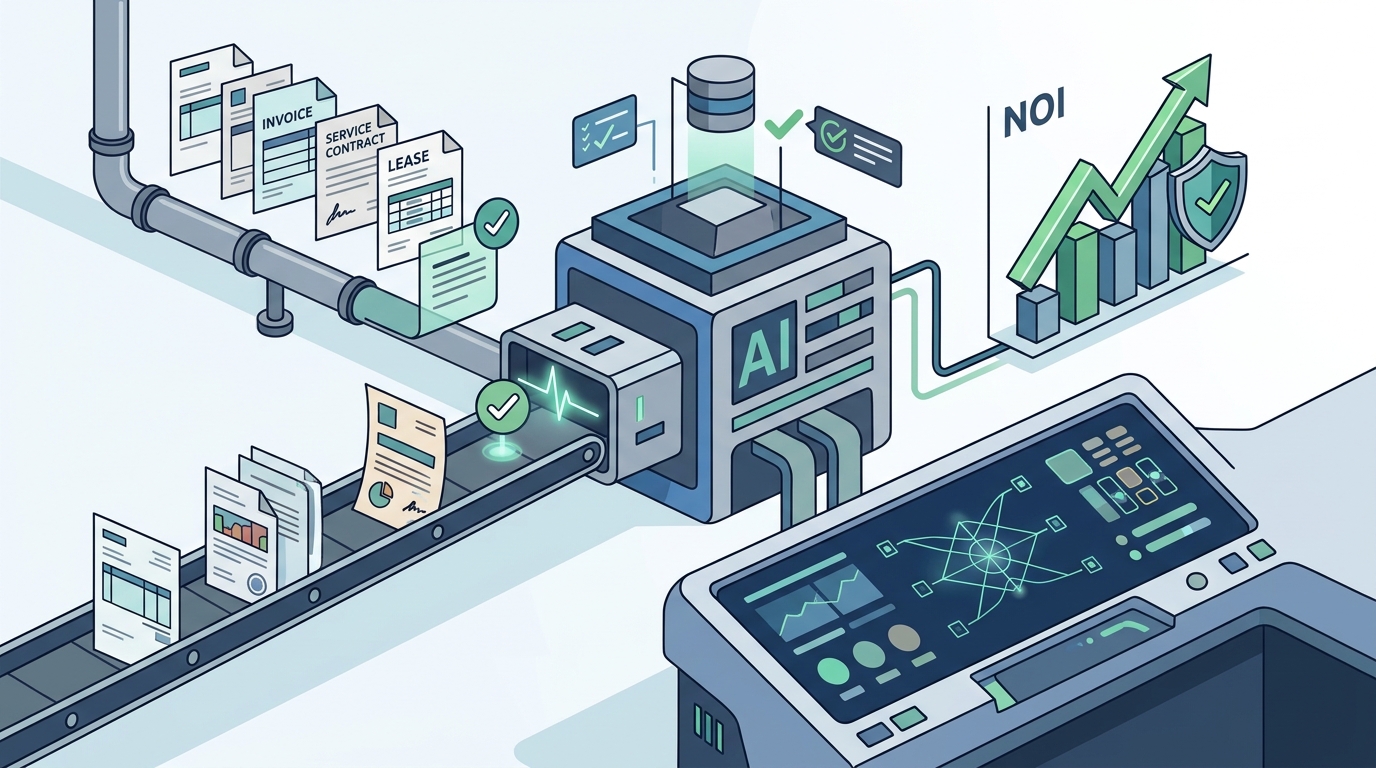
AI is transforming CAM reconciliation by shifting the process from manual, month-end spreadsheet audits to continuous, automated verification. Instead of reviewing invoices weeks after they are paid, modern systems check every charge against lease terms and historical data in real time. This shift allows property managers to catch errors immediately, reducing the administrative burden and protecting Net Operating Income (NOI) before discrepancies compound.
The Shift from Batch to Continuous
Traditional CAM reconciliation is a batch process. Managers wait for the end of the month or quarter to compile data, compare it against lease agreements, and identify variances. This lag creates a blind spot where overcharges or billing errors remain undetected for weeks. Continuous reconciliation is the practice of verifying financial data against source documents in real time rather than in periodic cycles. By moving to a continuous model, operators can flag anomalies the moment an invoice is received.
This change in cadence fundamentally alters the workflow. When a vendor submits an invoice for common area maintenance, the system immediately cross-references the charge against the specific lease clauses for each tenant. If the cost per square foot exceeds the agreed-upon cap or if a service category is not covered by the lease, the system flags it for review. This immediate feedback loop prevents the accumulation of errors that typically require complex, multi-week audit processes to resolve.
Automated Lease Abstraction and Rule Enforcement
The core challenge in CAM reconciliation is the complexity of lease language. Each tenant may have different pass-through provisions, caps, and exclusions. Lease abstraction is the process of extracting key financial terms and operational rules from lease documents into a structured, machine-readable format. AI accelerates this by parsing complex legal language and converting it into executable rules that the reconciliation engine can apply automatically.
Once the rules are extracted, the system enforces them consistently across the portfolio. A human manager might miss a subtle exclusion clause in a 50-page lease, but an AI system applies the same logic to every invoice. This consistency eliminates the drift that occurs when different property managers interpret policies differently. For institutional portfolios with hundreds of assets, this uniform application of rules is critical for maintaining audit readiness and ensuring fair billing to tenants.
Anomaly Detection in Vendor Spend
Beyond lease compliance, AI systems monitor vendor spend for patterns that indicate inefficiency or error. Anomaly detection is the use of statistical models to identify data points that deviate significantly from expected norms. In the context of CAM, this means the system learns the typical cost profile for each property and service type. If a landscaping invoice is 30% higher than the historical average for that specific asset, the system flags it for human review before payment is released.
This capability extends to detecting duplicate work or out-of-band pricing. For example, if two vendors submit invoices for the same repair job within a short timeframe, the system identifies the overlap. By catching these issues at intake, property managers can negotiate corrections with vendors before the money leaves the account. This proactive approach turns reconciliation from a reactive audit function into a proactive cost-control mechanism.
Governance and Audit Trails
As automation takes over routine checks, the role of the property manager shifts from data entry to governance. The manager sets the rules, defines approval thresholds, and reviews exceptions. Audit trail is a chronological record of every action, approval, and reconciliation step taken by the system. In an AI-driven environment, this trail is comprehensive and immutable, capturing who approved what, when, and why.
This level of documentation is essential for institutional investors and external auditors. Instead of relying on email chains or spreadsheet notes, the system provides a defensible record of every decision. The manager can see exactly which invoices were auto-approved, which were flagged, and what the resolution was. This transparency builds trust with stakeholders and simplifies the audit process, as the data is already organized and verified.
Implementation Strategies for Institutional Portfolios
Deploying AI for CAM reconciliation requires a phased approach. Start by digitizing your lease data and establishing a baseline for historical spend. Then, integrate the AI layer with your existing accounting and property management systems. The goal is to augment your current stack, not replace it entirely. This ensures that the AI has access to the necessary data to perform its checks without disrupting daily operations.
REIT AI’s Mondo platform is designed for this exact integration. It deploys inside your existing architecture, connecting to your accounting, banking, and document systems. The platform handles the heavy lifting of data extraction and verification, while the asset manager retains full control over rules and approvals. This approach allows institutional operators to scale their reconciliation capabilities without expanding their headcount linearly.
Key Takeaways
- Continuous reconciliation replaces month-end audits, catching errors in real time.
- AI automates lease abstraction, converting complex legal terms into executable rules.
- Anomaly detection flags unusual vendor spend before payment is released.
- Comprehensive audit trails provide a defensible record for institutional investors.
- The manager’s role shifts from manual data entry to governance and exception handling.
- Integration with existing systems is key to a successful deployment.
Frequently Asked Questions
How does AI handle complex lease structures?
AI uses natural language processing to parse lease documents and extract specific financial terms. It then applies these terms as rules to incoming invoices, ensuring that each charge is validated against the correct lease provisions.
Can AI replace human property managers?
No, AI automates routine tasks like data entry and initial verification. Human managers are still needed to set rules, approve exceptions, and make strategic decisions. The goal is to augment human capability, not replace it.
What data is needed to start AI reconciliation?
You need digitized lease documents, historical financial data, and access to your accounting system. The AI system ingests this data to build a baseline and learn the typical cost profiles for your portfolio.
How long does it take to implement?
Implementation time varies by portfolio size and data quality. However, modern platforms like Mondo are designed for rapid onboarding, often completing data migration and baseline calibration in two weeks or less.
Is the data secure?
Yes, enterprise-grade AI platforms use encryption in transit and at rest, with scoped access controls. Data remains within the client’s perimeter, and no client data is used to train third-party models.
Conclusion
AI is fundamentally changing CAM reconciliation by making it continuous, automated, and auditable. By shifting from manual batch processing to real-time verification, property managers can protect NOI and reduce administrative overhead. REIT AI provides the infrastructure to make this shift, offering an AI operating layer that integrates with your existing stack and puts you in control. To see how this works in practice, request a demo and explore the platform’s capabilities.