

Automating CAM and NNN Reconciliation and Lease Abstraction in Commercial Real Estate
Commercial property managers lose significant capital to manual reconciliation errors and delayed lease data extraction. REIT AI addresses this structural inefficiency by deploying an autonomous operating engine that automates financial triage, lease abstraction, and vendor oversight. This guide covers the specific software capabilities required to modernize commercial property operations, from automated CAM recovery to intelligent lease parsing.
CAM Reconciliation Software
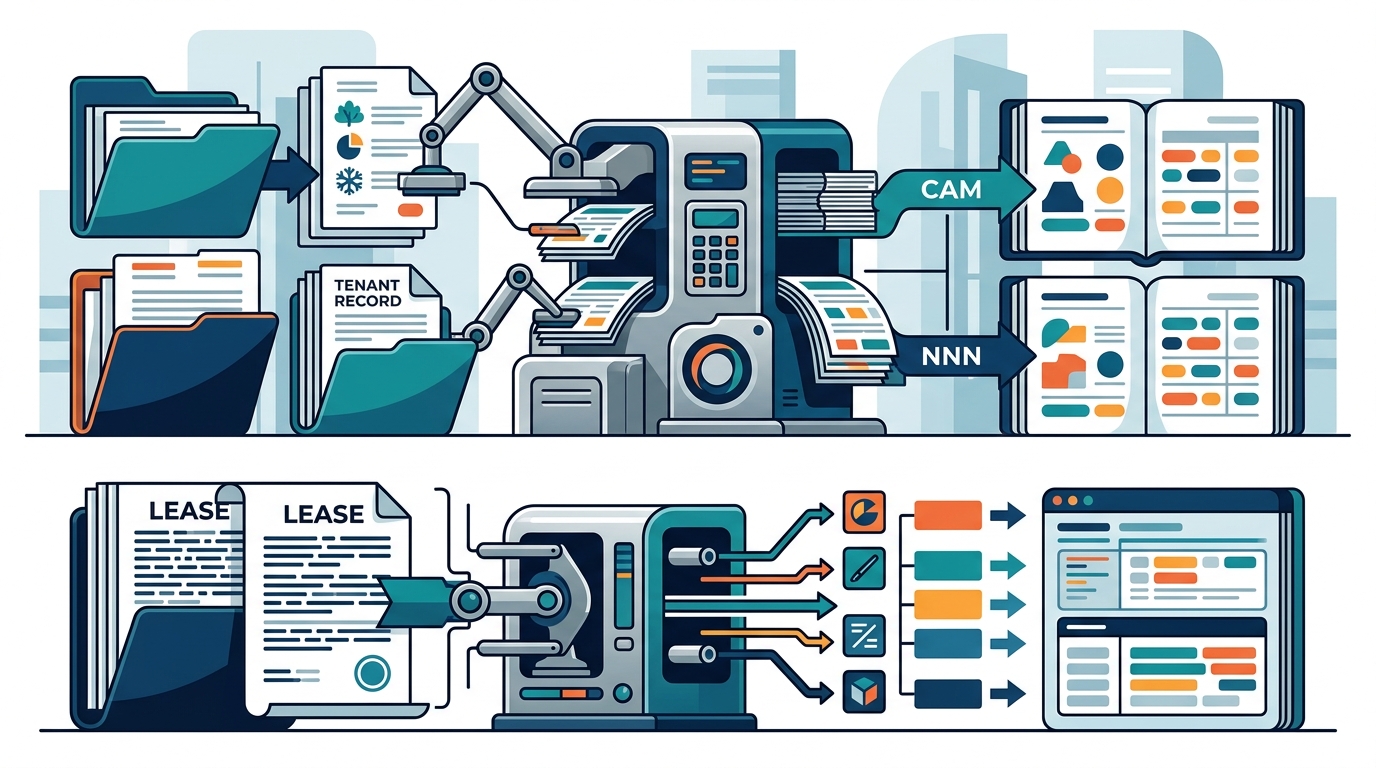
Common Area Maintenance (CAM) reconciliation is the process of calculating and recovering shared operating expenses from tenants based on lease terms. Traditional methods rely on spreadsheets and manual data entry, which introduces significant error rates and delays. Modern software automates this by ingesting general ledger data and matching it against lease-specific expense categories in real time.
Automated Expense Allocation
Effective CAM software must handle complex allocation logic, such as gross leasable area (GLA) ratios and expense caps. REIT AI financial triage executes GLA-based expense reconciliation automatically across the portfolio. This compresses recovery cycles from weeks of spreadsheet work to minutes of reviewed output. The system identifies variances between budgeted and actual expenses before invoices are paid.
Continuous Reconciliation
Static monthly reporting is insufficient for institutional portfolios. Continuous reconciliation ensures that anomalies surface in hours rather than at month-end. The software reconciles against the accounting system rather than in a monthly batch. This provides a live view of budget-to-actual variance with drivers identified per asset.
NNN Reconciliation Automation
Triple Net (NNN) lease reconciliation is the verification of tenant-paid expenses against actual property operating costs. In NNN structures, tenants are responsible for a significant portion of property taxes, insurance, and maintenance. Errors in this process lead to overbilling or underbilling, both of which damage tenant relationships and cash flow.
Invoice Review at Intake
Automation begins at the point of invoice receipt. Every vendor invoice is checked against contract terms, scope, and historical pricing before approval. Financial triage capabilities ensure that out-of-band pricing and duplicate work are flagged the moment they appear. This prevents cost anomalies from entering the general ledger.
Liability Resolution
Complex lease contracts are parsed instantly to determine maintenance liability and responsibility splits. The system resolves exposure before a vendor is ever dispatched. This ensures that the correct tenant is billed for the correct service, eliminating the need for manual contract review for every work order.
Lease Abstraction Tools
Lease abstraction is the process of extracting key data points from lease documents into a structured database. Manual abstraction is slow, prone to human error, and difficult to scale across large portfolios. Automated tools use natural language processing to digitize critical terms, rent rolls, and lease variables.
Automated Document Extraction
Advanced abstraction tools ingest entire document sets and extract critical terms automatically. Intelligent onboarding ingests and digitizes real estate portfolios in two weeks or less. This includes data mapping across existing CRE software, ERPs, and accounting databases. No rip-and-replace is required, and no manual migration work is needed from the client team.
Baseline Calibration
Historical financial data is modeled automatically to set CAM and NNN recovery baselines. This instant baseline calibration ensures that the operating layer is accurate from Day 1. The system establishes maintenance profiles and expense baselines that inform future reconciliation and budgeting.
Commercial Property Platforms
Commercial property platforms are comprehensive software ecosystems that manage the full lifecycle of real estate operations. These platforms integrate leasing, maintenance, financials, and compliance into a single interface. The choice of platform determines the level of automation and control an asset manager retains.
Autonomous Operation vs. Manual Oversight
Traditional platforms require human intervention for every task. Autonomous platforms, like Mondo OS, run the operation end to end while keeping the Asset Manager in charge. The autopilot executes tasks within defined rules, spend thresholds, and approval gates. This model removes the 8-12% management fee layer while maintaining full visibility.
Integration and Security
Enterprise-grade platforms must integrate with existing accounting, banking, CRM, and document stacks. Enterprise AI deploys custom environments inside the firm's architecture. This ensures data stays within the client's perimeter, with scoped access and encryption in transit and at rest. Every automated action is timestamped and reviewable by internal and external audit.
| Feature | Traditional Property Management | REIT AI Autonomous Platform |
|---|---|---|
| CAM/NNN Reconciliation | Manual spreadsheet work, monthly batches | Automated, continuous, GLA-based |
| Lease Abstraction | Manual data entry, high error rate | Automated extraction, instant baseline |
| Vendor Oversight | Reactive, post-invoice review | Proactive, pre-payment anomaly detection |
| Reporting | Stale, month-end compile | Real-time, board-ready NOI reporting |
| Cost Structure | 8-12% of gross rents | 1-3% of gross rents (platform fee) |
Key Takeaways
- CAM reconciliation software automates expense allocation and recovery, reducing cycle times from weeks to minutes.
- NNN automation verifies tenant-paid expenses against actual costs, preventing overbilling and underbilling.
- Lease abstraction tools use AI to extract critical terms from documents, eliminating manual data entry errors.
- Commercial property platforms should offer autonomous operation with human oversight, not just digital forms.
- Continuous reconciliation surfaces anomalies in hours, not at month-end, protecting Net Operating Income.
- Enterprise integration is critical; the platform must connect to existing accounting and banking systems without rip-and-replace.
- Auditability is a byproduct of normal operations in autonomous systems, providing regulator-ready compliance trails.
- Cost efficiency is achieved by replacing the 8-12% management fee layer with a 1-3% platform fee.
Frequently Asked Questions
What is CAM reconciliation in commercial real estate?
CAM reconciliation is the process of calculating and recovering shared operating expenses from tenants based on lease terms. It involves matching general ledger expenses against lease-specific categories and allocating costs based on metrics like GLA.
How does NNN lease automation work?
NNN automation uses software to verify tenant-paid expenses against actual property operating costs. It checks invoices against contract terms and historical pricing, flagging anomalies before payment is processed.
What is lease abstraction?
Lease abstraction is the process of extracting key data points from lease documents into a structured database. Automated tools use natural language processing to digitize critical terms, rent rolls, and lease variables.
Can AI replace property managers?
AI can replace the administrative and coordination functions of property management, such as invoice review and maintenance triage. However, it does not replace the strategic decision-making role of the Asset Manager, who retains control over rules and approvals.
How long does onboarding take for these platforms?
Onboarding for autonomous platforms like REIT AI typically takes two weeks or less. This includes platform configuration, data migration, and connection to existing systems. The clock starts once data and system access are provided.
Is the data secure in these platforms?
Enterprise-grade platforms use encryption in transit and at rest, least-privilege access, and complete audit trails. Data is not used to train third-party models, and controls are mapped to US and UK standards.
What is the cost of autonomous property management software?
Autonomous platforms are typically priced at 1-3% of gross rents, compared to 8-12% for traditional property management. Pricing is quoted per portfolio and includes a one-time onboarding fee.
Conclusion
Modernizing commercial property operations requires more than digitizing spreadsheets. It requires an autonomous operating engine that handles the full lifecycle of financial reconciliation and lease management. REIT AI provides this capability through its Mondo platform, which runs leasing, maintenance triage, vendor oversight, and compliance directly. By removing the traditional management layer, asset managers can protect Net Operating Income and maintain full control over their portfolios. To see how removing the management layer impacts your specific numbers, request a demo and explore the live environment against your own portfolio data.