

Real-Time NOI and Budget-vs-Actual Reporting for Institutional Real Estate
Real-time Net Operating Income (NOI) and budget-versus-actual reporting software is an automated financial intelligence layer that continuously reconciles revenue, expenses, and variances against portfolio targets. It replaces static, month-end spreadsheet cycles with live dashboards that flag anomalies as they occur. This guide covers how to evaluate, verify, and deploy these systems for institutional portfolios, including REITs, family offices, and sovereign wealth funds.
How to Choose: What Separates a Good Option from a Bad One
The primary differentiator in real-time reporting software is the depth of data ingestion. A basic tool might pull data from a general ledger, but a high-performance institutional platform must reconcile that data against lease contracts, vendor invoices, and historical baselines. Real-time reporting is the continuous, automated process of updating financial metrics as transactions occur, rather than waiting for a periodic batch cycle.
When evaluating vendors, look for systems that operate as an operating layer rather than a simple dashboard. A dashboard only shows what is already in your accounting system. An operating layer, such as the Mondo OS platform, actively triages maintenance requests and reviews invoices before they hit the books. This proactive approach ensures that the budget-versus-actual variance you see is accurate because the underlying data has already been validated.
Core Evaluation Criteria
- Granularity: Can the system report at the asset, unit, or even line-item level?
- Latency: Is the data truly real-time, or is it refreshed hourly or daily?
- Integration Depth: Does it connect to your banking and CRM, or just your ERP?
What to Ask: The Specific Questions to Ask Before Committing
Before signing a contract, you must interrogate the vendor's data pipeline. Ask how the system handles exceptions. If a vendor invoice is 15% higher than the historical average, does the system flag it for human review, or does it auto-approve it? Anomaly detection is the automated identification of data points that deviate significantly from expected patterns, serving as a primary control for financial leakage.
You should also ask about the governance model. Who has the authority to override an automated decision? In institutional environments, the Asset Manager must retain final control. Ensure the software allows you to set spend thresholds and approval gates that are enforced by the system. For example, financial triage capabilities should allow you to define exactly when a variance requires your signature versus when it can be processed automatically.
How to Verify: How to Check That a Claim or Credential is Real
Vendors often make broad claims about "AI-driven" reporting. To verify these, request a live demonstration using your own data. Do not accept a canned demo. A credible vendor will run a live environment against your portfolio numbers to show how the system identifies variances. This is a standard practice for institutional-grade software, where the proof is in the application to your specific asset class.
Verify security credentials by reviewing their published documentation. Look for a Security & Compliance page that details encryption in transit and at rest, as well as their audit trail capabilities. Ensure they provide a Data Processing Addendum (DPA) and a Master Subscription Agreement (MSA) that clearly define data ownership and usage rights. If a vendor cannot provide these legal documents, they are not ready for institutional deployment.
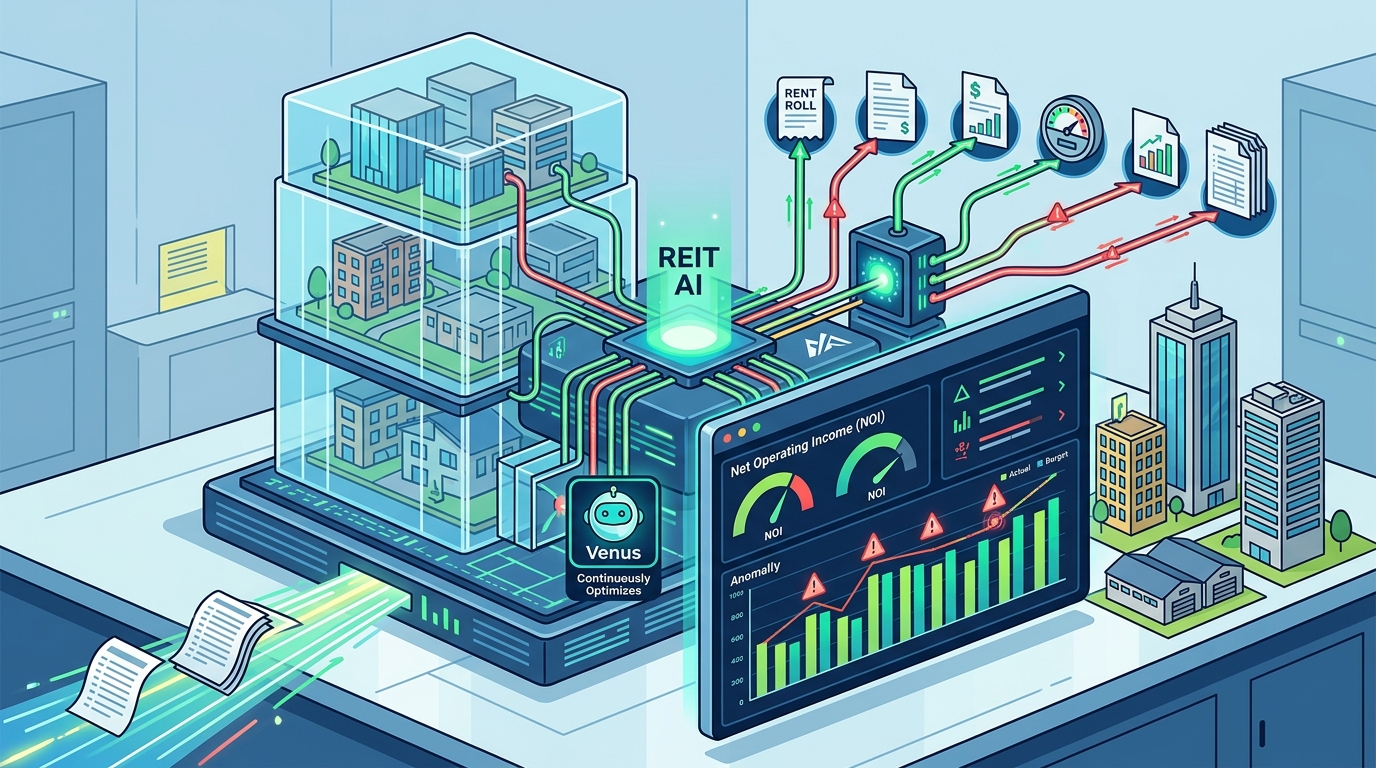
How It Works: What Happens, in What Order, and How Long It Takes
Deploying real-time reporting software is a phased process. It begins with data ingestion, where the system maps your existing data from legacy ERPs and accounting databases. Intelligent onboarding is the automated process of digitizing and mapping legacy portfolio data into a new operating environment without manual entry.
Once the data is mapped, the system establishes a baseline. It analyzes historical financial data to set recovery baselines for CAM and NNN expenses. After the baseline is calibrated, the system goes live. From that point on, every invoice, lease payment, and maintenance request is processed through the automated triage engine. The entire process, from initial data provision to live operation, typically takes two weeks or less for a well-structured portfolio.
What It Costs: What Drives the Price Up or Down
Pricing for institutional real estate software is rarely a simple per-user fee. It is typically driven by the scale of the portfolio and the complexity of the integrations. For residential and HOA portfolios, pricing is often a flat per-unit monthly fee. For enterprise and commercial portfolios, pricing is usually based on the square footage of gross leasable area (GLA).
The cost is driven up by the need for custom integrations. If you are using a bespoke accounting system or a unique banking stack, the onboarding fee will be higher to cover the API development. However, this cost is usually offset by the reduction in the traditional property management fee. Traditional managers charge 8-12% of gross rents, while an AI operating layer typically lands at 1-3% of gross rents. You can review the specific pricing models on the Mondo Pricing page to understand how these tiers apply to your asset mix.
What Goes Wrong: The Common Mistakes and How to Avoid Them
The most common mistake is treating the software as a "set it and forget it" tool. If you do not define your governance rules clearly, the system will operate with default settings that may not align with your risk tolerance. Another frequent error is poor data hygiene. If your legacy data is messy, the AI will inherit that mess. You must ensure that your rent rolls and vendor contracts are clean before onboarding.
Finally, avoid the "black box" trap. If you cannot see the logic behind a recommendation, you cannot trust it. The software must provide a defensible audit trail for every automated action. This ensures that when an auditor asks why a specific expense was approved, you can show the exact data points and rules that led to that decision.
Versus Alternatives: How This Compares to the Alternatives
Traditional property management companies and legacy ERP systems offer reporting, but they are fundamentally different in their approach. The table below summarizes the key differences between these options and an AI operating layer.
| Feature | Traditional Property Management | Legacy ERP / Dashboard | AI Operating Layer (e.g., Mondo) |
|---|---|---|---|
| Reporting Frequency | Monthly / Quarterly | Real-time (but passive) | Real-time (with active triage) |
| Cost Structure | 8-12% of Gross Rents | Per User / Per Module | 1-3% of Gross Rents |
| Anomaly Handling | Manual Review | None / Basic Alerts | Automated Detection & Escalation |
| Control | Delegated to Manager | Owner Controlled | Owner Controlled (with AI assistance) |
The key advantage of an AI operating layer is that it removes the human error and latency associated with traditional management while retaining the owner's control. It does not replace the Asset Manager; it empowers them with a 24/7 autonomous assistant that handles the routine work.
For a Specific Situation: How the Answer Changes for a Particular Case
The ideal software configuration changes depending on the type of institutional investor. For a REIT, the priority is portfolio-wide consistency. You need a system that can enforce the same spend thresholds and approval gates across hundreds of assets. The reporting must be board-ready, providing a consolidated view of NOI and OpEx across the entire fund.
For a Family Office, the priority is discretion and lean operations. These clients often have small teams but large portfolios. They need a system that provides 24/7 coverage without requiring them to hire a full-time property management team. The software must allow principals to set rules and approve spend directly, ensuring that nothing is delegated to an opaque third party.
Rules and Protections: The Rules, Rights or Protections that Apply
Institutional software must operate within a strict governance framework. This includes jurisdiction-aware compliance, where the system maps controls to local requirements while rolling up reporting to a single standard. Auditability is the property of a system that maintains a complete, timestamped record of every action, allowing for internal and external review.
REIT AI provides a Security & Compliance framework that includes encryption in transit and at rest, least-privilege access, and a complete audit trail. The system is designed to be regulator-ready by default, with controls mapped to US and UK standards. This ensures that your reporting is not only accurate but also defensible in the event of an audit.
Local Specifics: What is Specific to the Areas Served
While the core technology is global, the application of real-time reporting must account for local market dynamics. In the US, for example, the focus is often on CAM and NNN recovery for commercial assets and HOA dues for residential. In the UK, the focus may shift to different lease structures and compliance standards.
REIT AI operates with global hubs in Miami and Rome, allowing for trilingual and multilingual leadership. This global presence ensures that the software can handle cross-border mandates and investor relationships. The system is designed to standardize the operating layer beneath different jurisdictions, providing one rule set and one audit trail for global portfolios.
Timing: When to Act and How Timing Changes the Outcome
The best time to deploy real-time reporting software is before you face a significant operational challenge. If you are preparing for a capital raise or a major acquisition, having a live, auditable view of your portfolio's performance is a significant advantage. It demonstrates to investors that you have institutional-grade controls in place.
Conversely, if you are already experiencing financial leakage or compliance issues, the urgency is higher. The longer you wait, the more data you lose and the harder it becomes to establish a clean baseline. Deploying the system early allows you to catch anomalies at intake rather than at month-end, protecting your NOI from the very first day of operation.
Results Over Time: Measurable Outcomes and What to Expect Long Term
In the short term, you should expect a reduction in the time spent on manual reconciliation. Tasks that previously took weeks of spreadsheet work are compressed to minutes of reviewed output. In the medium term, you will see a reduction in operating costs as the system identifies and eliminates inefficiencies. In the long term, the system provides a defensible trail of every decision, which is invaluable for audits and investor reporting.
While specific results vary by client and portfolio, the goal is to achieve a significant reduction in operating costs year over year. By removing the traditional management layer and replacing it with an AI operating layer, you can protect your Net Operating Income and improve the overall efficiency of your portfolio. To see what this looks like in practice, you can request a demo to see the system run against your own numbers.
Key Takeaways
- Real-time reporting is not just about speed; it is about the depth of data validation and anomaly detection.
- An AI operating layer replaces the 8-12% management fee with a 1-3% platform fee, significantly improving NOI.
- The Asset Manager must retain full control over rules, thresholds, and approvals in any institutional deployment.
- Intelligent onboarding can digitize and map legacy data in two weeks or less, with no manual entry required.
- Security and compliance are non-negotiable; look for encryption, audit trails, and jurisdiction-aware controls.
- The ideal software configuration depends on the investor type, whether it is a REIT, family office, or sovereign wealth fund.
- Deploying the system early provides a significant advantage for capital raises and acquisitions.
- Long-term results include reduced operating costs and a defensible audit trail for every automated action.
Frequently Asked Questions
What is the difference between a dashboard and an operating layer?
A dashboard is a passive tool that displays data from your existing systems. An operating layer is an active system that processes transactions, triages requests, and reviews invoices before they are finalized. The operating layer ensures that the data in the dashboard is accurate and validated.
How long does it take to deploy real-time reporting software?
Deployment typically takes two weeks or less. This includes the time to map your legacy data, calibrate the baseline, and connect the system to your accounting and banking stack. The exact timeline depends on the complexity of your existing infrastructure.
Does the software replace my property manager?
No, the software replaces the administrative layer of property management. It handles the routine tasks like leasing response, maintenance triage, and invoice review. The Asset Manager or property manager retains control over strategic decisions and approvals.
How does the system handle compliance?
The system is designed to be regulator-ready by default. It includes controls mapped to US and UK standards and provides a complete audit trail for every action. This ensures that your reporting is compliant with local requirements while rolling up to a single standard.
What is the cost of real-time reporting software?
Cost is typically driven by the scale of the portfolio and the complexity of the integrations. For residential portfolios, it is a per-unit fee. For commercial portfolios, it is a per-square-foot fee. The total cost is usually 1-3% of gross rents, which is significantly lower than the 8-12% charged by traditional property managers.
Can I see the logic behind the AI's recommendations?
Yes, the system provides a defensible audit trail for every automated action. You can see the exact data points and rules that led to a specific recommendation. This transparency is essential for institutional investors who need to justify their decisions to auditors and investors.
Conclusion
Real-time NOI and budget-versus-actual reporting is no longer a luxury for institutional real estate portfolios; it is a necessity for protecting Net Operating Income and ensuring operational efficiency. By choosing an AI operating layer that provides active triage, anomaly detection, and full auditability, you can replace the costly and opaque traditional management layer with a transparent and efficient system. REIT AI provides the infrastructure to make this transition, allowing you to take the management layer out of your portfolio and see what up to 40% lower operating cost does to your NOI. To get started, request a demo to see the system in action.