

REIT AI provides the secure AI property management platform for REITs, institutional investors, and sovereign wealth funds. It operates inside your existing architecture with strict data isolation and custom deployment controls. This guide covers the two critical security pillars: custom deployment architectures and client data isolation.
Custom Deployment Architectures
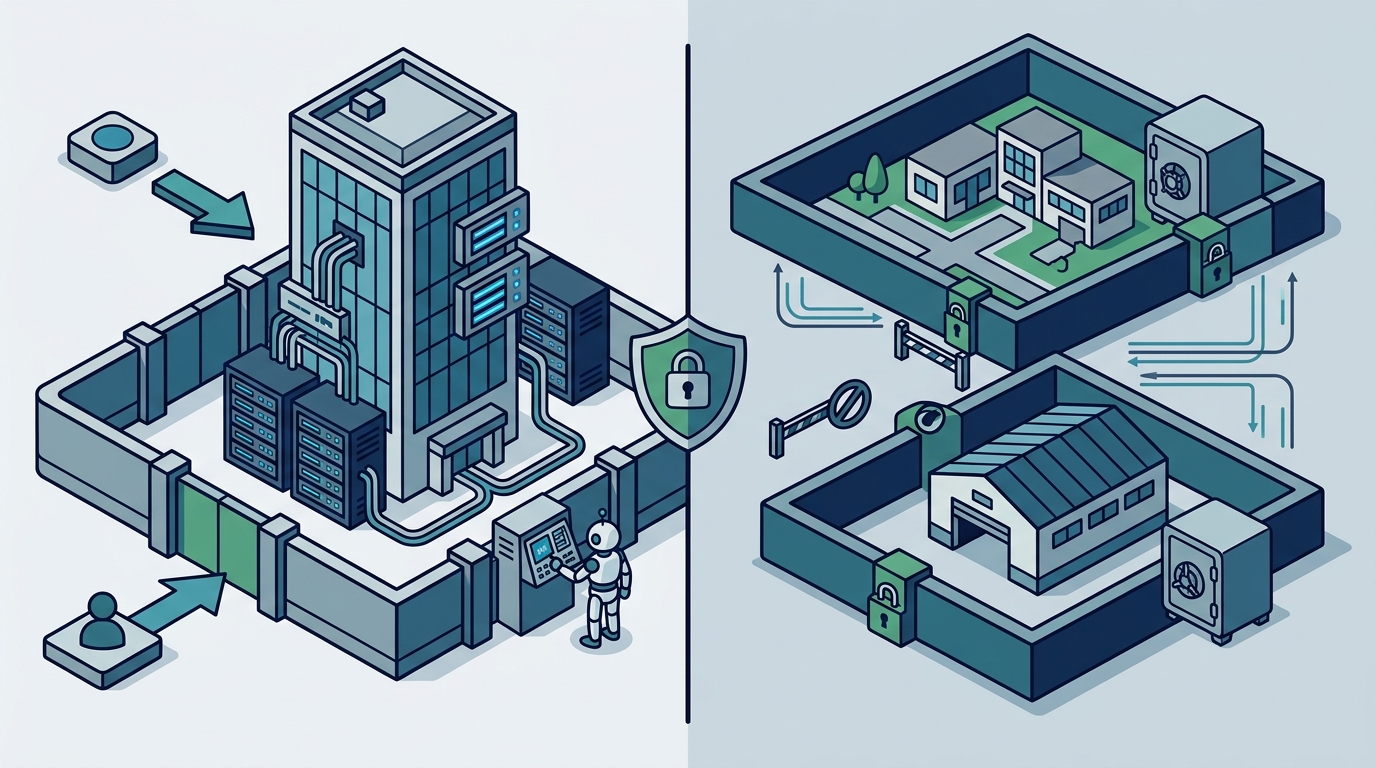
Institutional real estate portfolios cannot rely on generic, multi-tenant SaaS environments where data commingling is a structural risk. A custom deployment architecture is a software configuration where the AI operating layer is built directly inside the client's own system perimeter. This approach ensures that sensitive portfolio data, financial records, and tenant information never leave the client's controlled infrastructure.
Integration with Existing Stacks
REIT AI's Enterprise AI product deploys custom Claude environments within your firm's architecture. This means the platform connects to your existing accounting, banking, CRM, and document systems without requiring a rip-and-replace migration. The AI layer consolidates data management, back-office administration, and accounting into a single intelligent interface that respects your current operational workflows. By deploying inside your architecture, the system maintains scoped access and full software connectivity with the tools you already own.
Scoped Access and Audit Trails
Security in a custom deployment begins with least-privilege access. Every automated action taken by the AI is governed by strict permission boundaries defined by the Asset Manager. The system enforces these rules through a complete audit trail, where every recommendation, approval, and execution is timestamped and reviewable. This level of granularity is essential for institutions that must demonstrate control over their operational data to regulators and auditors.
Why Generic SaaS Falls Short
Traditional property management software often operates in shared cloud environments where data from multiple clients resides in the same database. While these platforms may use encryption, they cannot guarantee logical isolation at the architectural level. For sovereign wealth funds and large REITs, this shared environment presents an unacceptable risk profile. A custom deployment ensures that your data is physically or logically segregated in a way that generic platforms cannot replicate.
Client Data Isolation
Client data isolation is the technical and procedural framework that ensures one client's data is completely inaccessible to any other client or unauthorized party. In the context of institutional real estate, this isolation extends beyond simple encryption to include jurisdiction-aware compliance and strict data handling protocols.
Encryption and Data Handling
REIT AI implements encryption for data both in transit and at rest. This ensures that even if data is intercepted during transmission or accessed on storage media, it remains unreadable without the proper decryption keys. Furthermore, the platform does not use client data to train third-party AI models. This policy is critical for maintaining the confidentiality of proprietary portfolio strategies and tenant information.
Jurisdiction-Aware Compliance
Institutional investors often operate across multiple jurisdictions with varying data protection laws. REIT AI's platform maps controls to US and UK standards, ensuring that data handling complies with local regulations while reporting rolls up to a single, consistent format. This jurisdiction-aware approach allows sovereign wealth funds and global REITs to maintain a standardized operating layer without compromising local legal requirements.
Legal Documentation and Governance
Transparency in data handling is supported by comprehensive legal documentation. REIT AI publishes its Data Processing Addendum (DPA), Master Subscription Agreement (MSA), and Privacy Policy for review before deployment. These documents clearly define the roles of the service provider and the customer, outlining how data is processed, stored, and protected. This level of contractual clarity is a hallmark of institutional-grade security.
| Security Feature | Generic SaaS Platform | REIT AI Custom Deployment |
|---|---|---|
| Deployment Model | Shared multi-tenant cloud | Inside client's own architecture |
| Data Isolation | Logical separation in shared DB | Physical or strict logical isolation |
| AI Training Data | Often used for model improvement | Never used to train third-party models |
| Compliance Mapping | Generic global standards | Jurisdiction-aware (US/UK) |
| Audit Trail | Basic user logs | Complete, timestamped action trail |
Key Takeaways
- Custom deployment architectures place the AI layer inside the client's own system perimeter, preventing data from leaving the controlled environment.
- Client data isolation ensures that one client's data is completely inaccessible to others, a critical requirement for institutional investors.
- REIT AI does not use client data to train third-party AI models, preserving the confidentiality of proprietary portfolio strategies.
- Jurisdiction-aware compliance allows global portfolios to operate under a single platform while meeting local US and UK data protection standards.
- Complete audit trails with timestamped actions provide the transparency required for internal and external audits.
- Legal documentation, including DPAs and MSAs, is published for review before deployment, ensuring contractual clarity on data handling.
- Generic SaaS platforms often rely on shared cloud environments, which present higher data commingling risks than custom deployments.
- Scoped access and least-privilege controls ensure that automated actions are strictly governed by Asset Manager-defined rules.
Frequently Asked Questions
How does REIT AI ensure data isolation for multi-asset portfolios?
REIT AI uses a custom deployment architecture that operates inside the client's own system architecture. This ensures that data is isolated within the client's perimeter, with strict access controls and encryption preventing unauthorized access or data commingling.
Can REIT AI integrate with our existing accounting and banking systems?
Yes. The Enterprise AI product is designed to connect with your existing operational tools, including accounting, banking, CRM, and document systems. It consolidates these into one intelligent interface without requiring a rip-and-replace migration.
Is our data used to train AI models?
No. REIT AI has a strict policy against using client data to train third-party AI models. Your data remains confidential and is used solely to operate your specific portfolio within the agreed-upon parameters.
What compliance standards does REIT AI support?
The platform is mapped to US and UK standards, with jurisdiction-aware compliance controls. This allows institutions operating across different regions to maintain a consistent reporting format while adhering to local data protection laws.
How is the audit trail structured?
Every automated and approved action is captured with a defensible trail. Each action is timestamped and reviewable by internal and external auditors, providing complete visibility into the operational history of the portfolio.
Does REIT AI replace our existing property management software?
REIT AI deploys as an operating layer on top of your existing stack. It does not require you to rip out your current systems but rather integrates with them to provide AI-driven automation and visibility.
Who controls the rules and approvals within the platform?
The Asset Manager retains full control. They define the rules, spend thresholds, and approval gates. The AI executes within these boundaries, ensuring that the human operator remains in charge of all critical decisions.
Conclusion
For REITs, institutional investors, and sovereign wealth funds, security is not a feature; it is the foundation of trust. REIT AI addresses this need by providing a platform that operates within your own architecture, ensuring strict data isolation and jurisdiction-aware compliance. By choosing a custom deployment model, you retain full control over your data while leveraging the efficiency of AI-driven operations. To see how this architecture works in practice, request a demo of the REIT AI platform.