

Automating CAM and NNN Reconciliation and Lease Abstraction in Commercial Real Estate
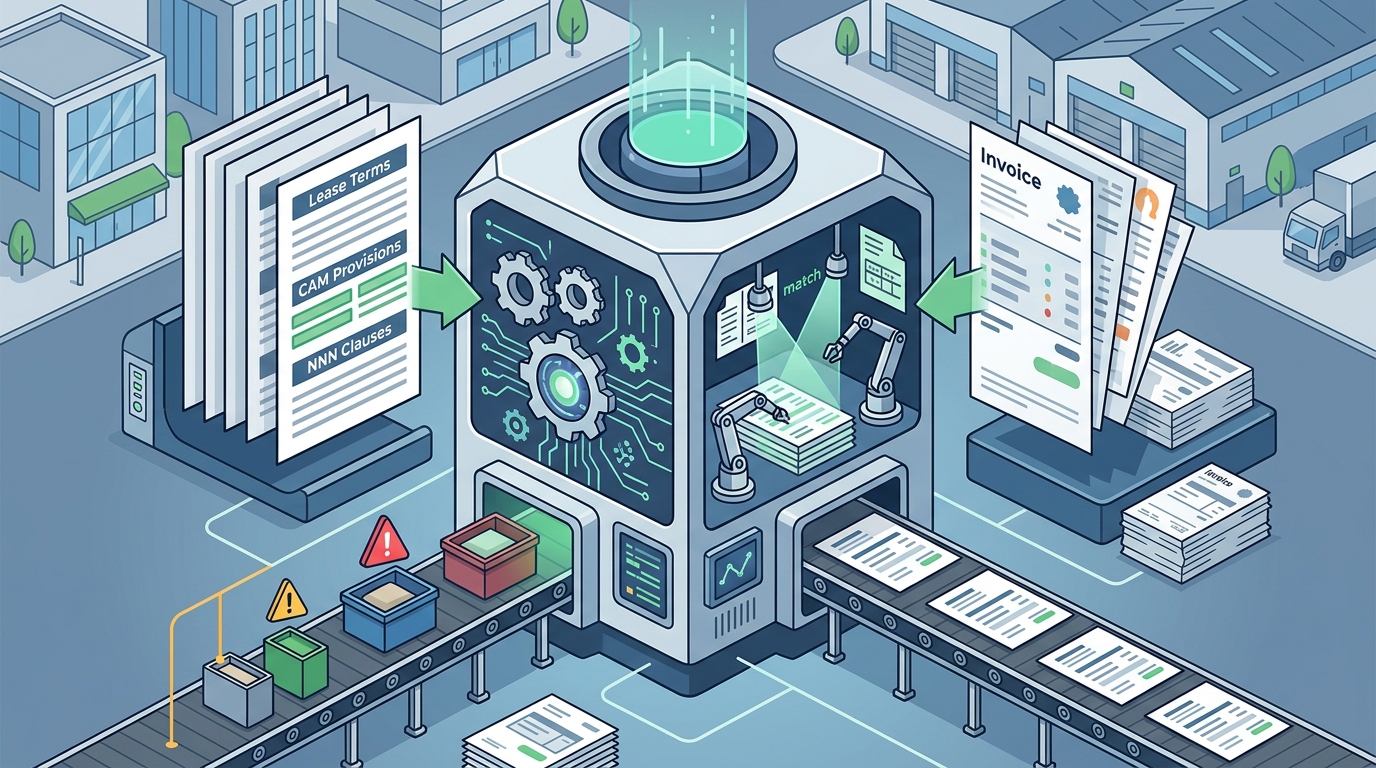
Commercial property software automates CAM and NNN reconciliation by parsing lease terms, matching invoices to contractual obligations, and flagging variances in real time. REIT AI provides an AI operating layer that handles these financial workflows alongside lease abstraction, removing manual spreadsheet work from institutional portfolios. This guide covers the specific tools, automation mechanics, and platform capabilities required to modernize commercial property accounting.
CAM Reconciliation Software
CAM reconciliation is the process of verifying that Common Area Maintenance charges billed to tenants align with the specific expense categories and caps defined in their leases. Traditional methods rely on manual spreadsheet work, which is prone to error and slow to execute. Modern software automates this by extracting expense data from invoices and matching it against lease variables.
Automated Expense Mapping
Effective CAM software maps general ledger accounts to lease-specific expense categories automatically. It identifies which costs are recoverable and which are excluded based on the lease terms. This mapping occurs at the invoice intake stage, ensuring that only valid charges proceed to the reconciliation queue.
Continuous Reconciliation
Unlike monthly batch processing, advanced platforms reconcile data continuously. They compare budget-to-actual variances in real time, allowing property managers to identify anomalies before they become significant financial discrepancies. This continuous approach replaces the month-end scramble with a steady, auditable workflow.
NNN Reconciliation Automation
Triple Net (NNN) reconciliation is the verification process ensuring that tenants pay their proportional share of property taxes, insurance, and operating expenses. In NNN leases, the landlord passes these costs directly to the tenant, making accurate calculation critical for cash flow. Automation in this area focuses on precise allocation and variance detection.
Proportional Share Calculation
Software calculates each tenant's share of expenses based on their square footage or gross leasable area (GLA). It handles complex allocation methods, including pro-rata shares and fixed amounts, without manual intervention. The system updates these calculations as lease terms change or as new tenants occupy space.
Invoice Exception Handling
Automated systems flag invoices that deviate from historical pricing or contract terms. If a vendor invoice exceeds the expected cost for a specific service, the system pauses the reconciliation and alerts the asset manager for review. This prevents overbilling tenants and protects the property's net operating income.
Lease Abstraction Tools
Lease abstraction is the process of extracting key terms from lease documents and converting them into structured data. This data drives all subsequent financial calculations, including CAM and NNN reconciliations. Manual abstraction is time-consuming and inconsistent, whereas automated tools provide accuracy and speed.
Document Parsing and Extraction
AI-driven tools parse PDFs and scanned documents to identify critical variables such as rent, expense caps, and maintenance responsibilities. They extract these terms into a standardized format that integrates with property management systems. This eliminates the need for manual data entry and reduces the risk of transcription errors.
Liability Determination
Advanced abstraction tools determine maintenance liability and responsibility splits based on lease language. They identify which party is responsible for specific repairs or capital improvements. This information is used to triage maintenance requests and ensure that costs are allocated correctly between the landlord and tenant.
Commercial Property Platforms
Commercial property platforms are comprehensive software solutions that manage the entire lifecycle of real estate assets. They integrate leasing, maintenance, financials, and reporting into a single interface. For institutional investors, the choice of platform determines the level of automation and visibility available across the portfolio.
Integration with Existing Stacks
Modern platforms deploy inside existing accounting, banking, and CRM systems. They do not require ripping out legacy infrastructure but instead layer automation on top of it. This approach ensures that data flows seamlessly between systems, providing a unified view of operations.
Comparison of Automation Capabilities
| Feature | Traditional Property Management | AI-Driven Operating Layer |
|---|---|---|
| CAM Reconciliation | Manual spreadsheet work, monthly cycles | Automated, continuous, real-time variance reporting |
| Lease Abstraction | Manual data entry, high error rate | AI parsing, structured data extraction |
| Invoice Review | Post-payment review, reactive | Pre-payment anomaly detection, proactive |
| Reporting | Stale, compiled at month-end | Live, board-ready, real-time |
Key Takeaways
- CAM reconciliation software automates the mapping of general ledger accounts to lease-specific expense categories.
- NNN reconciliation automation ensures accurate proportional share calculations for taxes, insurance, and operating expenses.
- Lease abstraction tools extract key terms from documents, reducing manual data entry and errors.
- Continuous reconciliation replaces monthly batch processing with real-time variance detection.
- AI-driven platforms integrate with existing accounting and banking systems without requiring rip-and-replace.
- Automated invoice review flags anomalies before payment, protecting net operating income.
- Institutional investors benefit from standardized rule sets and audit trails across multi-asset portfolios.
Frequently Asked Questions
What is CAM reconciliation in commercial real estate?
CAM reconciliation is the process of verifying that Common Area Maintenance charges billed to tenants align with the specific expense categories and caps defined in their leases. It ensures that tenants are only charged for recoverable costs.
How does NNN reconciliation differ from CAM reconciliation?
NNN reconciliation focuses on verifying that tenants pay their proportional share of property taxes, insurance, and operating expenses. CAM reconciliation focuses on common area maintenance costs. Both require accurate lease data and expense mapping.
Can software automatically abstract lease terms?
Yes, AI-driven tools can parse lease documents and extract key terms such as rent, expense caps, and maintenance responsibilities. This structured data drives financial calculations and reduces manual data entry.
What is the role of an AI operating layer in property management?
An AI operating layer automates routine tasks such as invoice review, maintenance triage, and financial reconciliation. It provides real-time visibility and allows asset managers to set rules and approve actions without handling manual coordination.
How does continuous reconciliation improve financial reporting?
Continuous reconciliation provides real-time variance reporting, replacing stale month-end compiles. This allows for proactive management of expenses and ensures that board-ready reports are always current.
Do AI platforms replace property management companies?
AI platforms can replace the manual coordination layer of property management, reducing operating costs. However, they do not replace the strategic decision-making role of asset managers, who retain control over rules and approvals.
Conclusion
Automating CAM and NNN reconciliation and lease abstraction is essential for modernizing commercial real estate operations. REIT AI provides an enterprise-grade AI operating engine that handles these financial workflows, protecting net operating income and producing regulator-ready compliance. By deploying inside your existing architecture, the platform offers full visibility and control without requiring a complete system overhaul. To see how removing the management layer impacts your portfolio, request a demo with REIT AI.