

REITs, institutional investors, and sovereign wealth funds require AI property management platforms that enforce strict data isolation and custom deployment architectures. REIT AI provides these controls through its Mondo OS and Enterprise AI products, ensuring that sensitive portfolio data remains within the client's perimeter. This guide covers the specific security frameworks, deployment models, and compliance standards necessary for institutional-grade real estate operations.
Custom Deployment Architectures
Institutional real estate portfolios cannot rely on generic, multi-tenant SaaS environments where data commingles with other users. A custom deployment architecture is a software configuration where the AI infrastructure is built directly inside the client's existing system architecture. This approach ensures that data management, back-office administration, and accounting are consolidated into a single intelligent interface that respects the firm's specific security boundaries.
Inside the Client Perimeter
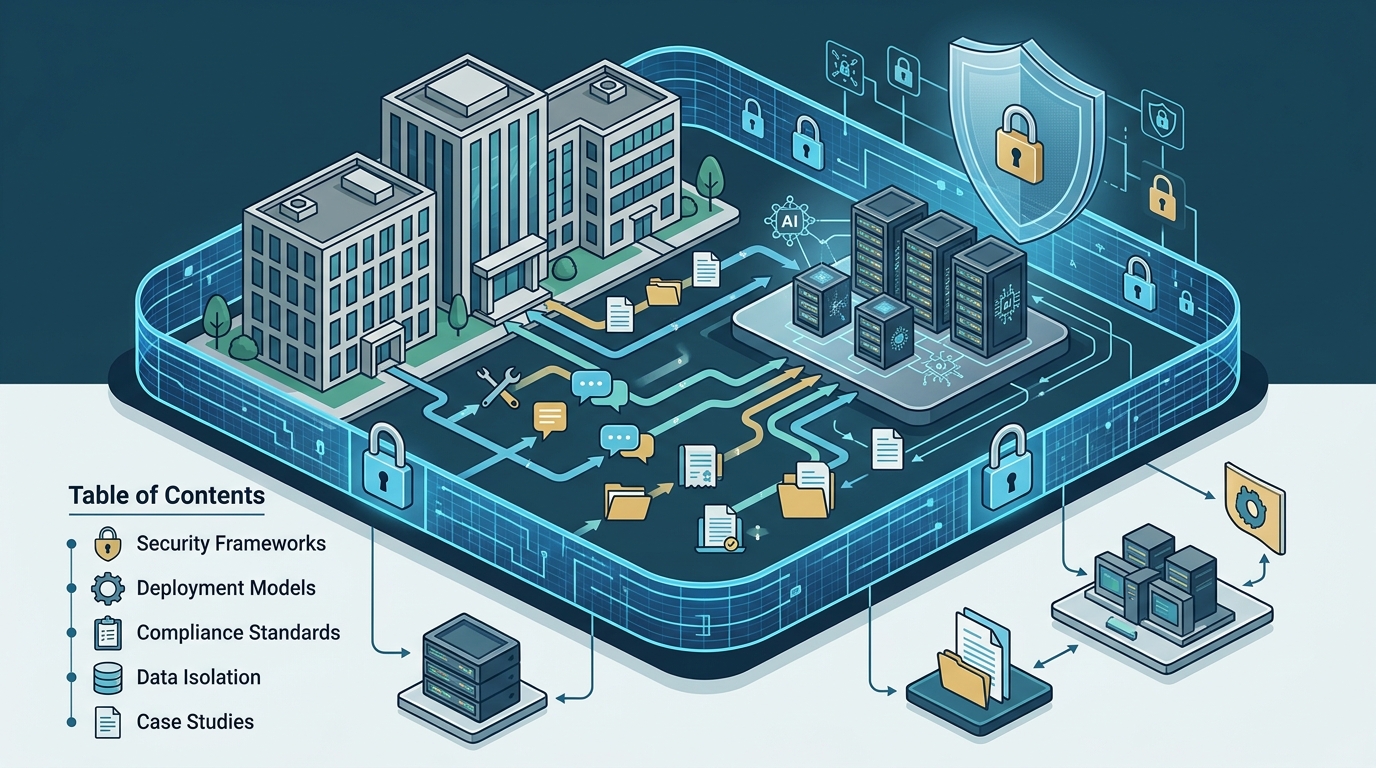
REIT AI deploys custom Claude environments that operate within the client's own infrastructure. This means that sensitive portfolio data, tenant records, and financial ledgers do not leave the client's perimeter. The platform connects to existing operational tools, including accounting systems, banking interfaces, and CRM platforms, without requiring a rip-and-replace migration. This integration strategy preserves the integrity of the client's existing security protocols while adding an intelligent layer on top.
Scoped Access and Integration
Integrations are scoped per system and reviewed with the client's IT team. This ensures that the AI platform only accesses the data necessary for its specific functions. For example, the maintenance triage module may access work order data, while the financial reconciliation module accesses general ledger entries. This granular access control prevents data leakage and ensures that the AI operates within defined boundaries. The deployment is revocable at any time, giving the client full control over their data and system access.
Client Data Isolation
Encryption and Access Controls
All data is encrypted in transit and at rest. This ensures that even if data is intercepted during transmission or accessed from storage, it remains unreadable without the appropriate decryption keys. Access controls follow the principle of least privilege, meaning that users and systems only have access to the data they need to perform their specific functions. This minimizes the attack surface and reduces the risk of internal data breaches.
No Third-Party Training
A critical aspect of data isolation is ensuring that client data is not used to train third-party AI models. REIT AI explicitly states that it does not use client data to train third-party models. This commitment is crucial for institutional clients who are concerned about data privacy and the potential leakage of proprietary information into public AI models. The platform's privacy policy and data processing addendum clearly outline these commitments, providing legal and technical assurance to clients.
Compliance and Auditability
Regulatory compliance is a non-negotiable requirement for REITs and institutional investors. A compliant AI platform is one that generates regulator-ready compliance reports as a byproduct of normal operations, rather than requiring a quarterly scramble to gather data. REIT AI's platform is built around FCA, FINRA, and SEC governance requirements from day one, ensuring that every action is captured with a defensible trail.
Jurisdiction-Aware Controls
For sovereign wealth funds and global institutional investors, compliance is not one-size-fits-all. REIT AI's platform features jurisdiction-aware compliance controls that map to local requirements while rolling up reporting to one consistent format. This allows clients to operate across multiple jurisdictions without maintaining separate compliance systems for each region. The platform supports US and UK standards, with the ability to extend to other regulatory frameworks as needed.
Complete Audit Trails
Every automated and approved action is timestamped and reviewable by internal and external audit. This complete audit trail ensures that clients can demonstrate compliance to regulators and investors. The audit trail includes details of who approved an action, when it was executed, and what data was accessed. This level of transparency is essential for maintaining trust with stakeholders and meeting regulatory requirements.
Governance Models and Approval Gates
Governance in AI property management is the set of rules, thresholds, and approval processes that define how the AI system operates. REIT AI's platform allows the Asset Manager to define these rules, ensuring that the AI operates within the client's risk appetite. The system enforces these rules automatically, reducing the risk of human error and ensuring consistent decision-making.
Spend Thresholds and Approval Gates
Clients can define spend thresholds that trigger approval gates. For example, any maintenance request below a certain amount may be approved automatically, while requests above that amount require manual approval from the Asset Manager. This ensures that the AI can handle routine tasks efficiently while keeping human oversight for high-value decisions. The approval gates are enforced by the system, ensuring that no action is taken without the appropriate authorization.
Escalation Paths
The platform includes defined escalation paths for situations that fall outside the predefined rules. If an AI action is flagged as anomalous or if a request exceeds a spend threshold, the system escalates the issue to the appropriate human operator. This ensures that exceptions are handled promptly and that the AI does not operate in a vacuum. The escalation paths are configurable, allowing clients to tailor the governance model to their specific needs.
Platform Security Comparison
When evaluating AI property management platforms, institutional investors should consider the following security and compliance features. The table below compares key features of REIT AI's platform with typical generic SaaS platforms.
| Feature | REIT AI (Mondo OS / Enterprise AI) | Generic SaaS Platform |
|---|---|---|
| Deployment Model | Custom deployment inside client architecture | Multi-tenant cloud SaaS |
| Data Isolation | Strict isolation, no third-party training | Shared infrastructure, potential data commingling |
| Encryption | In transit and at rest | In transit, variable at rest |
| Compliance | Jurisdiction-aware, regulator-ready by default | Basic compliance, manual reporting |
| Audit Trail | Complete, timestamped, reviewable | Limited, often not audit-ready |
| Governance | Configurable spend thresholds and approval gates | Fixed rules, limited configurability |
Key Takeaways
- Custom deployment architectures ensure that AI platforms operate within the client's security perimeter.
- Client data isolation prevents data leakage and ensures that client data is not used for third-party training.
- Jurisdiction-aware compliance controls allow global investors to operate across multiple regulatory frameworks.
- Complete audit trails provide a defensible record of every automated and approved action.
- Configurable governance models allow clients to define spend thresholds and approval gates.
- REIT AI's platform is built around FCA, FINRA, and SEC governance requirements from day one.
- Integration with existing systems preserves the integrity of the client's existing security protocols.
- Strict access controls follow the principle of least privilege to minimize the attack surface.
Frequently Asked Questions
What is a custom deployment architecture in AI property management?
A custom deployment architecture is a software configuration where the AI infrastructure is built directly inside the client's existing system architecture, ensuring that data remains within the client's perimeter.
How does REIT AI ensure client data isolation?
REIT AI ensures client data isolation through strict encryption, access controls, and a commitment not to use client data to train third-party AI models.
What compliance standards does REIT AI support?
REIT AI supports FCA, FINRA, and SEC governance requirements, with jurisdiction-aware controls for US and UK standards.
Can the AI platform be configured to require human approval for high-value actions?
Yes, REIT AI's platform allows clients to define spend thresholds and approval gates, ensuring that high-value actions require human approval.
Is REIT AI a licensed financial or legal advisor?
No, REIT AI provides operations software and automation for real estate owners and investors. It is not a licensed financial, investment, tax, or legal advisor.
How does the platform handle data encryption?
All data is encrypted in transit and at rest, ensuring that data remains secure even if intercepted during transmission or accessed from storage.
What is the role of the Asset Manager in REIT AI's platform?
The Asset Manager defines the rules, thresholds, and approval gates that govern the AI's operations, ensuring that the system operates within the client's risk appetite.
Can the platform be integrated with existing accounting and CRM systems?
Yes, REIT AI's platform connects to existing operational tools, including accounting systems, banking interfaces, and CRM platforms, without requiring a rip-and-replace migration.