

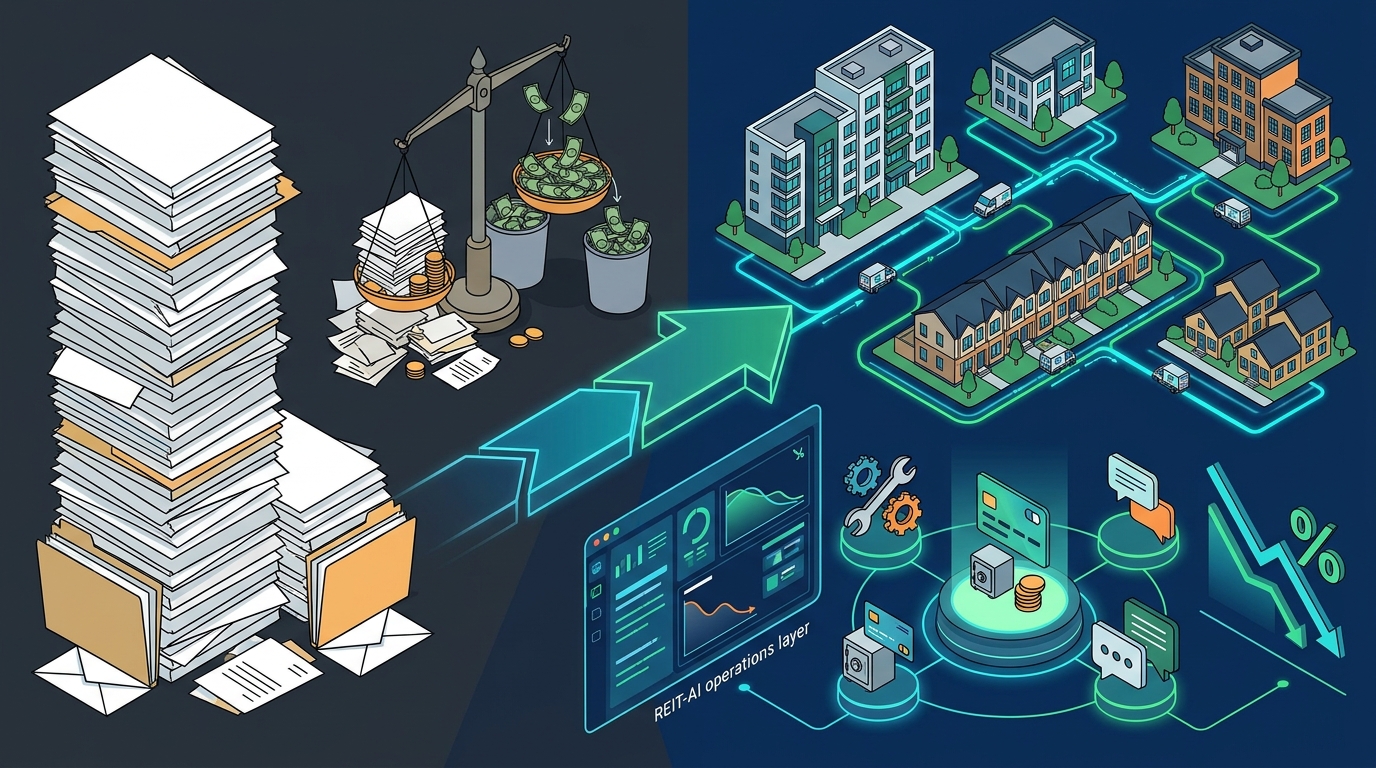
Many property owners feel that traditional management fees of 8-12% of gross rents are too high for the level of service received. Buildium is a popular software tool, but it is often used alongside a human management company, meaning the high fee structure remains. If you are looking for ways to reduce this cost, you need to look at platforms that automate the actual work rather than just digitizing the paperwork. REIT AI offers a different approach by providing an AI operating layer that handles operations directly, potentially lowering your total cost of ownership significantly.
1. REIT AI (Mondo OS)
REIT AI replaces the management layer entirely, aiming for up to 40% lower operating costs.
REIT AI is an enterprise-grade AI operating engine designed for institutional real estate. It does not just track data; it runs the operation. The platform, known as Mondo, handles leasing, maintenance triage, vendor oversight, and invoice review. By removing the third-party property management layer, you eliminate the 8-12% fee associated with human coordinators. Instead, you pay a platform fee that is typically 1-3% of gross rents, which is a fraction of the traditional cut.
2. Yardi Voyager
Yardi is a comprehensive ERP system that scales with large portfolios but requires significant implementation.
Yardi Voyager is a leading enterprise resource planning (ERP) system for real estate. It is a robust tool for managing complex financials and operations. However, it is a software platform, not a service provider. You still need a team of property managers to operate it. While it improves efficiency, it does not inherently remove the 8-12% management fee unless you build an in-house team to replace the external manager, which carries its own high labor costs.
3. AppFolio
AppFolio is a user-friendly property management software that streamlines workflows for mid-sized portfolios.
AppFolio is widely used by property management companies to manage their operations. It offers strong tools for tenant communication, maintenance, and accounting. Like Yardi, it is a tool for managers, not a replacement for them. If you use AppFolio, you are likely still paying a management company to operate the software. The fee structure remains tied to the human labor required to run the platform, so the 8-12% cut is still present in most scenarios.
4. In-House Management Teams
Building an internal team eliminates the external fee but adds fixed labor and overhead costs.
Some large owners choose to hire their own property managers. This removes the percentage-based fee from an external company. However, you must pay salaries, benefits, and overhead for a full-time team. For smaller or mid-sized portfolios, this fixed cost can be higher than the percentage fee. It also requires significant management oversight to ensure quality control, which can be a burden for asset managers who are not hands-on operators.
5. Hybrid AI-Assisted Management
Using AI tools to assist human managers can reduce headcount but rarely eliminates the fee structure.
Some traditional management companies are adopting AI tools to improve their efficiency. They may use chatbots for tenant inquiries or automated triage for maintenance. While this can make the service better, the management company still charges the standard 8-12% fee. They are using AI to protect their margin, not to pass savings to you. The fee remains the same, even if the internal cost to the manager is lower.
Choosing the Right Alternative
The best choice depends on your portfolio size and your desire for control. If you want to keep a human management company, tools like Yardi or AppFolio can help them work faster, but you will still pay the high fee. If you want to eliminate the fee entirely, you must either build an in-house team or use an AI operating layer like REIT AI. For institutional investors and REITs, an AI-first approach offers the most direct path to reducing operating costs while maintaining full visibility and control.
Frequently Asked Questions
Does REIT AI replace property management companies?
Yes, REIT AI is designed to replace the third-party property management layer. It runs the operations directly, including leasing, maintenance, and vendor oversight, while the Asset Manager retains full control over rules and approvals.
How much does REIT AI cost compared to traditional management?
Traditional management fees are typically 8-12% of gross rents. REIT AI pricing is typically 1-3% of gross rents, depending on the portfolio size and vertical. This represents a significant reduction in the cost of operations.
Is REIT AI suitable for small portfolios?
REIT AI serves institutional investors, REITs, and family offices. For residential portfolios, there is a minimum of 30 units. For commercial and institutional assets, the minimum is a single asset. It is designed for portfolios that require institutional-grade governance and scale.
Can I still control the operations if I use REIT AI?
Yes, the Asset Manager stays in charge. You set the rules, spend thresholds, and approval gates. The AI executes the tasks, but every significant action is subject to your governance model. You have full visibility into every automated action.
What is the difference between REIT AI and software like AppFolio?
AppFolio is a software tool used by property managers to do their jobs. REIT AI is an operating layer that does the job itself. AppFolio requires a human team to operate it, while REIT AI automates the operations, allowing you to remove the management fee entirely.
How long does it take to onboard REIT AI?
Onboarding is a one-time process that typically takes two weeks or less. This includes platform configuration, data migration, and connection to your existing accounting and banking systems.
Next Steps
If you are ready to explore how an AI operating layer can reduce your costs, request a demo with REIT AI. We can show you how Mondo runs a live environment against your own portfolio numbers.