

Secure AI Property Management Platforms for Institutional Real Estate
For REITs, institutional investors, and sovereign wealth funds, security is the primary gatekeeper for adopting AI in property operations. A platform is only secure enough if it isolates client data, enforces strict access controls, and operates within the client's existing architecture. This guide covers the two critical technical pillars: custom deployment architectures and client data isolation.
Custom Deployment Architectures
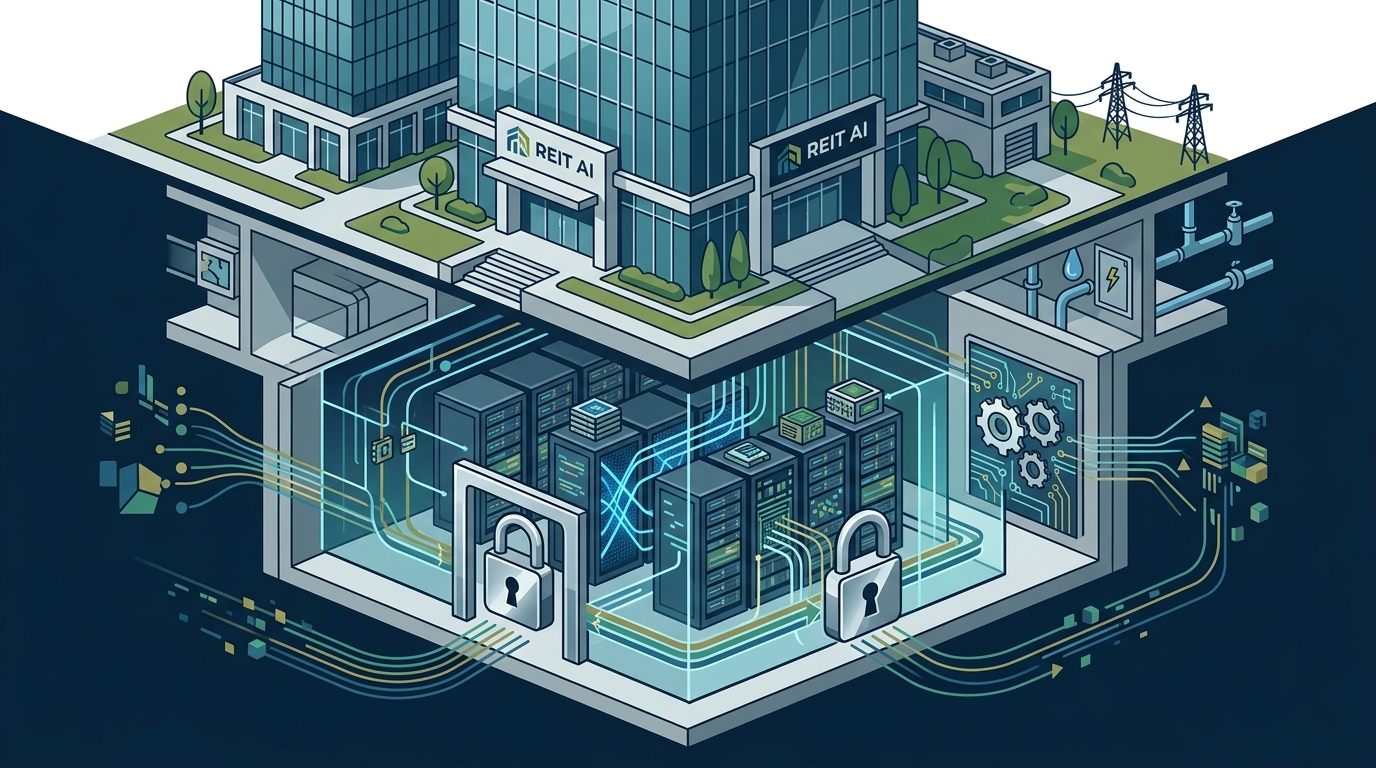
Custom deployment architecture is the method of integrating software directly into a client's existing infrastructure rather than forcing the client to migrate to a generic third-party cloud. For institutional real estate, this approach is critical because it allows the AI layer to operate inside the client's security perimeter. Traditional property management software often requires ripping out existing accounting, banking, and CRM systems. This creates significant operational risk and data exposure during migration. A custom deployment avoids this by building bespoke integrations that connect to the tools an institution already owns and trusts.
Operating Inside the Client Perimeter
Institutional investors, particularly sovereign wealth funds and large REITs, operate under strict governance frameworks. They cannot simply upload sensitive portfolio data to a generic multi-tenant SaaS environment without rigorous vetting. A secure platform deploys its AI environments directly into the firm's architecture. This means data management, back-office administration, and accounting are consolidated into one intelligent interface that remains within the client's control. The system uses scoped access and audit trails to ensure that every automated action is logged and reviewable. This architecture supports the principle that the Asset Manager remains in charge, setting the rules and approving every move while the AI executes the operational tasks.
Integration Without Disruption
One of the biggest barriers to AI adoption in real estate is the fear of disrupting live operations. Custom deployment addresses this by ensuring nothing is ripped out. The platform connects across operational tools, including accounting, storage, CRM, banking, and reporting systems. This full software connectivity allows the AI to work with the stack the institution already owns. For example, a custom environment can consolidate data from disparate sources into a single view, enabling real-time anomaly detection without requiring the client to change their core banking relationships. This approach minimizes the risk of data loss and ensures business continuity during the transition to AI-driven operations.
Scalability and Governance
Custom deployments are not just about security; they are about scalability. As a portfolio grows, the AI environment scales with it. The architecture supports multi-entity reporting, allowing consolidated visibility across different jurisdictions and asset classes. This is particularly important for sovereign wealth funds that operate across borders. The system standardizes the operating layer beneath all managers, applying one rule set and one audit trail across regions. This ensures that governance is consistent, regardless of where the assets are located. The result is a scalable infrastructure that delivers institutional-grade controls without the need for massive headcount expansion.
Client Data Isolation
Client data isolation is the technical and procedural framework that ensures one client's data is completely separated from another's, preventing unauthorized access or leakage. In a multi-tenant environment, where multiple clients use the same software instance, isolation is the primary defense against data breaches. For institutional investors, data isolation is not just a technical feature; it is a fundamental requirement for trust. A platform must demonstrate that it can handle sensitive financial data, lease agreements, and tenant information with the highest level of confidentiality.
Encryption and Access Controls
Robust data isolation begins with encryption. Data must be encrypted both in transit and at rest. This ensures that even if data is intercepted during transmission or accessed on a server, it remains unreadable without the proper decryption keys. Access controls are equally important. The platform must implement least-privilege access, meaning users and systems can only access the data they need to perform their specific functions. This limits the potential damage if a credential is compromised. Additionally, the platform should not use client data to train third-party AI models. This is a critical distinction for institutional clients who want to ensure their proprietary data remains their own.
Auditability and Compliance
Data isolation is only effective if it can be verified. Every automated and approved action must be timestamped and reviewable by internal and external auditors. This creates a defensible trail that supports compliance with regulatory standards. For REITs and institutional investors, this auditability is essential for meeting the requirements of bodies like the SEC and FINRA. The platform should provide jurisdiction-aware compliance, mapping controls to local requirements while rolling up reporting to one consistent format. This ensures that the client can demonstrate compliance to regulators without having to manually compile data from multiple sources.
Legal and Operational Safeguards
Technical controls must be backed by legal and operational safeguards. The platform should publish clear legal documentation, including Data Processing Addendums (DPA), Master Service Agreements (MSA), and Acceptable Use Policies. These documents define the roles and responsibilities of both the provider and the client. They specify how data is processed, stored, and protected. Furthermore, the platform should offer revocable integrations, allowing the client to disconnect the AI from their systems at any time. This gives the client ultimate control over their data and ensures that the relationship is based on trust and transparency.
| Security Feature | Generic SaaS Platform | Custom Institutional Deployment |
|---|---|---|
| Deployment Model | Multi-tenant cloud | Inside client architecture |
| Data Isolation | Logical separation | Physical and logical separation |
| Access Control | Standard role-based | Scoped, least-privilege |
| Audit Trail | Basic logging | Comprehensive, regulator-ready |
| Integration | Pre-built connectors | Bespoke API integrations |
Key Takeaways
- Custom deployment architectures allow AI to operate inside the client's security perimeter, reducing data exposure.
- Client data isolation is the primary defense against breaches in multi-tenant environments.
- Encryption in transit and at rest is a baseline requirement for institutional-grade security.
- Least-privilege access controls limit the potential damage from compromised credentials.
- Comprehensive audit trails are essential for meeting regulatory compliance requirements.
- Legal documentation, including DPAs and MSAs, defines the responsibilities of both parties.
- Revocable integrations give clients ultimate control over their data and systems.
- Scalable architectures support multi-entity reporting across jurisdictions and asset classes.
Frequently Asked Questions
What is a custom deployment architecture in real estate software?
A custom deployment architecture is a method of integrating software directly into a client's existing infrastructure. It allows the AI layer to operate inside the client's security perimeter, using bespoke integrations to connect to existing tools.
How does client data isolation work in a multi-tenant environment?
Client data isolation works by ensuring that one client's data is completely separated from another's. This is achieved through encryption, access controls, and logical or physical separation of data stores.
Why is auditability important for institutional investors?
Auditability is important because it allows investors to verify that every automated action is logged and reviewable. This supports compliance with regulatory standards and provides a defensible trail for internal and external audits.
Can AI platforms operate without ripping out existing systems?
Yes, custom deployment architectures are designed to integrate with existing systems without requiring a rip-and-replace. This minimizes operational risk and ensures business continuity during the transition.
What legal documents should an institutional client review before deploying AI?
Institutional clients should review the Data Processing Addendum (DPA), Master Service Agreement (MSA), and Acceptable Use Policy. These documents define how data is processed, stored, and protected, and outline the responsibilities of both parties.
How does a custom deployment support multi-entity reporting?
A custom deployment supports multi-entity reporting by consolidating data from disparate sources into a single view. This allows for consolidated visibility across different jurisdictions and asset classes, applying one rule set and one audit trail across regions.
Is it safe to use client data to train AI models?
For institutional clients, it is generally not safe to use client data to train third-party AI models. A secure platform should not use client data for this purpose, ensuring that proprietary data remains the client's own.
What is the role of the Asset Manager in an AI-driven operation?
The Asset Manager remains in charge, setting the rules and approving every move. The AI executes the operational tasks, but the Asset Manager retains full oversight of rules, approvals, and spend.
Conclusion
For REITs, institutional investors, and sovereign wealth funds, the security of an AI property management platform is non-negotiable. Custom deployment architectures and robust client data isolation are the two pillars that ensure a platform is secure enough for institutional use. By operating inside the client's architecture and enforcing strict data controls, a platform can provide the benefits of AI automation without compromising security or governance. REIT AI offers custom Claude environments that are built inside your firm's architecture, consolidating data management, back-office admin, and accounting into one intelligent interface. To see how a secure AI layer can transform your operations, request a demo today.