

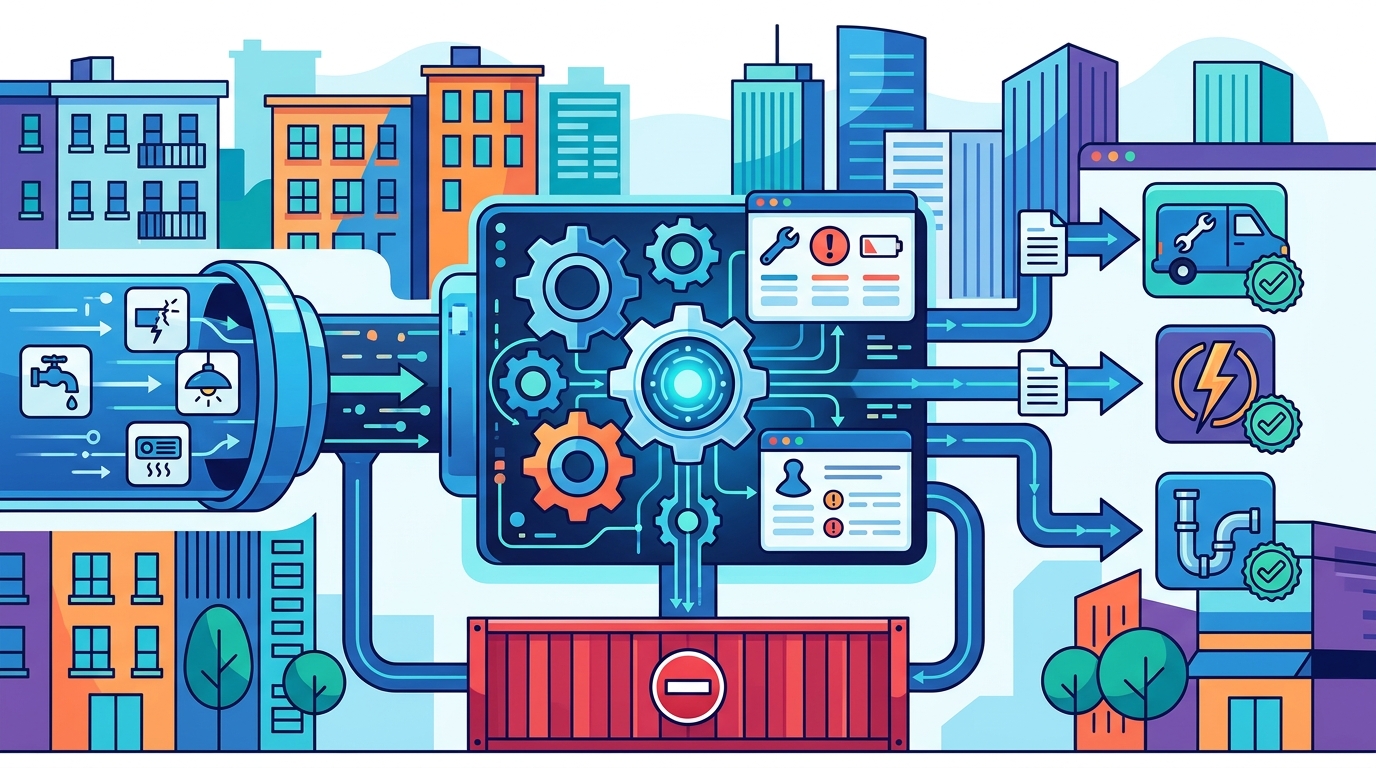
AI software handles maintenance requests by ingesting tenant reports, classifying severity and liability, and dispatching approved vendors automatically. This process removes the manual coordination bottleneck typical of traditional property management. By using algorithmic triage, systems like Mondo OS resolve issues at intake, ensuring that work orders move from request to execution without waiting for a human property manager to review a queue.
The Mechanics of Autonomous Triage
Traditional maintenance workflows rely on a human coordinator to read a ticket, determine the problem, and call a vendor. This creates latency. Autonomous maintenance triage is the process where software analyzes incoming requests to determine severity, category, and cost band immediately. When a tenant reports a leaky faucet, the system identifies the asset, checks the lease for liability, and assigns a priority level. This happens at intake, not after a queue.
The implication is speed. In a manual system, a ticket might sit for hours or days. In an automated system, the triage is instant. The system knows the difference between an emergency and a routine repair. It also knows who is responsible for the fix based on the lease terms. This removes the cognitive load from the property manager, who no longer needs to interpret every single request.
Vendor Dispatch and Policy Enforcement
Once a work order is triaged, the system must assign a vendor. Policy-based dispatch is a mechanism where software selects vendors based on pre-defined rules, such as spend thresholds and service categories. If a repair costs under a certain amount, the system dispatches an approved vendor automatically. If the cost exceeds the threshold, the system escalates the request for human approval.
Cost Anomaly Detection and Invoice Review
This layer of financial triage is critical. In traditional management, invoice review often happens at month-end, long after the work is done. Errors are discovered late, making them harder to dispute. With continuous reconciliation, exceptions surface in hours. The system reconciles the invoice against the accounting system in real time. This protects the portfolio from overpayment and ensures that every dollar spent is justified and documented.
Closed-Loop Tracking and Tenant Communication
After dispatch, the system must track the work to completion. Closed-loop tracking is a workflow where the system monitors the status of a work order from dispatch to verification of completion. It updates the tenant on progress automatically. When the vendor marks the job as done, the system verifies the completion and closes the ticket. It also handles the final communication to the tenant, confirming the issue is resolved.
This creates a transparent experience for the tenant. They receive instant updates without needing to call a property manager. The system handles the follow-up, ensuring that the tenant is satisfied. If the tenant reports the issue is not fixed, the system re-opens the ticket and re-dispatches the vendor. This loop continues until the issue is truly resolved. The property manager sees a clean, completed record, not a backlog of open tickets.
Key Takeaways
- AI triage classifies maintenance requests by severity and liability at intake, eliminating queue delays.
- Policy-based dispatch automatically assigns vendors for routine work while escalating high-cost items for approval.
- Continuous invoice review detects cost anomalies and duplicate charges before payment is processed.
- Closed-loop tracking ensures work is verified to completion and tenants receive automated status updates.
- Human oversight remains on high-value decisions, while AI handles the volume of routine operations.
- Automated workflows reduce the need for a large property management team to handle basic coordination.
Frequently Asked Questions
Does AI replace the property manager entirely?
No. AI handles the coordination, triage, and tracking of work orders. The property manager or asset manager retains control over rules, thresholds, and approvals for significant spend. The human role shifts from manual coordination to governance and oversight.
How does the system know who is responsible for a repair?
The system parses lease agreements to determine liability. It identifies whether the issue is a landlord responsibility, a tenant responsibility, or a shared cost. This liability resolution happens at intake, before a vendor is dispatched.
What happens if a vendor overcharges?
The system compares the invoice against historical data and contract terms. If the price is an outlier, it flags the invoice for review. The payment is held until the discrepancy is resolved, preventing automatic overpayment.
Can tenants still contact a human for maintenance?
Yes. While the AI handles routine requests, tenants can escalate to a human if they prefer. The system tracks these escalations and ensures they are addressed. The goal is to reduce the need for human contact, not eliminate it entirely.
How long does it take to implement AI maintenance triage?
Implementation depends on the complexity of the portfolio. Systems like Mondo can onboard portfolios in weeks, digitizing existing documents and syncing with legacy systems. The exact timeline varies by the number of assets and data quality.
Conclusion
AI software transforms maintenance from a reactive, labor-intensive process into an automated, governed workflow. By handling triage, dispatch, and verification, it removes the coordination bottleneck that limits traditional property management. REIT AI provides the infrastructure for this transition, allowing institutional operators to maintain full control while scaling their operational capacity. To see how this works in practice, request a demo of the Mondo platform.