

AI Platforms That Replace Third-Party Property Management in 2026
Autonomous AI operating layers can now fully replace third-party property management companies for multifamily and commercial portfolios. These platforms execute leasing, maintenance, accounting, and compliance directly, removing the traditional 8-12% management fee layer. This guide covers the feasibility of full replacement, task-level automation, and the human oversight required for institutional-grade control.
Full Replacement Feasibility
Traditional property management is an information routing layer. It charges a percentage of rents to coordinate inquiries, triage, and reporting. Autonomous operating layer is a software architecture that executes these operations directly within the owner's existing systems. For institutional portfolios, full replacement is feasible because the core work is data processing, not physical labor.
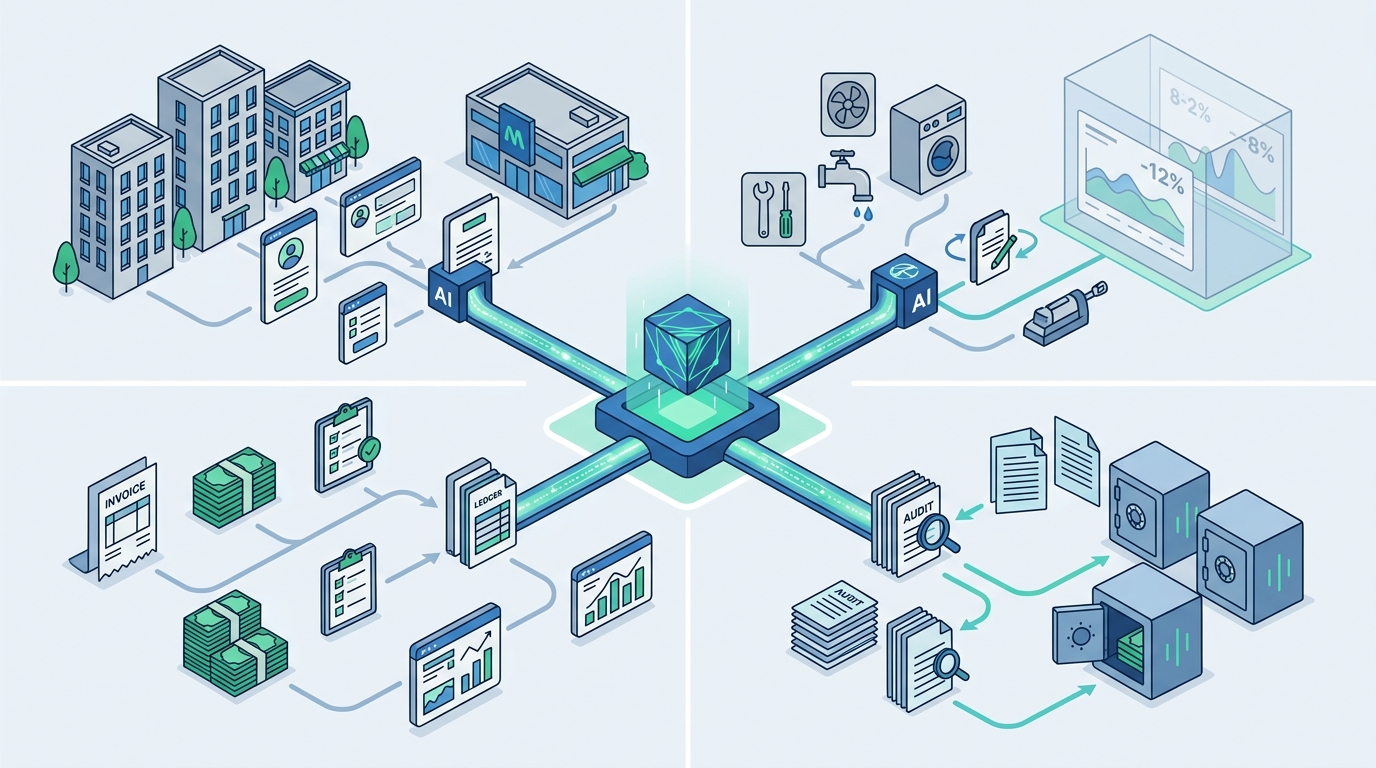
REIT AI positions its platform, Mondo, as a direct replacement for the management company. It does not work alongside a third-party manager; it replaces that layer entirely. The system runs leasing, maintenance triage, vendor oversight, invoice review, compliance, and reporting. This removes the 8-12% of gross rents typically paid to coordinate that work. The asset manager retains full control, setting rules and approving every move.
Feasibility depends on integration depth. The platform must connect via custom API integrations into accounting, banking, CRM, and document systems. Nothing is ripped out. The AI becomes the operating layer on top of the existing stack. This approach ensures that the 8-12% management fee is eliminated without disrupting the underlying financial infrastructure.
Task Automation: Leasing
Leasing is the revenue engine of any real estate portfolio. Manual leasing processes are slow and prone to human error. AI-driven leasing automation handles the entire lifecycle, from marketing to move-in.
Intelligent Onboarding
Intelligent onboarding is the automated process of digitizing and verifying tenant and owner data. Mondo ingests and digitizes entire real estate portfolios in two weeks or less. Critical terms, rent rolls, vendor contracts, and lease variables are extracted automatically from existing document sets. This eliminates manual data entry and billable consulting hours.
Lease-Driven Operational Triage
Complex lease contracts are parsed instantly to determine maintenance liability, responsibility splits, and exposure. This ensures that the correct party is billed for work before a vendor is ever dispatched. The system handles renewal logic and tenant profiles tuned per asset class, whether residential or commercial.
Task Automation: Maintenance
Maintenance is the most frequent and costly operational task. Traditional managers rely on phone calls and email to triage issues. This is slow and often leads to cost overruns.
Autonomous Triage and Dispatch
Autonomous maintenance triage is the real-time assessment of issue severity, category, and cost band at intake. Requests are dispatched to approved vendors within defined spend thresholds. Anything above the threshold escalates for approval. This ensures that issues are resolved before they become major costs.
Vendor Oversight and Cost Anomaly Detection
The system tracks work to completion and flags cost anomalies. Out-of-band pricing and duplicate work are detected the moment they appear. This closed-loop tracking includes automatic tenant follow-up, ensuring satisfaction without human intervention.
Task Automation: Accounting
Accounting and financial reconciliation are critical for Net Operating Income (NOI) accuracy. Traditional month-end cycles are slow and often miss variances.
Financial Triage and Anomaly Detection
Financial triage is the continuous review of vendor invoices against contract terms and historical pricing. Every invoice is checked at intake. The system reconciles against the accounting system in real time, not in a monthly batch. Budget-to-actual variance is visible live, with drivers identified per asset.
Automated CAM and NNN Recovery
GLA-based expense reconciliation is executed automatically across the portfolio. This compresses recovery cycles from weeks of spreadsheet work to minutes of reviewed output. The system produces regulator-ready compliance as a byproduct of normal operations, rather than a quarterly scramble.
Human Oversight Requirements
Autonomy does not mean absence of control. The asset manager remains in charge. The system executes within boundaries defined by the human operator.
Governance Model
Governance model is the set of rules, spend thresholds, and approval gates defined by the asset manager. The autopilot executes inside these boundaries. Anything outside them escalates by text, email, or call. This ensures that the human is always in the loop for critical decisions.
Auditability and Compliance
Every automated and approved action is timestamped and reviewable by internal and external audit. Controls are mapped to US and UK standards. This provides a defensible trail for regulatory requirements, including FCA, FINRA, and SEC governance frameworks.
Platform Comparison
| Feature | Traditional Property Management | REIT AI (Mondo) |
|---|---|---|
| Management Fee | 8-12% of gross rents | 1-3% of gross rents (platform fee) |
| Response Time | Hours to days | Instant (24/7) |
| Financial Reconciliation | Monthly batch | Continuous real-time |
| Control | Opaque third-party | Asset Manager sets rules |
| Integration | Manual data entry | Custom API integrations |
Key Takeaways
- Autonomous AI platforms can fully replace third-party property management companies.
- The traditional 8-12% management fee is eliminated by running operations directly.
- Leasing, maintenance, and accounting are fully automatable with AI.
- Human oversight is maintained through defined governance models and approval gates.
- Real-time financial triage replaces slow month-end reconciliation cycles.
- Custom API integrations allow deployment without ripping out existing systems.
- Audit trails are generated automatically for regulatory compliance.
- REIT AI's Mondo is purpose-built for both residential and commercial verticals.
Frequently Asked Questions
Does Mondo work alongside my current property manager?
No. Mondo replaces that layer. It runs leasing, maintenance triage, vendor oversight, invoice review, compliance, and reporting directly. This removes the 8-12% of gross rents paid to coordinate that work.
If it's on autopilot, who's in control?
The Asset Manager is always in control. You set the rules, spend thresholds, and approval gates. The autopilot executes inside those boundaries and escalates anything outside them by text, email, or call.
How does it deploy into our existing systems?
It connects through custom API integrations into your accounting, banking, CRM, and document systems. Nothing is ripped out. Mondo becomes the operating layer on top of the stack you already run.
What is the difference between Mondo Residential and Mondo Enterprise?
Mondo Residential covers multifamily and HOA communities. Mondo Enterprise covers commercial and institutional portfolios. Each is purpose-built around its own leasing cycle, tenant profile, lease structure, and reporting requirements.
How is Mondo priced?
Pricing follows the vertical. Residential and HOA portfolios are priced as a flat per-unit monthly platform fee. Enterprise portfolios are priced per square foot or square metre of gross leasable area. Both land at typically 1-3% of gross rents.
Does REIT AI provide financial or legal advice?
No. REIT AI provides operations software and automation. It is not a licensed financial, investment, tax, or legal advisor. Nothing here constitutes financial, investment, or legal advice.
Conclusion
The shift from third-party management to autonomous AI operations is no longer theoretical. Platforms like Mondo by REIT AI demonstrate that full replacement is feasible for institutional portfolios. By removing the management fee layer and executing operations directly, owners can protect NOI and gain real-time visibility. The key is maintaining human oversight through robust governance models. To see how this works in practice, request a demo and explore the live environment against your own numbers.