

AI-powered maintenance triage reduces response times by instantly classifying incoming requests by severity and routing them to the correct vendor, eliminating the manual queue delays inherent in traditional property management. This automation ensures critical issues are addressed immediately while routine tasks are batched efficiently, significantly accelerating the time from tenant report to vendor dispatch across large portfolios.
The Bottleneck of Manual Triage
Traditional property management relies on human coordinators to read, categorize, and assign maintenance requests. This manual process creates a significant bottleneck, especially in multi-property portfolios where a single coordinator might manage hundreds of units. The delay between a tenant reporting a leak and a plumber being dispatched is often measured in hours or days, not minutes. This lag is not just an inconvenience; it is a structural inefficiency that erodes tenant satisfaction and increases the severity of minor issues. according to Improving Emergency Response
Manual triage is inherently inconsistent. One coordinator might prioritize a water leak differently than another, leading to uneven service levels across a portfolio. Without a standardized, automated system, response times fluctuate based on the workload of the human staff rather than the actual urgency of the issue. This inconsistency makes it difficult for asset managers to guarantee service levels or predict operational costs. according to AI Property Maintenance
How AI Classifies Urgency Instantly
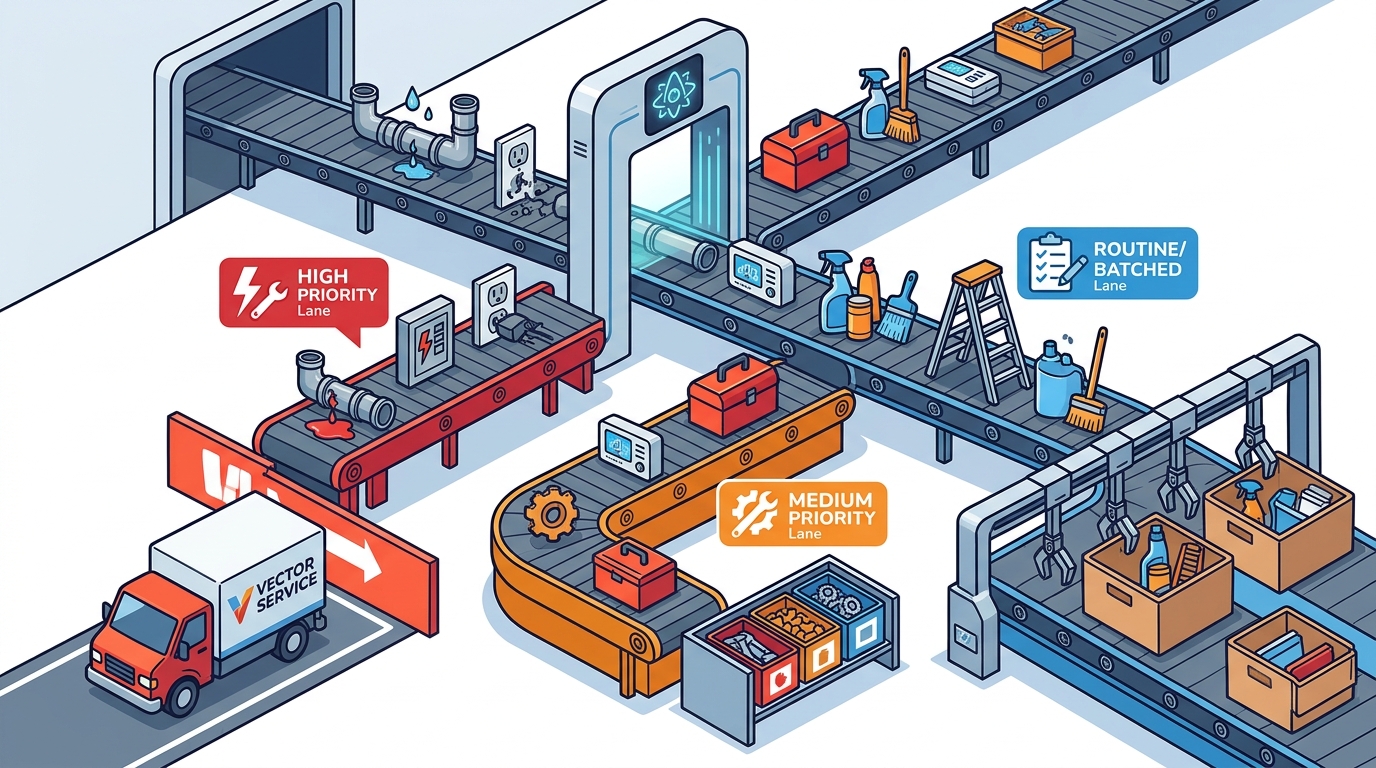
AI-powered maintenance triage is the automated process of analyzing incoming maintenance requests to determine their severity, category, and appropriate cost band at the moment of intake. Instead of waiting for a human to review a queue, the system processes the request immediately. It uses natural language processing to understand the context of the report, distinguishing between a dripping faucet and a burst pipe. This instant classification allows the system to apply pre-defined policies that dictate the appropriate response time and vendor tier.
The system does not invent universal response-time thresholds but rather applies the organization's specific triage policy. For example, an active or worsening water report is treated as requiring elevated attention, and the AI recommends the corresponding configured priority. This ensures that critical issues are flagged for immediate action, while non-urgent tasks are scheduled for efficient batch processing. The result is a consistent, policy-driven response that does not depend on human availability or subjective judgment.
Automated Vendor Dispatch and Oversight
Once a request is triaged, the next step is dispatching the appropriate vendor. In traditional models, a coordinator must manually select a vendor, negotiate pricing, and schedule the visit. This manual coordination adds further delay. AI systems automate this step by matching the triaged request to approved vendors within defined spend thresholds. If the estimated cost exceeds the threshold, the system escalates the request for approval, ensuring that no unauthorized spend occurs. according to Scheduling Request Representative
This automated dispatch is supported by continuous vendor oversight. The system tracks the work order from dispatch to completion, verifying that the work was performed as described. It also flags cost anomalies, such as out-of-band pricing or duplicate work, before an invoice is ever paid. This closed-loop tracking ensures that the speed of dispatch does not come at the cost of quality or financial control. The vendor is held accountable to the same standards as the property, creating a transparent and efficient operational cycle.
Scalability Across Multiple Properties
The primary advantage of AI triage in a multi-property portfolio is scalability. As a portfolio grows, the operational burden in a traditional model scales linearly with headcount. Adding more properties requires adding more coordinators, which increases cost and complexity. AI systems, however, do not suffer from this linear scaling. The same automated logic that triages a request in one building can be applied to hundreds of buildings simultaneously without additional headcount.
This scalability allows a lean team to manage a large book of assets. The asset manager can set governance rules once, such as spend thresholds and vendor policies, and have them enforced consistently across every asset. This unified governance eliminates the drift that occurs when individual property managers interpret policies differently. The result is a portfolio-wide standard of service that is both fast and consistent, regardless of the number of properties under management.
Key Takeaways
- AI triage eliminates the manual queue, reducing the time from tenant report to vendor dispatch from hours to minutes.
- Automated classification ensures consistent application of triage policies across all properties in a portfolio.
- Instant severity detection allows critical issues to be prioritized immediately, preventing minor problems from becoming major damages.
- Automated vendor dispatch matches requests to approved vendors within spend thresholds, reducing coordination delays.
- Continuous oversight and cost anomaly detection ensure that speed does not compromise financial control or quality.
- Scalability allows a lean team to manage a large portfolio without linear increases in headcount.
Frequently Asked Questions
How does AI determine the severity of a maintenance request?
AI uses natural language processing to analyze the text of the request and cross-references it with historical data and pre-defined policies. It identifies keywords and context to classify the issue by severity, category, and cost band, ensuring that critical issues are prioritized according to the organization's specific triage policy.
Can AI triage handle complex or unusual maintenance issues?
Yes, but with a human-in-the-loop approach. For standard issues, the AI handles triage and dispatch autonomously. For complex or unusual issues that fall outside pre-defined policies, the system escalates the request to a human asset manager for review and decision, ensuring that no critical judgment is made without oversight.
Does AI triage replace property managers?
No, it augments them. AI handles the routine, high-volume tasks of triage and dispatch, freeing property managers to focus on strategic oversight, vendor relationships, and exception handling. The asset manager retains full control over rules, thresholds, and approvals.
How does AI triage improve vendor performance?
By providing continuous oversight and closed-loop tracking, AI ensures that vendors are held accountable for both the speed and quality of their work. Cost anomalies and incomplete work are flagged automatically, creating a transparent feedback loop that encourages better vendor performance over time.
Is AI triage suitable for all types of real estate?
Yes, the core logic of triage and dispatch is applicable to residential, commercial, and mixed-use properties. However, the specific policies and vendor tiers may need to be tailored to the unique requirements of each asset class. The system is designed to be flexible and adaptable to different portfolio structures.
How long does it take to implement AI triage?
Implementation time varies depending on the complexity of the portfolio and the existing systems in place. However, modern AI platforms are designed for rapid deployment, often integrating with existing accounting and CRM systems within weeks. The goal is to minimize disruption while maximizing the speed of implementation.
Conclusion
AI-powered maintenance triage is not just a convenience; it is a structural shift in how real estate portfolios are operated. By automating the classification and dispatch of maintenance requests, it eliminates the delays and inconsistencies inherent in manual processes. This allows asset managers to deliver faster, more consistent service across large portfolios without increasing headcount. For institutional investors and property owners, this translates into improved tenant satisfaction, reduced operational risk, and greater control over costs. REIT AI provides the infrastructure to make this shift, offering an autonomous operating layer that runs maintenance triage on autopilot while keeping the asset manager in full control. To see how AI triage can transform your portfolio's response times, request a demo today.