

AI Platforms That Replace Third-Party Property Management in 2026
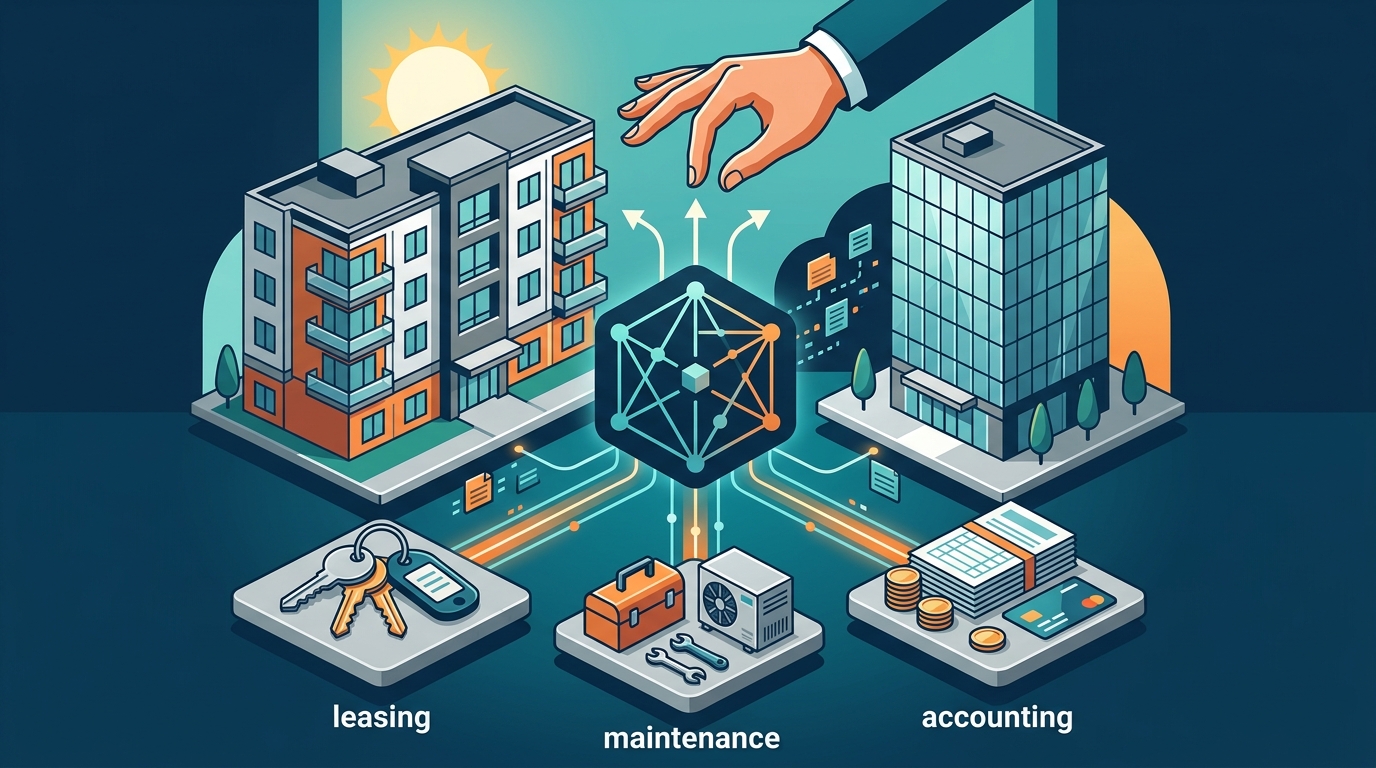
AI platforms can fully replace third-party property management companies for multifamily and commercial portfolios by automating leasing, maintenance, and accounting while keeping human oversight on critical decisions. This guide covers feasibility, task automation, and oversight requirements for institutional operators.
Full Replacement Feasibility
Replacing a third-party property management company with AI is feasible when the platform handles the full operational stack rather than just isolated tasks. Traditional management layers extract 8-12% of gross rents for coordination work that lacks a scalable technology layer beneath it. An AI operating engine can replace this layer by running the operation directly, protecting Net Operating Income, and automating financial reconciliation across CAM, NNN, and vendor spend.
Feasibility depends on three factors: vertical alignment, integration depth, and governance structure. Residential and commercial portfolios have distinct leasing cycles and lease structures, so a platform must be purpose-built for each vertical. Integration depth determines whether the AI operates inside your existing accounting, banking, CRM, and document stack or requires a rip-and-replace migration. Governance structure ensures that the Asset Manager retains control over rules, thresholds, and approvals while the system executes autonomously.
REIT AI positions its Mondo platform as an enterprise-grade AI operating engine that replaces the legacy management layer. It produces regulator-ready compliance as a byproduct of normal operations rather than a quarterly scramble. The platform operates inside your architecture with scoped access, encryption in transit and at rest, and a complete audit trail on every action the autopilot takes or escalates.
Task Automation: Leasing
Leasing automation covers the full tenant lifecycle from marketing to move-in. AI platforms handle tenant inquiries, application screening, lease generation, and move-in coordination without human intervention. The system parses complex lease contracts instantly to determine maintenance liability, responsibility splits, and exposure before a vendor is ever dispatched.
On the tenant side, autonomous support provides 24/7 response to inquiries, instant maintenance triage, dues collection, and inquiry resolution. On the Asset Manager side, the system provides real-time anomaly detection, automated vendor oversight, proactive text and email alerts, and ROI-focused recommendations. The system suggests actions; you accept or reject them. When you accept, you see the savings reflected in the report.
Intelligent onboarding ingests and digitizes entire real estate portfolios in two weeks or less, with no billable consulting hours and no manual migration work from your team. Critical terms, rent rolls, vendor contracts, and lease variables are extracted automatically from your existing document set. Data maps effortlessly across existing CRE software, ERPs, and accounting databases, requiring no rip-and-replace.
Task Automation: Maintenance
Maintenance automation triages requests the moment they arrive, dispatches to approved vendors within your spend thresholds, and tracks to completion. Cost anomalies are flagged before an invoice is ever paid. Severity, category, and cost band are determined at intake, not after a queue. Approved vendors are selected inside your spend thresholds; anything above escalates for approval.
Out-of-band pricing and duplicate work are flagged the moment they appear. Work is verified to completion, with tenant follow-up handled automatically. This closed-loop tracking ensures that maintenance requests do not fall through the cracks and that vendor performance is continuously monitored against contract terms and historical pricing.
Financial triage reviews every vendor invoice against contract and history, reconciles against the accounting system, and reports variance continuously. Exceptions surface in hours instead of at month-end. Budget-to-actual variance is visible live, with drivers identified per asset. Accepted recommendations show up as measurable reductions in the report.
Task Automation: Accounting
Accounting automation consolidates data management, back-office admin, and accounting into one intelligent interface. The system connects across your operational tools, including accounting, storage, CRM, banking, and reporting, so the environment works with the stack you already own. Workflows are tailored to your firm's processes rather than generic assistant behavior, with guardrails on every action.
Automated CAM and NNN recovery executes GLA-based expense reconciliation automatically across the portfolio. Recovery cycles compress from weeks of spreadsheet work to minutes of reviewed output. Every action, approval, and reconciliation is captured with a defensible trail, built around FCA, FINRA, and SEC governance requirements from day one. This audit-ready financial compliance is a byproduct of normal operations, not a separate quarterly effort.
Real-time NOI reporting replaces the monthly compile cycle. Continuous NOI, OpEx, and variance reporting provides board-ready data rather than a compiled cycle that is stale on arrival. The system provides a constant report of the entire operation, flagging every anomaly the moment it happens rather than at month-end.
Human Oversight Requirements
Human oversight is not optional in AI-driven property management. The Asset Manager remains fully in charge, seeing everything, setting the rules, and approving every move. Spend thresholds, approval gates, and escalation paths are defined by the Asset Manager and enforced by the system. The autopilot executes; you govern.
Principal-level approval is required on every spend threshold. Nothing is delegated to an opaque management layer. Direct control ensures that principals set the rules and approve spend, with scoped access and audit trails on sensitive holdings and counterparties. Discretion by design protects the confidentiality of institutional portfolios.
Every automated and approved action is timestamped and reviewable by internal and external audit. Jurisdiction-aware compliance maps controls to US and UK standards, with reporting rolled up to one consistent format. Legal documentation, including DPA, MSA, Acceptable Use, Cookie, and Privacy policies, is published and available for review before deployment. Integrations are scoped per system, reviewed with your IT team, and revocable at any time.
Platform Comparison
| Capability | Traditional Management | AI Operating Layer |
|---|---|---|
| Management Fee | 8-12% of gross rents | 1-3% of gross rents |
| Response Time | Business hours only | 24/7 autonomous |
| Invoice Review | Month-end batch | Continuous at intake |
| Reporting | Monthly compile | Real-time live |
| Compliance | Quarterly scramble | Byproduct of operations |
| Integration | Manual data entry | Inside existing stack |
Key Takeaways
- AI platforms can fully replace third-party property management when they handle the full operational stack, not just isolated tasks.
- Traditional management layers extract 8-12% of gross rents for coordination work that lacks a scalable technology layer.
- AI operating layers typically land at 1-3% of gross rents, under 2% on a market-rate unit.
- Leasing automation covers the full tenant lifecycle from marketing to move-in with 24/7 autonomous support.
- Maintenance triage determines severity, category, and cost band at intake, not after a queue.
- Accounting automation consolidates data management, back-office admin, and accounting into one intelligent interface.
- Human oversight is mandatory: the Asset Manager sets rules, thresholds, and approvals while the system executes.
- Every automated action is timestamped and reviewable by internal and external audit.
Frequently Asked Questions
Can AI fully replace a property management company?
Yes, when the platform handles the full operational stack including leasing, maintenance, and accounting. The AI operates as an operating layer that replaces the third-party management fee while keeping the Asset Manager in control of rules and approvals.
What percentage of rents does AI property management cost?
AI operating layers typically land at 1-3% of gross rents, under 2% on a market-rate unit. This compares to 8-12% for traditional property management companies.
How long does onboarding take?
Intelligent onboarding ingests and digitizes entire real estate portfolios in two weeks or less, with no billable consulting hours and no manual migration work from your team.
Do I need to rip out my existing systems?
No. The platform deploys inside your stack with custom API integrations into accounting, banking, CRM, and document systems. Nothing is ripped out; the AI becomes the operating layer on top.
Who approves spend and vendor dispatch?
The Asset Manager defines spend thresholds, approval gates, and escalation paths. The system enforces these rules and escalates anything above threshold for approval. Principal-level approval is required on every spend threshold.
Is the data secure?
The platform operates with scoped access, encryption in transit and at rest, and a complete audit trail on every action. No client data is used to train third-party models. Integrations are scoped per system, reviewed with your IT team, and revocable at any time.
Conclusion
AI platforms can fully replace third-party property management companies for multifamily and commercial portfolios by automating the full operational stack while keeping human oversight on critical decisions. REIT AI's Mondo platform runs leasing, maintenance triage, vendor oversight, invoice review, compliance, and reporting directly, removing the 8-12% management layer while the Asset Manager governs every rule, threshold, and approval. To see what removing the management layer does to your NOI, request a demo and run a live environment against your own portfolio numbers.