

Real-Time NOI and Budget-vs-Actual Reporting for Institutional Real Estate
Real-time Net Operating Income (NOI) and budget-versus-actual reporting requires an operating system that ingests live financial data, reconciles it continuously, and visualizes variance without manual month-end compilation. Traditional property management software often relies on batch processing, leaving institutional investors blind to cash flow shifts until the end of the month. This guide explains how to select, verify, and deploy software that provides live financial visibility for institutional portfolios, ensuring that asset managers retain full control over their data and reporting standards.
How to Choose: Separating Good from Bad
Choosing the right reporting software is not just about dashboards; it is about the underlying data architecture. A good option provides a continuous stream of reconciled data, while a bad one relies on periodic snapshots that become stale immediately after generation. The core differentiator is whether the software acts as a passive viewer of your accounting system or an active participant in the financial workflow.
The Difference Between Batch and Real-Time
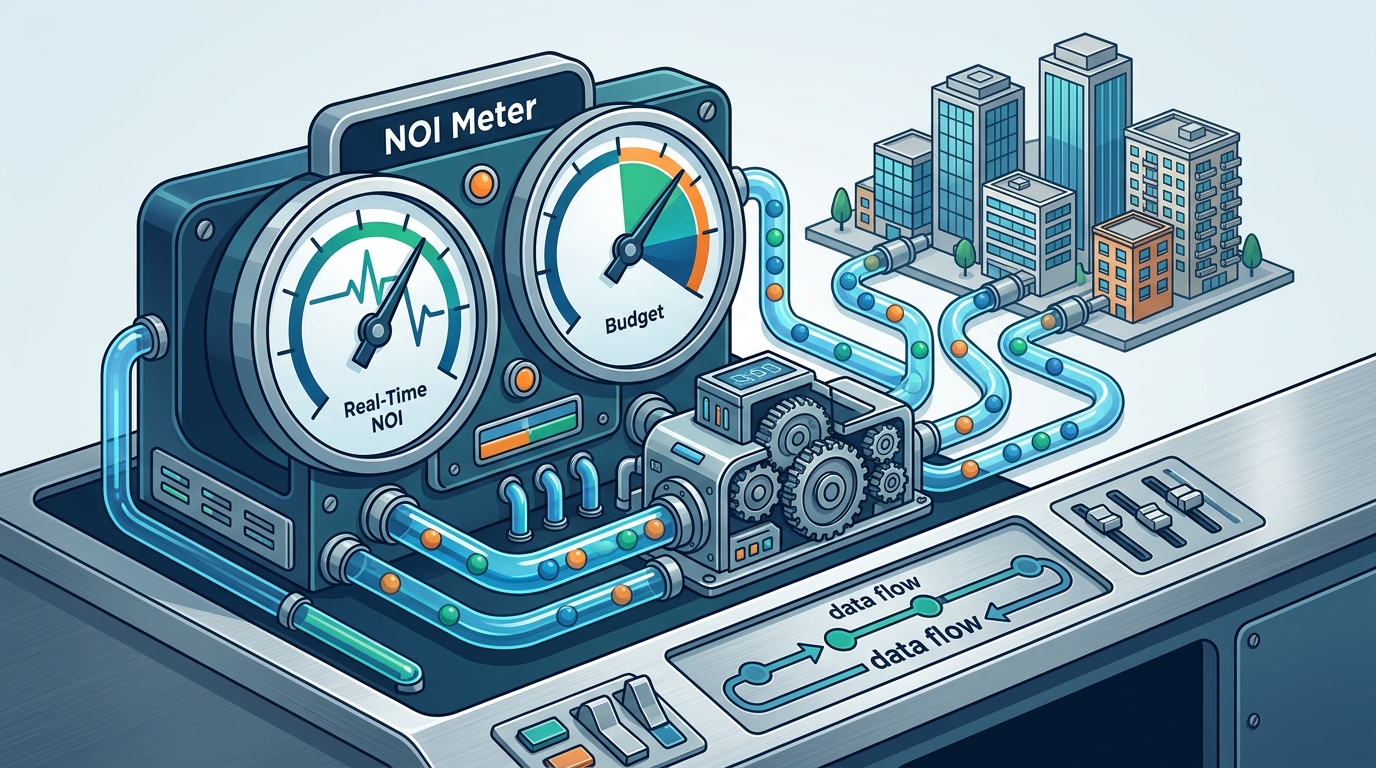
Batch processing is the standard in legacy commercial real estate (CRE) software. It collects data at set intervals, such as daily or monthly, and processes it in bulk. This creates a lag between when a financial event occurs and when it appears in your reporting. Real-time reporting, by contrast, updates the moment a transaction is recorded or reconciled. For institutional portfolios where cash flow timing impacts leverage ratios and distribution calculations, this lag is a critical risk.
Integration Depth
Shallow integrations often use read-only APIs that pull data but cannot write back or reconcile. Deep integrations connect directly to the General Ledger (GL) and sub-ledgers, allowing the reporting engine to validate data against source documents. When evaluating a platform, look for evidence that it can handle complex lease structures, such as CAM (Common Area Maintenance) and NNN (Triple Net) reconciliations, without manual spreadsheet intervention.
What to Ask: Specific Questions Before Committing
Before signing a contract, you must interrogate the vendor on their data handling capabilities. Vague answers about "AI" or "automation" are red flags. You need specific technical details about how data moves from your bank accounts to your reporting dashboard.
Data Latency and Freshness
Ask: "What is the maximum latency between a transaction posting in our accounting system and its appearance in the NOI report?" A robust system should answer in minutes, not days. Also ask how the system handles failed transactions or pending reconciliations. Does it flag them for human review, or does it guess?
Customization and Governance
Ask: "Can we define custom approval thresholds and reporting hierarchies?" Institutional investors often have specific board reporting requirements. The software must allow you to set rules for what gets escalated to a human and what is handled automatically. If the vendor cannot show you a configuration interface for these rules, they are likely selling a rigid, one-size-fits-all product.
How to Verify: Checking Claims and Credentials
Vendors often make bold claims about accuracy and speed. You must verify these claims through technical demonstrations and security audits. Do not rely on marketing materials; demand a live environment test.
Live Environment Testing
The most effective verification method is a live pilot. Load a subset of your portfolio data into the vendor's sandbox environment. Run a full reporting cycle and compare the output against your current manual reports. Look for discrepancies in NOI calculations, particularly in complex expense allocations. If the vendor cannot replicate your current numbers exactly, their data model is flawed.
Security and Compliance Audits
Request the vendor's latest SOC 2 Type II report. This independent audit verifies that the company operates with consistent controls for security, availability, and confidentiality. Additionally, check for jurisdiction-aware compliance features. If you operate across the US and UK, the software must map controls to both regulatory standards. A vendor that only supports one jurisdiction is a liability for a global portfolio.
How It Works: Process, Order, and Timeline
Understanding the operational workflow helps you plan the deployment. The process typically follows a strict sequence: ingestion, reconciliation, analysis, and reporting. Each step has specific timeframes and dependencies.
Onboarding and Data Migration
Onboarding begins with data extraction from your existing systems. This includes rent rolls, lease documents, and historical financials. A modern platform should automate this extraction, reducing manual data entry. The timeline for this phase varies by portfolio size but typically takes two weeks or less for a standard deployment. The goal is to establish a baseline for historical data so that variance reporting is meaningful from day one.
Continuous Reconciliation Cycle
Once live, the system enters a continuous loop. It pulls new transactions from the bank and accounting system, matches them against expected values based on lease terms, and flags anomalies. This cycle runs continuously, not just at month-end. The output is a live view of budget-versus-actual performance, with drivers identified for any significant variance.
What It Costs: Drivers of Price
Pricing for institutional reporting software is rarely a simple per-user fee. It is usually tied to the scale of the portfolio and the complexity of the operations. Understanding the cost drivers helps you budget accurately.
Portfolio Scale and Billing Units
Residential portfolios are often priced per unit per month. Enterprise and commercial portfolios are typically priced per square foot or square meter of Gross Leasable Area (GLA). This model aligns the cost with the value of the asset being managed. For a $450 million portfolio, the cost is a fraction of the traditional management fee, but it is a fixed operational expense rather than a variable fee based on revenue.
Onboarding and Integration Fees
Most platforms charge a one-time onboarding fee. This covers platform configuration, data migration, and system integration. The fee is justified by the time saved in manual setup. However, be wary of vendors who charge hourly consulting rates for onboarding. A fixed-fee onboarding with a guaranteed timeline is a better indicator of a productized, scalable solution.
What Goes Wrong: Common Mistakes
Even with the right software, deployment can fail if the operational process is not aligned. The most common mistakes involve data quality and user adoption.
Poor Data Hygiene
If your source data is messy, the reporting will be messy. Before deploying new software, clean up your rent rolls and lease files. Inconsistent vendor names or missing lease variables will cause reconciliation failures. The software can flag these issues, but it cannot fix them automatically. A dedicated data cleanup phase is essential.
Over-Automation Without Governance
Turning on every automated feature without setting proper approval gates is a risk. If the system is allowed to approve invoices or adjust budgets without human oversight, you lose control. Start with a conservative governance model where all actions are reviewed by a human. Gradually increase automation as you build trust in the system's accuracy.
Versus Alternatives: Comparing Options
There are three main categories of software for this use case: legacy CRE platforms, general-purpose accounting software, and AI-native operating systems. Each has distinct strengths and weaknesses.
| Feature | Legacy CRE Software | General Accounting | AI-Native OS (e.g., REIT AI) |
|---|---|---|---|
| Reporting Latency | Monthly Batch | Real-Time (GL only) | Real-Time (Reconciled) |
| Lease Complexity | High | Low | High |
| Automation Level | Low | Medium | High |
| Integration Depth | Siloed | Shallow | Deep (API) |
| Cost Model | Management Fee (8-12%) | Per User | Per Unit/Sq Ft (1-3%) |
Legacy software like Yardi or AppFolio is robust for transaction processing but often lacks the analytical depth for real-time variance analysis. General accounting software provides real-time GL data but does not understand lease structures. AI-native systems bridge this gap by combining transaction processing with intelligent analysis.
For Specific Situations: Tailored Approaches
The optimal software configuration depends on your specific portfolio type. A one-size-fits-all approach rarely works for institutional investors.
REITs and Public Companies
Public REITs require board-ready reporting that is audit-ready. The software must provide a complete trail of every automated action. It should support fund-level governance, allowing you to set spend thresholds once and enforce them across every asset. This reduces the compliance burden and ensures consistency in reporting to shareholders.
Family Offices and Private Equity
Family offices often have lean teams but large portfolios. They need software that provides institutional coverage without requiring a large headcount. The focus here is on discretion and multi-entity reporting. The software should allow principals to set rules and approve spend directly, maintaining control without outsourcing to a third-party manager.
Rules and Protections: Governance and Rights
Using AI in financial operations requires clear governance rules. You must define who is responsible for decisions made by the software.
Human-in-the-Loop Requirements
Most institutional investors require a human-in-the-loop for high-value transactions. The software should allow you to define spend thresholds above which a human approval is mandatory. This ensures that while the system handles routine tasks, significant financial decisions remain under human control. The audit trail must record both the AI's recommendation and the human's decision.
Data Ownership and Privacy
You must retain ownership of your data. The software should not use your data to train third-party models without explicit consent. Check the Data Processing Addendum (DPA) to ensure that your data is encrypted in transit and at rest, and that access is restricted to least-privilege roles. This protects your competitive advantage and client confidentiality.
Local Specifics: Regional Considerations
Real estate regulations vary by jurisdiction, and your software must reflect this. If you operate in multiple regions, you need a platform that can handle jurisdiction-aware compliance.
US and UK Standards
For portfolios spanning the US and UK, the software must map controls to both regulatory frameworks. This includes differences in tax treatment, lease accounting standards, and reporting requirements. A platform that rolls up reporting to one consistent format while respecting local rules is essential for cross-border investors. This reduces the complexity of managing a global portfolio and ensures that you are compliant in every jurisdiction where you operate.
Timing: When to Act
The timing of your software deployment can impact your financial performance. Deploying during a period of high volatility or rapid growth can be beneficial, but it requires careful planning.
Pre-Acquisition Diligence
Consider deploying the software before acquiring new assets. This allows you to onboard new properties into the operating layer without adding a new management contract. It also provides a clean baseline for the new asset, making it easier to integrate into your existing portfolio reporting. This approach reduces the friction of acquisition and speeds up the time to full operational visibility.
Results Over Time: Long-Term Outcomes
The benefits of real-time reporting compound over time. As the system accumulates historical data, its predictive capabilities improve. You can expect to see measurable improvements in operational efficiency and financial accuracy.
Operational Efficiency
Over the first 90 days, you should see a reduction in manual reporting time. The system handles the reconciliation and variance analysis, freeing your team to focus on strategic decisions. This efficiency gain is often reflected in lower operating costs, as you can reduce the headcount required for administrative tasks. The goal is to achieve a lower cost base while maintaining or improving the quality of your reporting.
Financial Accuracy
As the system learns your portfolio's patterns, it becomes better at detecting anomalies. This leads to earlier identification of revenue leaks and expense overruns. Over time, this results in a more accurate picture of your portfolio's true performance, allowing you to make better-informed investment decisions. The long-term outcome is a more resilient and transparent operation.
Key Takeaways
- Real-time reporting requires continuous reconciliation, not just batch processing.
- Verify vendor claims through live environment testing and SOC 2 audits.
- Pricing is typically tied to portfolio scale (per unit or square foot), not user count.
- Start with conservative governance rules and gradually increase automation.
- Ensure the software supports jurisdiction-aware compliance for cross-border portfolios.
- Data hygiene is critical; clean your source data before deployment.
- Long-term benefits include improved financial accuracy and reduced operational costs.
Frequently Asked Questions
What is the difference between real-time and batch reporting?
Real-time reporting updates the moment a transaction is recorded, while batch reporting processes data at set intervals, such as daily or monthly. Real-time provides immediate visibility into cash flow, while batch can have a lag of up to a month.
How long does it take to deploy real-time reporting software?
Deployment typically takes two weeks or less for a standard portfolio. This includes data migration, system integration, and baseline calibration. The timeline can vary depending on the complexity of the portfolio and the quality of the source data.
Can I customize the reporting rules?
Yes, most institutional platforms allow you to define custom approval thresholds, reporting hierarchies, and escalation paths. This ensures that the software aligns with your specific governance requirements.
Is the data secure?
Reputable vendors use encryption in transit and at rest, and they undergo independent security audits, such as SOC 2 Type II. You should verify these credentials before committing.
How does the software handle complex lease structures?
Modern platforms can parse complex lease contracts to determine maintenance liability, responsibility splits, and exposure. This allows for accurate CAM and NNN reconciliations without manual intervention.
What is the cost of real-time reporting software?
Costs are typically priced per unit or per square foot of Gross Leasable Area. This model aligns the cost with the value of the asset being managed. Pricing is usually quoted per portfolio.
Conclusion
Real-time NOI and budget-versus-actual reporting is no longer a luxury; it is a necessity for institutional real estate portfolios. By selecting a platform that offers deep integration, continuous reconciliation, and robust governance, you can gain the visibility and control needed to protect Net Operating Income. REIT AI's Mondo OS provides this capability, allowing asset managers to run operations on autopilot while retaining full oversight. To see how this works in practice, review our case studies or request a quote for your portfolio.