

Fastest Property Management Onboarding: Rent Roll & Lease Migration Guide
REIT AI's Mondo platform offers the fastest onboarding for institutional portfolios, completing rent roll and lease migration in two weeks or less. This guide covers how to evaluate migration speed, verify vendor claims, and avoid common data pitfalls. We detail the technical steps, cost drivers, and long-term outcomes for institutional real estate operators.
How to Choose: Separating Good from Bad
Choosing a platform with fast onboarding requires looking beyond marketing promises. A good option prioritizes automated data extraction over manual entry. Automated Document Extraction is the critical differentiator. It is the process of using AI to pull critical terms, rent rolls, and lease variables directly from existing PDFs and spreadsheets. Bad options rely on billable consulting hours for manual migration, which extends timelines to months.
Core Criteria for Speed
First, check if the platform ingests legacy systems automatically. Second, verify if it maps data to your existing ERP without rip-and-replace. Third, ensure it calibrates historical financial baselines instantly. REIT AI's Mondo OS is designed for this exact workflow, ingesting entire portfolios in two weeks or less with no manual migration work from your team.
What to Ask: Pre-Commitment Questions
Before signing a contract, you must ask specific technical questions. Do not accept vague answers about "fast setup." Ask: "How many billable hours are required for data migration?" The answer should be zero for a true automated platform. Ask: "What is the guaranteed onboarding timeline?" REIT AI guarantees two weeks or less, starting once you provide agreed data and system access. If the clock pauses due to client tasks, the guarantee adjusts accordingly.
Technical Due Diligence
Ask how the platform handles lease variables. Does it parse complex clauses like CAM and NNN recovery automatically? Ask about synchronization. Does it map effortlessly across existing CRE software and accounting databases? These questions reveal if the vendor has a true AI layer or just a database wrapper.
How to Verify: Checking Claims
Vendor claims of "fast onboarding" are often marketing fluff. You must verify these claims through technical demonstrations. Request a live environment run against your own portfolio numbers. This is the only way to see if the AI can actually parse your specific lease structures. Check for audit trails. Every automated action should be timestamped and reviewable. If a vendor cannot show you a defensible trail of their migration process, do not trust their speed claims.
Security and Compliance Checks
Verify data handling controls. Encryption in transit and at rest is mandatory. Check if they use client data to train third-party models. REIT AI ensures no use of client data for third-party model training, maintaining strict data privacy. Review their legal documentation, including DPAs and MSAs, before deployment.
How It Works: The Migration Sequence
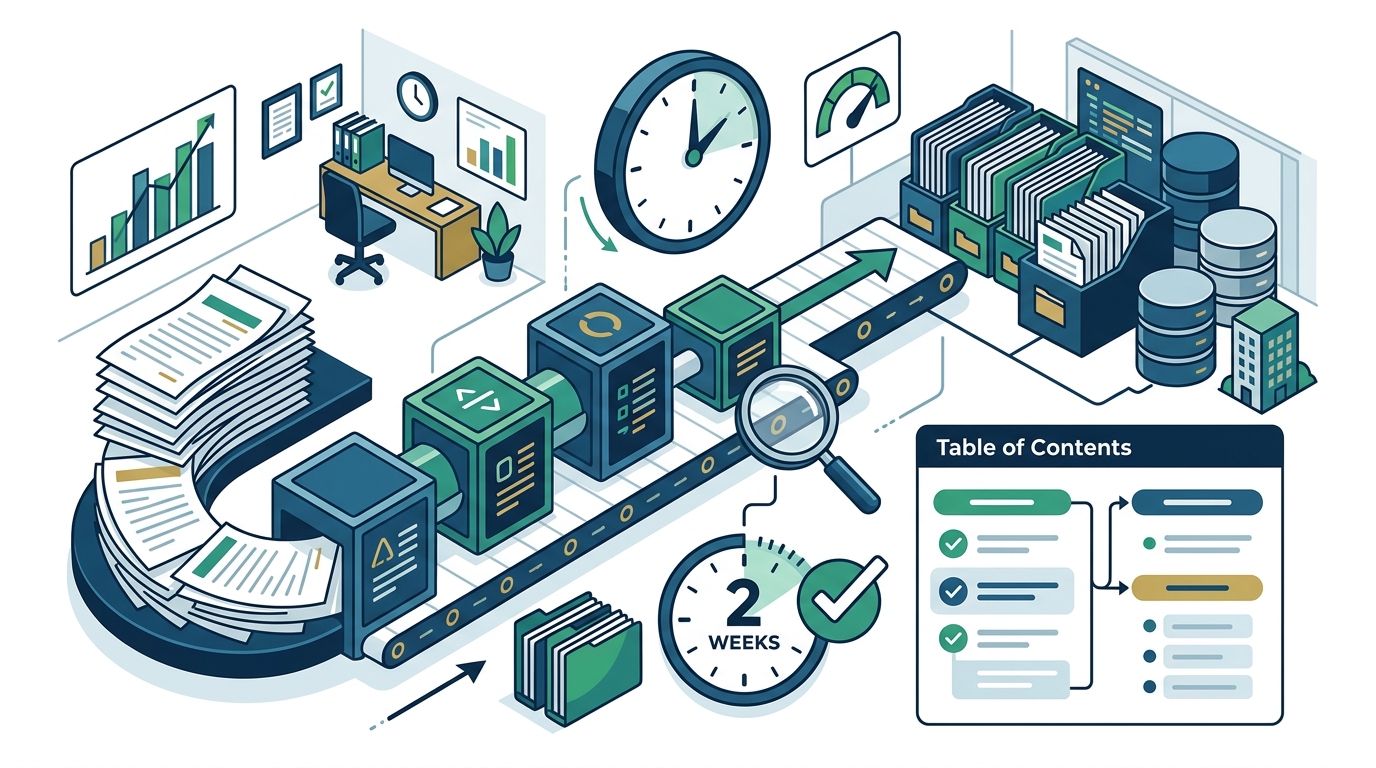
Fast onboarding follows a strict, automated sequence. Step one is automated document extraction. The system digitizes your existing document set, pulling out rent rolls and vendor contracts. Step two is legacy system synchronization. Data maps across your existing ERPs and accounting databases. Step three is instant baseline calibration. Historical financial data is modeled to set CAM/NNN recovery baselines and maintenance profiles.
The Two-Week Guarantee
This sequence is designed to complete in two weeks or less. The clock starts when you provide data and system access. It pauses only when client tasks or third-party dependencies run late. This zero-friction deployment unlocks NOI growth from Day 1, replacing the traditional month-end compile with real-time visibility.
What It Costs: Price Drivers
Onboarding costs are driven by complexity, not just unit count. A one-time onboarding fee covers platform configuration, data migration, and system connections. This fee is distinct from the recurring platform fee. For residential portfolios, pricing is typically per unit per month. For enterprise portfolios, pricing is per square foot or square metre of gross leasable area. Both models land at typically 1-3% of gross rents, which is significantly lower than the 8-12% charged by traditional property management companies.
Hidden Cost Traps
Watch for hidden costs in manual migration. If a vendor charges billable consulting hours for data entry, your onboarding cost will skyrocket. Automated platforms eliminate this. The platform fee covers the full system: leasing, maintenance triage, vendor oversight, and compliance. There are no hidden per-action fees for the core operating layer.
What Goes Wrong: Common Mistakes
The most common mistake is providing incomplete data. If your rent rolls are outdated or lease documents are missing, the AI cannot calibrate baselines accurately. This leads to variance errors in the first month. Another mistake is failing to define approval gates. If you do not set spend thresholds and escalation paths before go-live, the system may execute actions you do not want. Always test the approval workflow in a sandbox environment first.
Data Hygiene Failures
Dirty data in, dirty data out. If your legacy system has duplicate vendors or inconsistent unit IDs, the migration will carry these errors forward. Clean your data before handing it over. REIT AI's intelligent onboarding is robust, but it relies on the integrity of the source documents. Ensure your document set is complete and current.
Versus Alternatives: Platform Comparison
Traditional property management platforms often require 3-6 months for full migration. They rely on manual data entry and billable consulting. AI-native platforms like REIT AI's Mondo OS reduce this to two weeks. The difference is the underlying architecture. Legacy systems are databases; AI-native systems are operating engines that parse and reconcile data automatically.
| Feature | Traditional PM Platform | REIT AI Mondo OS |
|---|---|---|
| Onboarding Time | 3-6 Months | 2 Weeks or Less |
| Data Migration | Manual Entry / Consulting | Automated Extraction |
| Lease Parsing | Manual Review | Instant AI Triage |
| Cost Model | 8-12% of Rents | 1-3% of Rents |
| Reporting | Month-End Compile | Real-Time NOI |
For Specific Situations: Tailored Approaches
The approach changes based on your portfolio type. For REITs, the focus is on fund-level governance. You set spend thresholds once, and they are enforced identically across every asset. For family offices, the focus is on discretion and multi-entity reporting. You need consolidated visibility across jurisdictions without expanding headcount. For sovereign wealth funds, the focus is on cross-border standardization. One rule set, one audit trail, one live view.
Residential vs. Enterprise
Residential portfolios require tuning for leasing cycles and renewal logic. Enterprise portfolios require tuning for complex lease structures like NNN and CAM. The platform scope is identical, but the billing unit and specific workflow triggers differ. Ensure the vendor has purpose-built verticals for your asset class.
Rules and Protections: Compliance
Onboarding is not just about speed; it is about compliance. The platform must produce regulator-ready compliance as a byproduct of normal operations. This means every action, approval, and reconciliation is captured with a defensible trail. Controls are mapped to US and UK standards. Jurisdiction-aware compliance ensures that reporting rolls up to one consistent format, regardless of where the asset is located.
Legal Protections
Review the Master Subscription Agreement carefully. It should clarify that the provider is not a licensed real estate broker or fiduciary. All property management rules remain under your sole control. The software provides decision support, not professional advice. This distinction protects you legally while giving you operational autonomy.
Local Specifics: Regional Considerations
Local regulations impact onboarding complexity. In the US, focus on state-specific landlord-tenant laws and fair housing compliance. In the UK, focus on FCA and FINRA governance requirements if you have cross-border mandates. The platform must be jurisdiction-aware. It should adapt its compliance checks based on the location of each asset. This ensures that a single global portfolio operates under local rules without manual intervention.
Global Hubs
REIT AI operates with global hubs in Miami and Rome. This allows for trilingual and multilingual leadership support. If you have assets in Europe and the US, this geographic presence ensures that local nuances are understood and handled correctly during the onboarding process.
Timing: When to Act
Timing is critical for maximizing ROI. The best time to onboard is before a major acquisition or capital raise. This ensures that the new asset is integrated into the operating layer immediately. If you wait until after the deal closes, you lose the first month of real-time data. Also, consider the end of your fiscal year. Onboarding in Q4 allows you to start the new year with clean, automated reporting. Avoid onboarding during peak maintenance seasons if your team is already stretched thin.
Acquisition-Ready Diligence
Use the onboarding process as part of your acquisition diligence. Onboard a new asset into the operating layer without adding a management contract. This gives you immediate visibility into the asset's true operational performance. It replaces the stale, compiled reports you would otherwise receive from a traditional manager.
Results Over Time: Long-Term Outcomes
Fast onboarding is the entry point, but long-term results are the goal. In the first 90 days, you should see a significant reduction in OpEx. Anomalies that previously surfaced at month-end are flagged at intake. Invoice exceptions are caught before payment. Over time, the platform delivers up to 40% lower operating cost year over year. This is not a guarantee, but an illustrative figure based on the removal of the 8-12% management layer. The real benefit is the protection of Net Operating Income through continuous, automated oversight.
Measurable Outcomes
Track your NOI, OpEx, and variance reporting continuously. The platform provides board-ready reporting rather than a compiled cycle that is stale on arrival. You will see measurable reductions in the report as accepted recommendations are executed. This creates a feedback loop where the system gets smarter and more efficient over time.
Key Takeaways
- Automated document extraction is the key to fast onboarding, reducing timelines from months to two weeks.
- Always ask for a live demonstration against your own portfolio data to verify speed claims.
- Onboarding fees should cover configuration and migration, with no billable consulting hours.
- Traditional platforms charge 8-12% of rents; AI-native platforms typically land at 1-3%.
- Define approval gates and spend thresholds before go-live to maintain control.
- Jurisdiction-aware compliance is essential for cross-border portfolios.
- Onboarding before acquisitions allows for immediate integration and visibility.
- Long-term results include real-time NOI reporting and continuous OpEx reduction.
Frequently Asked Questions
How long does Mondo onboarding take?
Mondo onboarding takes two weeks or less, guaranteed. The clock starts once you provide the agreed data and system access, and pauses when client tasks or third-party dependencies run late.
Is there a cost for data migration?
There is a one-time onboarding fee that covers platform configuration, data migration, and system connections. There are no billable consulting hours for manual migration work.
Does Mondo replace my existing accounting system?
No, Mondo deploys inside your stack. It connects to your existing accounting, banking, CRM, and document systems via custom API integrations. There is no rip-and-replace required.
How is Mondo priced?
Residential portfolios are priced per unit per month. Enterprise portfolios are priced per square foot or square metre of gross leasable area. Both typically land at 1-3% of gross rents.
Can I control the AI's actions?
Yes, the Asset Manager stays in complete control. You set the rules, spend thresholds, and approval gates. The autopilot executes, but you approve every move.
Is my data used to train AI models?
No, REIT AI does not use client data to train third-party models. Data is encrypted in transit and at rest, with least-privilege access and a complete audit trail.
Conclusion
Fast onboarding is no longer a luxury; it is a requirement for institutional real estate. By choosing a platform with automated extraction and AI-native architecture, you can migrate your portfolio in two weeks. REIT AI's Mondo OS provides this speed without compromising on control or compliance. To see how removing the management layer impacts your NOI, request a demo and run a live environment against your own numbers.