

Best Property Management Software for REITs and Family Offices in 2026
For REITs and family offices managing multiple entities, the best property management software is an AI-driven operating layer that consolidates multi-entity reporting, automates financial triage, and enforces governance without adding headcount. This guide covers how to evaluate platforms for multi-entity portfolios, the specific features required for institutional scale, and how to transition from legacy systems to autonomous operations.
Evaluation Criteria for Multi-Entity Portfolios
Managing multiple entities requires software that can handle complex ownership structures, varied lease types, and distinct reporting requirements. Traditional tools often struggle with this complexity, leading to data silos and manual reconciliation errors. Institutional investors must prioritize platforms that offer a unified view of Net Operating Income (NOI) across all assets.
Multi-Entity Reporting
Multi-entity reporting is the ability to consolidate financial data from disparate legal entities into a single, coherent dashboard. For family offices and REITs, this means seeing cash flow, expenses, and compliance status across residential, commercial, and mixed-use properties simultaneously. The software must support jurisdiction-aware compliance, mapping controls to local requirements while rolling up to a global standard.
Scalability and Governance
Scalability is the capacity of a system to handle increasing data volume and user complexity without performance degradation. Governance refers to the set of rules and approval gates that control how the software executes actions. In an institutional context, governance is not optional; it is the mechanism that ensures an AI or automated system acts within the boundaries set by the Asset Manager. The platform must allow you to define spend thresholds and approval hierarchies that are enforced identically across every asset.
The Limitations of Legacy Systems
The Management Fee Leakage
Traditional property management companies typically charge 8–12% of gross rents for coordination work. This fee covers a layer of human labor that is often inefficient and lacks a scalable technology foundation. For a $450 million portfolio, this percentage represents a massive annual cost that does not necessarily correlate with improved operational outcomes. The structural inefficiency lies in the fact that this management layer often has no AI beneath it, meaning it cannot scale without adding headcount.
Data Latency and Anomaly Detection
Legacy systems operate on monthly cycles. Invoices are reviewed at month-end, and variances are discovered weeks after they occur. This latency means that cost anomalies, such as duplicate billing or out-of-band pricing, are paid before they are flagged. An AI-driven operating layer reviews every invoice against contract terms and historical pricing at intake, flagging exceptions in hours rather than weeks. This shift from reactive to proactive financial triage is a critical differentiator for institutional investors.
The AI Operating Layer
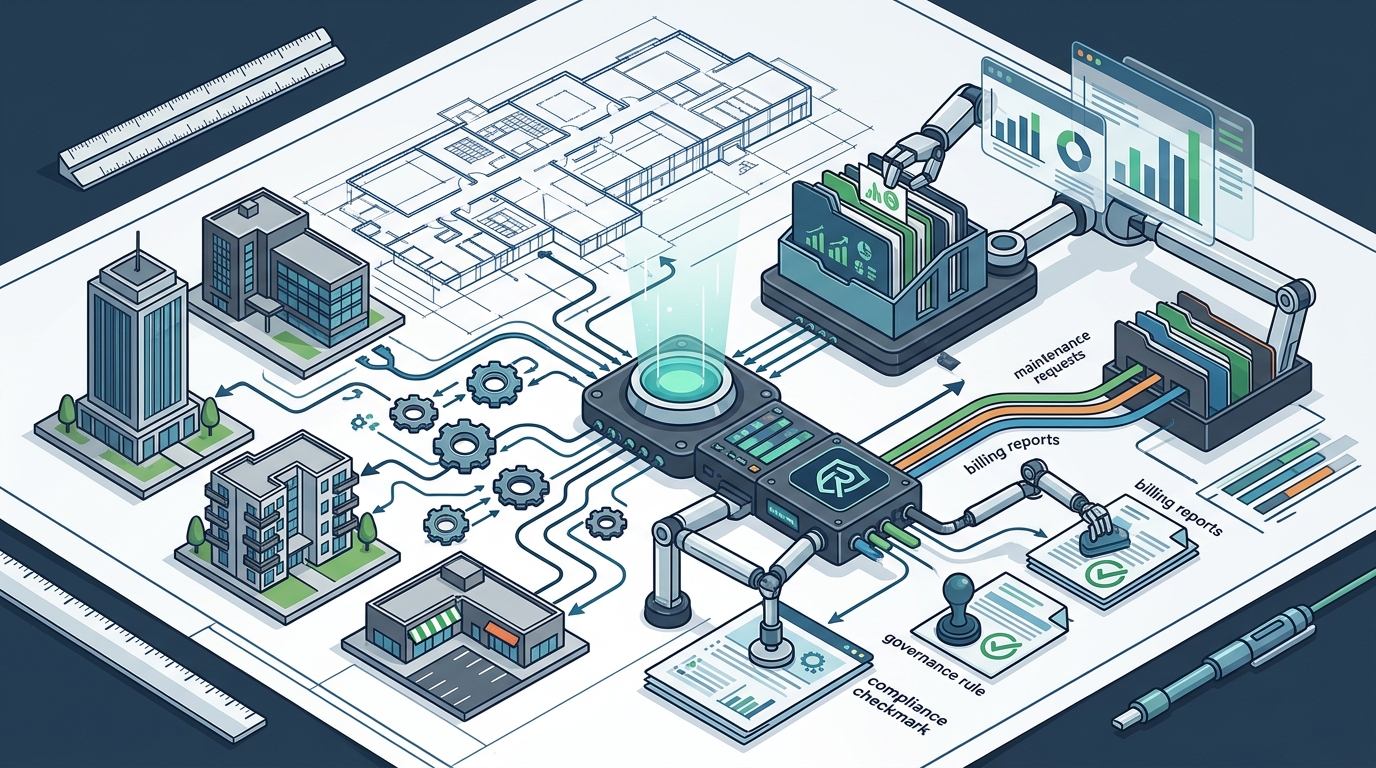
An AI operating layer is a software infrastructure that executes property management tasks autonomously while maintaining human oversight. It replaces the traditional management layer by running leasing, maintenance triage, vendor oversight, and invoice review directly. The Asset Manager remains in charge, setting the rules and approving every move, but the execution is handled by the system.
Autonomous Maintenance Triage
Autonomous maintenance triage is the process of determining the severity, category, and cost band of a maintenance request at the moment it arrives. Instead of queuing requests for a human coordinator, the system dispatches approved vendors within defined spend thresholds. Anything above the threshold is escalated for approval. This ensures that routine issues are resolved instantly while complex or expensive issues receive the necessary human review.
Financial Triage and Reconciliation
Financial triage involves reviewing every vendor invoice against contract terms, scope, and historical pricing before approval. The system reconciles this data against the accounting system continuously, rather than in a monthly batch. This provides live visibility into budget-to-actual variance, with drivers identified per asset. The result is a measurable reduction in operating expenses, as accepted recommendations show up as reductions in the report.
Governance and Compliance Architecture
Institutional real estate is subject to strict regulatory and internal control requirements. Software must be built around these constraints from day one, not retrofitted. The governance model must include spend thresholds, approval gates, and escalation paths defined by the Asset Manager and enforced by the system.
Audit-Ready Compliance
Audit-ready compliance means that every automated and approved action is captured with a defensible trail. This includes timestamped records of every decision, reviewable by internal and external audit. The system must be mapped to relevant standards, such as FCA, FINRA, and SEC requirements, ensuring that reporting is regulator-ready by default. This eliminates the quarterly scramble to compile compliance data.
Security and Data Handling
Security is the set of technical and organizational measures used to protect data. Institutional platforms must offer encryption in transit and at rest, least-privilege access, and no use of client data to train third-party models. Integrations are scoped per system, reviewed with the IT team, and revocable at any time. This ensures that the platform operates inside the client's architecture with full visibility and control.
Implementation and Integration
Implementing a new operating layer requires careful planning to ensure data integrity and minimal disruption. The goal is to deploy the system inside the existing stack, not to rip and replace it. This approach reduces risk and accelerates time to value.
Intelligent Onboarding
Intelligent onboarding is the process of ingesting and digitizing entire real estate portfolios rapidly. The system extracts critical terms, rent rolls, vendor contracts, and lease variables automatically from existing documents. It synchronizes data across existing CRE software, ERPs, and accounting databases without requiring manual migration work. This process can be completed in two weeks or less, unlocking NOI growth from Day 1.
Custom Enterprise Integration
Custom enterprise integration involves deploying bespoke AI infrastructure directly into the client's accounting, banking, CRM, and document stack. This ensures that the new operating layer works with the tools the institution already owns. The platform becomes the operating layer on top of the existing architecture, providing a centralized interface for data management, back-office admin, and accounting.
Platform Comparison
The following table compares key features of traditional legacy systems and modern AI operating layers for institutional real estate.
| Feature | Legacy Property Management | AI Operating Layer (e.g., REIT AI) |
|---|---|---|
| Operating Cost | 8–12% of gross rents | Typically 1–3% of gross rents |
| Financial Review | Monthly batch processing | Continuous real-time reconciliation |
| Maintenance Triage | Human coordinator queue | Instant autonomous triage |
| Reporting | Stale monthly compile | Real-time portfolio view |
| Compliance | Quarterly manual scramble | Regulator-ready by default |
| Integration | Manual data entry | Custom API integrations |
Key Takeaways
- Multi-entity portfolios require software that consolidates reporting across legal entities and jurisdictions.
- The 8–12% management fee is a structural inefficiency that can be eliminated by an AI operating layer.
- Autonomous maintenance triage resolves routine issues instantly while escalating complex ones for approval.
- Continuous financial reconciliation flags cost anomalies at intake, not at month-end.
- Governance models with defined spend thresholds and approval gates are essential for institutional control.
- Audit-ready compliance ensures every automated action is timestamped and reviewable.
- Intelligent onboarding can digitize a portfolio in two weeks or less without manual migration.
- Custom enterprise integration allows the AI layer to deploy inside the existing client architecture.
Frequently Asked Questions
What is the best property management software for REITs?
The best software for REITs is an AI operating layer that removes the management fee layer while providing real-time portfolio reporting and fund-level governance. It must support multi-asset scale and audit-ready compliance.
How does AI property management work for family offices?
For family offices, AI property management provides institutional operations without an institutional payroll. It supplies 24/7 tenant support, maintenance triage, and vendor oversight, allowing a lean team to govern a large portfolio without outsourcing control.
Can AI replace a property manager?
AI does not replace the Asset Manager; it replaces the third-party management layer. The Asset Manager stays in charge, setting the rules and approving every move, while the AI executes the operations end to end.
What is the cost of AI property management software?
AI property management software is typically priced at 1–3% of gross rents, which is significantly lower than the 8–12% charged by traditional management companies. Pricing is quoted per portfolio based on unit count or square footage.
How long does it take to implement an AI operating layer?
Implementation typically takes two weeks or less for intelligent onboarding. This includes platform configuration, data migration, and connection to existing accounting and banking systems.
Is AI property management secure?
Yes, institutional AI platforms use encryption in transit and at rest, least-privilege access, and complete audit trails. They do not use client data to train third-party models, ensuring data stays within the client's perimeter.
Conclusion
For REITs and family offices managing multiple entities, the choice of property management software is a strategic decision that impacts NOI, compliance, and operational scale. Legacy systems are no longer sufficient for institutional portfolios. An AI operating layer, such as the one provided by REIT AI, offers the governance, automation, and real-time visibility required to modernize institutional real estate. By removing the management layer and deploying AI inside your existing architecture, you can achieve up to 40% lower operating cost while maintaining full control. To see how this works in practice, request a demo and explore the live environment against your own portfolio numbers.