

Consolidating Multi-Entity Accounting with Property Management Software
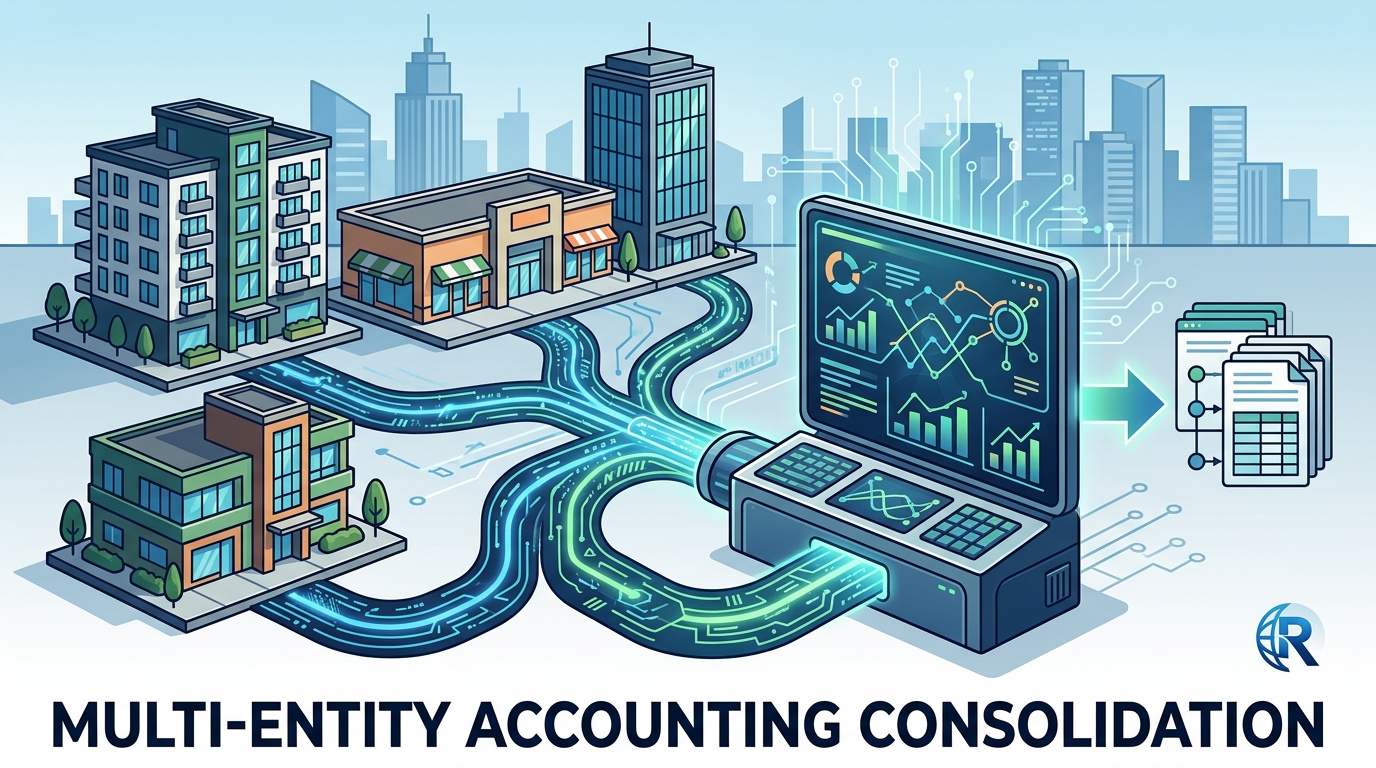
Property management software consolidates accounting across multiple real estate entities by centralizing data ingestion, automating intercompany reconciliation, and unifying reporting standards. This approach eliminates manual spreadsheet work and provides a single source of truth for institutional portfolios. REIT AI addresses this complexity by deploying an autonomous operating layer that standardizes financial workflows across diverse asset classes and jurisdictions.
The Fragmentation Problem
Multi-entity accounting is the process of managing financial records for multiple legal entities within a single corporate structure. In institutional real estate, this often means dealing with dozens or hundreds of Special Purpose Vehicles (SPVs), each with its own bank accounts, tax IDs, and lease structures. Traditional property management relies on manual data entry and periodic batch processing, which creates significant lag between operational events and financial reporting. according to Financial statement
This fragmentation leads to data silos where information about a single asset is scattered across different systems. For example, maintenance costs might be recorded in one system while lease revenue is tracked in another. The result is a high risk of reconciliation errors and delayed financial visibility. REIT AI was built to replace this legacy coordination layer with a technology-driven operating engine that handles these workflows automatically.
Centralized Data Ingestion
Consolidation begins with how data enters the system. Modern property management software uses automated document extraction to pull critical terms, rent rolls, and vendor contracts from existing documents. This eliminates the need for manual data entry, which is both slow and prone to human error. By digitizing the intake process, the software creates a clean, structured dataset that can be mapped across existing Enterprise Resource Planning (ERP) and accounting databases.
REIT AI’s intelligent onboarding capability ingests and digitizes entire real estate portfolios in a fraction of the time typically required by manual migration. This rapid setup allows for instant baseline calibration, where historical financial data is modeled to set recovery baselines and maintenance profiles from the outset. The implication is that asset managers gain immediate visibility into their portfolio’s financial health without waiting for month-end closing cycles.
Automated Intercompany Reconciliation
Intercompany reconciliation is the process of matching financial transactions between related entities to ensure accuracy in consolidated financial statements. In real estate, this often involves Common Area Maintenance (CAM) and Net Net Net (NNN) expense recoveries, where costs are shared or passed through to tenants across different legal entities. Manual reconciliation of these complex splits is a major source of operational leakage and audit friction.
REIT AI executes GLA-based expense reconciliation automatically across the portfolio. The system compresses recovery cycles from weeks of spreadsheet work to minutes of reviewed output. By parsing complex lease contracts instantly, the software determines maintenance liability and responsibility splits before a vendor is even dispatched. This ensures that intercompany transactions are recorded accurately at the point of occurrence, rather than being corrected after the fact.
Unified Reporting Standards
Unified reporting is the practice of generating financial statements that adhere to a single set of standards across all entities in a portfolio. For institutional investors, this means producing regulator-ready compliance reports that reflect the true economic performance of the portfolio. Without a unified standard, asset managers must spend significant time translating data from different local systems into a format acceptable to investors and regulators.
REIT AI produces regulator-ready compliance as a byproduct of normal operations rather than a quarterly scramble. The system maps controls to US and UK standards, with reporting rolled up to one consistent format. This allows for real-time portfolio reporting instead of month-end cycles. The implication is that board members and investors receive continuous Net Operating Income (NOI) and variance reporting that is current and reliable, rather than a compiled cycle that is stale on arrival.
Governance and Auditability
Governance in multi-entity accounting refers to the set of rules and controls that ensure financial data is handled securely and accurately. As portfolios grow in complexity, the need for a defensible audit trail becomes critical. Every automated action, approval, and reconciliation must be captured with a timestamp and reviewable by internal and external auditors.
REIT AI operates inside the client’s architecture with scoped access, encryption in transit and at rest, and a complete audit trail on every action the autopilot takes. The Asset Manager sets the rules, spend thresholds, and approval gates, while the system executes within those boundaries. This model ensures that while the software handles the heavy lifting of consolidation, human oversight remains in charge of every significant financial decision. To see how this governance model works in practice, you can review the security and compliance architecture.
Key Takeaways
- Multi-entity accounting is the process of managing financial records for multiple legal entities, which requires centralized data management to avoid silos.
- Automated document extraction and data ingestion eliminate manual entry errors and accelerate portfolio onboarding.
- Intercompany reconciliation for CAM and NNN expenses can be automated to reduce recovery cycles from weeks to minutes.
- Unified reporting standards allow for real-time, regulator-ready compliance across US and UK jurisdictions.
- Strong governance controls, including scoped access and audit trails, are essential for maintaining trust in automated financial workflows.
- REIT AI replaces the traditional 8-12% management layer with an autonomous operating engine that protects Net Operating Income.
Frequently Asked Questions
How does REIT AI handle data from different accounting systems?
REIT AI connects through custom API integrations into your existing accounting, banking, CRM, and document systems. Nothing is ripped out; the platform becomes the operating layer on top of the stack you already run, ensuring seamless data flow.
Can the software manage both residential and commercial entities?
Yes, REIT AI offers two distinct verticals. Mondo Residential covers multifamily and HOA communities, while Mondo Enterprise covers commercial and institutional portfolios. Each is purpose-built around its own leasing cycle and reporting requirements.
Who is in control of the financial approvals?
The Asset Manager is always in control. You set the rules, the spend thresholds, and the approval gates. The autopilot executes inside those boundaries and escalates anything outside them by text, email, or call.
How long does it take to onboard a multi-entity portfolio?
Mondo ingests and digitizes entire real estate portfolios in two weeks or less, guaranteed. This includes data migration from existing systems and connection to your accounting and banking stack.
Does REIT AI provide financial or legal advice?
No, REIT AI provides operations software and automation. It is not a licensed financial, investment, tax, or legal advisor. The software supports compliance workflows but does not warrant regulatory approval or legal outcomes.
Ready to Consolidate Your Portfolio?
REIT AI provides the autonomous operating layer needed to streamline multi-entity accounting and protect your Net Operating Income. By replacing the traditional management layer with intelligent infrastructure, you can gain real-time visibility and control over your entire portfolio. To see what removing the management layer does to your NOI, request a demo and explore the Mondo walkthrough library.