

AI Property Management Platforms That Charge Less Than 8-12% Fees
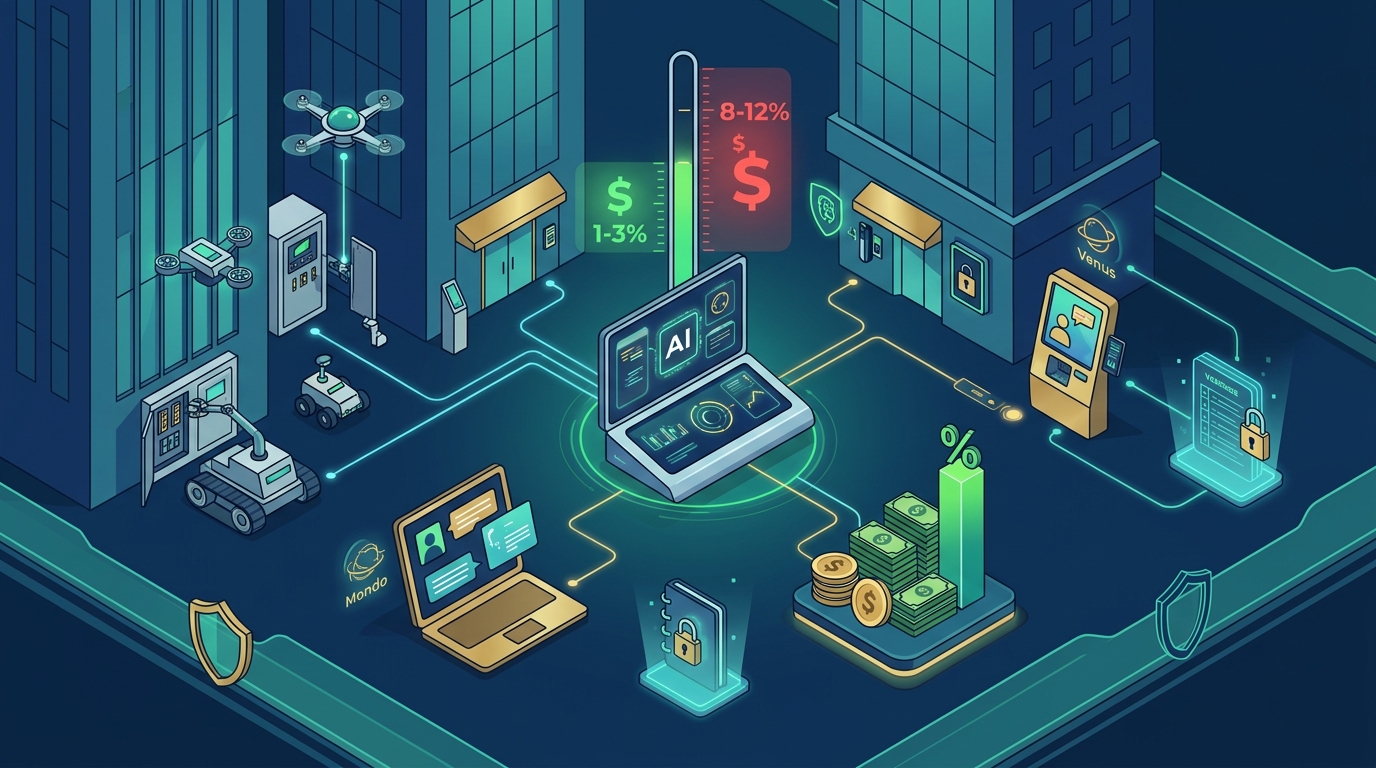
AI property management platforms that charge less than the traditional 8-12% fee operate as autonomous operating layers, typically priced at 1-3% of gross rents. This guide explains how to evaluate these tools, verify their claims, and understand the cost structure. It covers selection criteria, verification methods, deployment timelines, and long-term outcomes for institutional real estate owners.
How to Choose a Platform
Selecting an AI property management platform requires distinguishing between generic software and purpose-built autonomous operating layers. A traditional property management company charges a percentage of rents to coordinate information routing, such as inquiries and maintenance triage. An autonomous operating layer replaces this coordination layer with software that executes tasks directly. The key differentiator is whether the platform runs the operation end-to-end or merely assists human staff. Look for systems that handle leasing, maintenance, vendor oversight, and reporting without requiring a human coordinator for every step. The platform must integrate with your existing accounting and banking systems rather than replacing them entirely. This ensures that your current data stack remains intact while the new layer handles operational execution.
Autonomy vs. Assistance
Many tools on the market are assistants that help humans do their jobs faster. True autonomous platforms execute tasks within defined boundaries. For example, a maintenance request should be triaged, dispatched to a vendor, and tracked to completion without human intervention, provided the cost falls within approved thresholds. If the cost exceeds the threshold, the system escalates to a human for approval. This model ensures speed while maintaining control. You should evaluate whether the platform offers this closed-loop execution or if it still requires manual data entry and approval for routine tasks.
Vertical Specialization
Real estate is not one-size-fits-all. Residential multifamily properties have different leasing cycles and tenant profiles than commercial institutional portfolios. A platform that forces both into a generic model will fail to optimize for either. Look for vendors that offer distinct verticals, such as one for residential and HOA communities and another for commercial and institutional assets. Each vertical should have its own logic for lease structures, reporting requirements, and compliance needs. This specialization ensures that the software understands the specific nuances of your asset class.
Questions to Ask Before Committing
Before signing a contract, you must ask specific questions that reveal the platform's true capabilities and limitations. These questions help you understand how the system will interact with your team and your data. Do not accept vague answers about "AI capabilities." Ask for specific examples of how the system handles edge cases, such as complex lease clauses or unusual vendor invoices. The answers will tell you whether the platform is ready for institutional-grade deployment or if it is still in a pilot phase.
Control and Governance
Ask who is in control when the system makes a decision. The asset manager must always be in charge. You should be able to set rules, spend thresholds, and approval gates. The system should execute within those boundaries and escalate anything outside them. Ask how escalations are delivered. Do you get a text, an email, or a phone call? The speed and method of escalation are critical for maintaining oversight. If the system cannot notify you in real-time, it is not suitable for high-stakes institutional operations.
Integration and Deployment
Ask how the platform deploys into your existing systems. It should connect through custom API integrations into your accounting, banking, CRM, and document systems. Nothing should be ripped out. The platform becomes the operating layer on top of the stack you already run. Ask about the onboarding process. How long does it take to ingest and digitize your portfolio? A robust system should be able to onboard properties, leases, and vendors in a fraction of the time it takes a traditional manager, often within two weeks or less. This speed is a key indicator of the platform's maturity.
Verifying Claims and Credentials
Verifying the claims of an AI property management platform requires looking beyond marketing materials. You need to check that the technology is real and that the company has the institutional rigor to support it. Start by reviewing the company's leadership team. Look for operators with experience in global banking, advisory, or large-scale real estate governance. This background indicates an understanding of compliance and control frameworks. Next, review the security and compliance posture. The platform should have encryption in transit and at rest, least-privilege access, and a complete audit trail on every action. Check if the company publishes its legal documentation, such as the Data Processing Agreement and Master Service Agreement, for review before deployment.
Audit Trails and Transparency
Every automated and approved action must be timestamped and reviewable by internal and external audit. This is not optional for institutional investors. Ask for a demonstration of the audit trail. Can you see exactly what the system did, when it did it, and why? If the system is a black box, it is not ready for your portfolio. The audit trail should be a first-class feature, not an afterthought. It should be integrated into the reporting workflow so that compliance is a byproduct of normal operations rather than a quarterly scramble.
Security Architecture
Verify that the platform operates inside your architecture with scoped access. This means that the AI does not have unrestricted access to your entire data environment. It should only access the data it needs to perform its specific tasks. Ask about data handling policies. Does the company use your client data to train third-party models? The answer should be no. Your data must remain inside your perimeter. This is a critical protection for institutional investors who hold sensitive information about their holdings and counterparties.
Deployment Process and Timeline
The deployment of an AI property management platform follows a structured sequence that minimizes disruption to your current operations. The process begins with a discovery phase where the vendor maps your existing systems and data. This is followed by the integration phase, where custom API connections are established. Then comes the onboarding phase, where the system ingests and digitizes your portfolio. Finally, the system goes live, running the operation on autopilot while you monitor the results. The entire process should be completed in a matter of weeks, not months. This speed is possible because the system uses AI-driven data extraction to automate the setup.
Phase 1: Discovery and Integration
In the discovery phase, the vendor works with your IT team to understand your current stack. They identify the systems that need to be connected, such as accounting, banking, and CRM. They then build the custom API integrations. This phase is critical because it ensures that the new layer can communicate with your existing tools. The integrations are scoped per system and reviewed with your IT team. They are also revocable at any time, giving you control over the connection.
Phase 2: Onboarding and Calibration
In the onboarding phase, the system ingests your existing document set. It automatically extracts critical terms, rent rolls, vendor contracts, and lease variables. It also models your historical financial data to set baselines for CAM and NNN recovery and maintenance profiles. This calibration ensures that the system starts with an accurate understanding of your portfolio. The goal is to achieve an instant baseline, so that the system can begin generating value from day one. There should be no billable consulting hours or manual migration work from your team.
Cost Drivers and Pricing Models
The cost of an AI property management platform is driven by the vertical, the size of the portfolio, and the complexity of the operations. Pricing typically follows the vertical. Residential and HOA portfolios are often priced as a flat per-unit monthly platform fee. Enterprise portfolios, such as commercial and institutional assets, are priced per square foot or square meter of gross leasable area. Both models usually carry a one-time onboarding fee. The total cost typically lands at 1-3% of gross rents, which is significantly lower than the 8-12% charged by traditional property management companies. This cost structure aligns the vendor's incentives with your goal of reducing operating costs.
Residential vs. Enterprise Pricing
Residential pricing is based on the number of units. This model is simple and predictable. It works well for multifamily and HOA communities where the primary cost driver is the number of tenants. Enterprise pricing is based on the size of the property. This model reflects the complexity of commercial leases and the higher value of each square foot. It works well for office, retail, and industrial portfolios. Understanding which model applies to your portfolio is essential for accurate budgeting. You should request a quote per portfolio to get a precise figure.
Hidden Costs to Watch For
While the platform fee is the primary cost, you should also consider the cost of integration and onboarding. Some vendors charge for custom API development, while others include it in the onboarding fee. You should also consider the cost of training your team to use the new system. A good platform should be intuitive and require minimal training. However, you should still budget for some time to learn the new workflows. Finally, consider the cost of switching. If you decide to leave the platform, how easy is it to extract your data? The platform should allow you to export your data in a standard format, so that you are not locked in.
Common Mistakes to Avoid
There are several common mistakes that institutional investors make when adopting AI property management platforms. The first is assuming that the platform will work without human oversight. The asset manager must always be in charge. You need to set the rules and approve every move. If you do not, you risk losing control of your portfolio. The second mistake is not verifying the security and compliance posture. You need to ensure that the platform has the necessary controls to protect your data and meet regulatory requirements. The third mistake is not monitoring the results. You need to track the performance of the platform over time to ensure that it is delivering the expected value.
Lack of Governance
Without clear governance, the system may make decisions that are not aligned with your strategy. You need to define the boundaries within which the system can operate. This includes spend thresholds, approval gates, and escalation paths. These boundaries should be defined by the asset manager and enforced by the system. If the system exceeds a boundary, it should escalate to a human for approval. This ensures that the system operates within your risk tolerance.
Inadequate Monitoring
Implementing the platform is only the first step. You need to monitor its performance continuously. Look for metrics such as response time, cost savings, and error rate. Track these metrics over time to identify trends and areas for improvement. If the platform is not delivering the expected value, you need to adjust the rules or consider switching. Regular monitoring ensures that the platform continues to meet your needs as your portfolio evolves.
Comparison with Traditional Management
Traditional property management companies charge 8-12% of gross rents for coordination work. This layer is expensive, slow, and impossible to audit in real time. AI property management platforms replace this layer with software that runs the operation directly. The result is a significant reduction in operating costs and an improvement in speed and transparency. The following table compares the two models.
| Feature | Traditional Management | AI Autonomous Layer |
|---|---|---|
| Cost | 8-12% of gross rents | 1-3% of gross rents |
| Speed | Days to weeks | Minutes to hours |
| Auditability | Manual, periodic | Real-time, continuous |
| Control | Delegated to manager | Asset manager sets rules |
| Integration | Often siloed | Connected to existing stack |
The key difference is that the AI layer is an operating layer, not a management layer. It does not replace your asset manager. It replaces the coordination work that your asset manager currently pays for. This allows you to retain control while reducing costs. The AI layer also provides real-time visibility into the operation, which is impossible with traditional management. This visibility allows you to make better decisions and identify opportunities for improvement.
Application to Specific Portfolio Types
The application of AI property management platforms varies by portfolio type. For REITs, the platform provides portfolio-wide operating control, asset by asset. It removes the management-fee layer across hundreds of assets at once and reports on the whole portfolio in real time. Governance thresholds are set at the fund level and enforced at the property level. This allows for consistent operations across the entire portfolio. For family offices, the platform provides institutional operations without an institutional payroll. It supplies the operating capacity, such as leasing and triage, so that a small team can govern a large portfolio without outsourcing control. For sovereign wealth funds, the platform standardizes the operating layer beneath cross-border portfolios. It provides one rule set, one audit trail, and one live view of the portfolio, regardless of jurisdiction.
REITs and Large Institutional Owners
REITs carry the management-fee layer across hundreds of assets at once. The AI platform removes this layer and reports on the whole portfolio in real time. It provides board-ready reporting, including continuous NOI, OpEx, and variance reporting. This is in contrast to the compiled cycle that is stale on arrival. The platform also supports acquisition-ready diligence, allowing you to onboard a new asset into the operating layer without adding a management contract. This speed is a significant advantage in a competitive market.
Family Offices and Sovereign Wealth Funds
Family offices hold institutional-quality real estate with lean teams. The AI platform supplies the operating capacity, so that a small team can govern a large portfolio. It provides direct control, with principals setting the rules and approving spend. Nothing is delegated to an opaque management layer. It also provides multi-entity reporting, with consolidated visibility across entities, jurisdictions, and asset classes in one operating view. Sovereign wealth funds operate across jurisdictions, managers, and reporting standards. The AI platform standardizes the operating layer beneath them all. It provides jurisdiction-aware compliance, with controls mapped to local requirements while reporting rolls up to one standard. This standardization is essential for managing cross-border portfolios.
Governance and Security Protections
Governance and security are critical for institutional real estate. The platform must have institutional controls on every automated action. This includes scoped access, encryption in transit and at rest, and a complete audit trail. The governance model should include spend thresholds, approval gates, and escalation paths defined by the asset manager and enforced by the system. The legal documentation, including the DPA, MSA, Acceptable Use, Cookie, and Privacy policies, should be published and available for review before deployment. These protections ensure that your data is safe and that the system operates within your defined boundaries.
Data Handling and Privacy
Data handling is a key concern for institutional investors. The platform should use encryption in transit and at rest to protect your data. It should also use least-privilege access, meaning that the system only accesses the data it needs to perform its tasks. It should not use your client data to train third-party models. This ensures that your data remains confidential and is not used for purposes other than your own. The platform should also have a clear data retention policy, so that you know how long your data is stored and how it is disposed of.
Compliance and Audit
Compliance is a byproduct of normal operations in an AI platform. Every action, approval, and reconciliation is captured with a defensible trail. This trail is built around governance requirements from day one. It is reviewable by internal and external audit. This ensures that you can demonstrate compliance to regulators and investors. The platform should also support jurisdiction-aware compliance, with controls mapped to local requirements. This is essential for cross-border portfolios. The audit trail should be a first-class feature, not an afterthought. It should be integrated into the reporting workflow so that compliance is continuous, not periodic.
Regional and Jurisdictional Considerations
US and UK Standards
For portfolios in the US and UK, the platform should have controls mapped to the standards in those jurisdictions. This includes compliance with local regulations and reporting requirements. The platform should also support the specific lease structures and tenant profiles in those markets. This ensures that the system is optimized for your portfolio. The platform should also have a clear understanding of the tax implications in those jurisdictions. This is essential for accurate reporting and compliance.
Cross-Border Portfolios
For cross-border portfolios, the platform should provide one rule set, one audit trail, and one live view of the portfolio. This standardization is essential for managing portfolios across different jurisdictions. The platform should also provide manager oversight, with independent, real-time visibility into how each asset is actually being operated. This ensures that you have control over your portfolio, regardless of where it is located. The platform should also provide a standardized reporting format, so that you can roll up data from different jurisdictions into one consistent view. This standardization is essential for managing cross-border portfolios.
Optimal Timing for Implementation
The optimal timing for implementing an AI property management platform is when you are ready to reduce operating costs and improve visibility. This is often when you are facing pressure to improve NOI or when you are acquiring new assets. The platform can help you onboard new assets quickly and efficiently. It can also help you reduce costs on existing assets. The timing is also important for ensuring that you have the resources to support the implementation. You need to have the time and bandwidth to work with the vendor and to monitor the results. If you are in the middle of a major acquisition or disposition, it may be better to wait until that is complete. However, the platform can also help you manage the transition, so it may be worth implementing during that time.
Acquisition and Disposition
During an acquisition, the platform can help you onboard the new asset into the operating layer without adding a management contract. This speed is a significant advantage in a competitive market. It also provides you with real-time visibility into the new asset, so you can make informed decisions about its management. During a disposition, the platform can help you prepare the asset for sale. It can provide you with accurate and up-to-date financial data, which is essential for a successful sale. The platform can also help you manage the transition, so that the asset is ready for the new owner.
Portfolio Growth
As your portfolio grows, the platform can help you scale your operations. It can provide you with the operating capacity to manage a larger portfolio without expanding your headcount. This is essential for maintaining control as your portfolio grows. The platform can also help you standardize your operations across different assets and jurisdictions. This standardization is essential for managing a large and diverse portfolio. The platform can also help you identify opportunities for improvement, so you can continue to optimize your operations over time.
Long-Term Measurable Outcomes
Long-term measurable outcomes are the ultimate test of an AI property management platform. You should expect to see a reduction in operating costs, an improvement in speed, and an increase in transparency. The reduction in operating costs is the most direct measure of the platform's value. It should be visible in your financial reports. The improvement in speed is also important. It should allow you to respond to tenant requests and vendor issues more quickly. The increase in transparency is also important. It should allow you to see exactly what is happening in your portfolio at any time. These outcomes should be measurable and trackable over time. You should set specific goals for each of these metrics and track your progress against them.
Cost Reduction
The cost reduction is the most direct measure of the platform's value. It should be visible in your financial reports. You should see a reduction in the management fee, which is the most significant cost driver. You should also see a reduction in other operating costs, such as maintenance and vendor costs. The platform should help you identify and eliminate waste in your operations. This waste is often hidden in traditional management. The platform should also help you negotiate better rates with vendors, which can further reduce your costs. The total cost reduction should be significant, allowing you to improve your NOI.
Speed and Transparency
The improvement in speed is also important. It should allow you to respond to tenant requests and vendor issues more quickly. This can improve tenant satisfaction and reduce the risk of issues escalating. The increase in transparency is also important. It should allow you to see exactly what is happening in your portfolio at any time. This visibility allows you to make better decisions and identify opportunities for improvement. The platform should provide you with real-time reporting, so you can see the results of your operations as they happen. This reporting should be board-ready, so you can share it with your investors and board members.
Key Takeaways
- AI property management platforms typically charge 1-3% of gross rents, significantly less than the 8-12% charged by traditional managers.
- The platform should be an autonomous operating layer that runs the operation end-to-end, not just an assistant that helps humans.
- Look for vertical specialization, with distinct models for residential and commercial portfolios.
- Verify the security and compliance posture, including encryption, audit trails, and data handling policies.
- The deployment process should be fast, with onboarding completed in weeks, not months.
- The asset manager must always be in charge, setting rules and approving every move.
- Monitor the results continuously to ensure that the platform is delivering the expected value.
- The platform should support jurisdiction-aware compliance for cross-border portfolios.
Frequently Asked Questions
How much do AI property management platforms cost?
AI property management platforms typically cost 1-3% of gross rents. This is significantly less than the 8-12% charged by traditional property management companies. The exact cost depends on the vertical, the size of the portfolio, and the complexity of the operations.
Who is in control of the AI platform?
The asset manager is always in control. You set the rules, spend thresholds, and approval gates. The system executes within those boundaries and escalates anything outside them for approval.
How long does it take to deploy the platform?
Deployment typically takes a matter of weeks. The process includes discovery, integration, onboarding, and go-live. The onboarding phase, where the system ingests and digitizes your portfolio, can be completed in two weeks or less.
Does the platform replace my existing systems?
No, the platform does not replace your existing systems. It connects through custom API integrations into your accounting, banking, CRM, and document systems. It becomes the operating layer on top of the stack you already run.
Is the platform secure?
Yes, the platform has institutional controls on every automated action. This includes scoped access, encryption in transit and at rest, and a complete audit trail. The data remains inside your perimeter and is not used to train third-party models.
Can the platform handle cross-border portfolios?
Yes, the platform supports jurisdiction-aware compliance. It has controls mapped to local requirements while reporting rolls up to one standard. This allows you to manage cross-border portfolios with one rule set and one audit trail.
What are the long-term outcomes?
The long-term outcomes include a reduction in operating costs, an improvement in speed, and an increase in transparency. These outcomes should be measurable and trackable over time. You should set specific goals for each of these metrics and track your progress against them.
Conclusion
AI property management platforms offer a compelling alternative to traditional management, with significantly lower costs and improved visibility. By choosing a purpose-built autonomous operating layer, you can reduce your operating costs while retaining full control over your portfolio. Request a demo to see how REIT AI can transform your operations.